Amager Bryghus Brand Guidelines
Two school friends, one island and an imperial stout, since 2007.
Aa
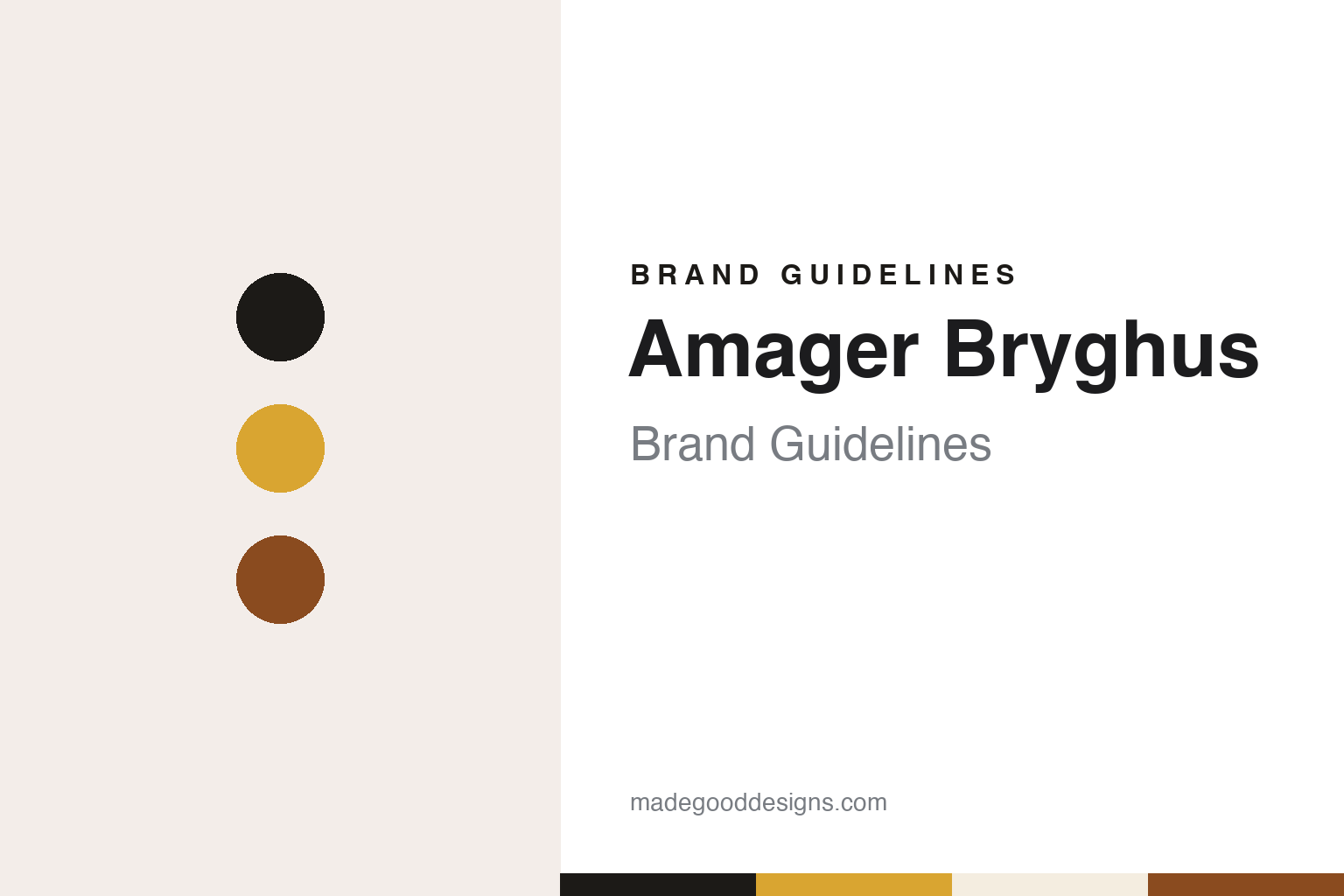
Two constants: a stout black, copper and hop gold palette and a sturdy slab serif register. Abstract homage — not an Amager Bryghus product or mark; no label, logo, can or bottle is reproduced.
A brewery for the island
From a school project on fermentation to a brewery of its own.
Amager Bryghus is a craft brewery on Amager, the island that holds the southern part of Copenhagen and Copenhagen Airport. It was founded in 2007 by two friends, Morten Valentin Lundsbak and Jacob Storm, English Wikipedia records, citing the brewery’s own history. The company’s account, archived in 2017, says the two were classmates at a technical upper-secondary school, where they wrote a joint physics and chemistry project on fermentation in beer; many home brews later, it says, they opened their own brewery in April 2007.
The company says the founders had no capital to speak of and started on modest, borrowed funds in a former nuclear shelter in Tårnby, the municipality that covers this part of the island. The craft-beer magazine Beerbay, in a feature by Jesús Olano published in May 2018, described the first premises as an old warehouse that had earlier belonged to the Church of Scientology, which had stored books there. Both accounts agree that the place was bare: the brewery’s head of communications, Henrik Papsø, told Beerbay that it was all concrete walls and took about a year to fit out.
For the first four years, Papsø said in the same interview, the business was just the two founders, with Jacob brewing the beer and Morten selling it, and growth came organically rather than through large investments. The ambitions were local at first. The company says the aim was simply to become Amager’s favourite beer, sold mainly on the island and around Copenhagen. In December 2011, it says, the first brewing kit was judged too small, a new one was bought, and production more than doubled.
The brewery still speaks for itself on ownership. Its history page says Amager Bryghus is entirely independent of outside investors and that, as at the founding in 2007, Morten and Jacob alone share the ownership. The company is registered as Amager Bryghus ApS.
Colour
A friend’s stout, seven sins and a label Sweden would not sell.
The beer that made the name was a thank-you. Papsø told Beerbay that a friend, Peter Frederiksen, had spent his weekends and holidays for a whole year helping to fit out the brewery, and asked for a good porter in return. Jacob Storm’s idea of a good porter was a strong imperial stout, and the result was named Hr. Frederiksen — “Mr Frederiksen.” At the first Copenhagen Beer Festival, Beerbay reports, the founders were approached by Shelton Brothers, an importer of European craft beer based in Massachusetts, which began bringing the beer to the United States.
The success changed the beer and the look of the bottles. The first, more mainstream beers carried labels with old photographs and images of Amager, Papsø told Beerbay; after Hr. Frederiksen the brewery moved towards stronger, hoppier and more experimental beers. The brewery’s archived 2017 beer list also includes a Fru Frederiksen — “Mrs Frederiksen” — alongside barrel-aged editions of Hr. Frederiksen.
The best-known label story concerns the Sinner Series, seven beers named after the seven deadly sins, each with its own cartoon label. The Local reported in April 2013 that Sweden’s state alcohol retailer, Systembolaget, had refused the label for Lust, a 9.2 per cent Belgian-style ale, because of its cartoon of a topless woman in a bath; a Systembolaget spokesman called it “quite a sexual label.” The brewery answered by blacking out the picture entirely. Papsø told The Local that it took ten attempts before a version was accepted, and that a humorous back-label text had been rejected too. The Huffington Post picked up the story the following day.
Typography
Design and documentation.
The seven brands in this group are all Nordic beer names: Mikkeller, To Øl, Nøgne Ø, Aass, Karhu, Lervig and Amager Bryghus. They span two centuries of brewing. Aass was founded in Drammen in 1834 and is still owned by the Aass family, English Wikipedia records; Karhu is a Finnish beer brand that belongs to the brewer Sinebrychoff, part of the Carlsberg Group. The rest are products of the craft-beer wave that began around the turn of this century: Nøgne Ø in Grimstad in 2002, Lervig in Stavanger in 2003, Mikkeller in Copenhagen in 2006, Amager Bryghus on the island of Amager in 2007 and To Øl in Copenhagen in 2010.
A beer brand’s identity is usually carried less by a single bottle than by a name, a label and the place it promises, because the company behind it may have changed hands, taken on investors or moved its brewing somewhere else entirely. Some of these names began as “gypsy” brewers that rented other breweries’ equipment before, in some cases, building their own; others became part of larger brewing groups. That makes the questions behind each name worth asking plainly: who started it, who owns it now, and where its beer is actually brewed.
Each guide separates what independent sources record from what the company says about itself — its founding story, its owners over time, where its beer is brewed and how its labels and cans have changed — and marks plainly what rests only on the company’s own word.
Aa
A sturdy slab serif for a brewery that grew out of a basement. (Specimen set in Bitter, a slab-serif STAND-IN; NOT the Amager Bryghus logo.)
Amager Bryghus
Still on the island, now beside the runway.
The brewery outgrew its first home in 2017. English Wikipedia dates the move to that year, and the brewery’s own website, as archived by the Wayback Machine, switched to the new address between November and December 2017. The new brewery stands in the Kirstinehøj business area in Kastrup, next to Copenhagen Airport. The company describes it with some humour as a rather dreary industrial building that rubs up against the airport, with fermentation tanks and oak barrels inside.
Today the company says it is best known for strongly hopped IPAs and imperial stouts, alongside more traditional beers, and for beers aged in whisky barrels. Its website sells beer in 44 cl cans and 75 cl bottles, runs a bottle shop at the brewery and lists two beer bars, including a taproom at Nørreport in central Copenhagen. Each summer it holds what it calls “Amarkaner Day,” after the local word for people from Amager, with rockabilly music and hot dogs.
For a design guide, Amager Bryghus shows how a small, founder-owned brewery can let its beer names and labels carry the story — a friend honoured on an imperial stout, seven sins drawn as cartoons and a local pride written into the company’s own vocabulary. Compare Mikkeller and To Øl, two other Copenhagen craft-beer names, and BrewDog, the Scottish craft brewer also founded in 2007. For this guide we use stout black, copper and hop gold with a slab serif, an unofficial interpretation; no product or logo is reproduced.
Explore & save
Keep Amager Bryghus’s identity on hand — save it to a board in the Made Good inspiration library.
Amager Bryghus identity set
Pin the Amager Bryghus stout black, copper and hop gold palette and the sturdy slab serif register to your own board.