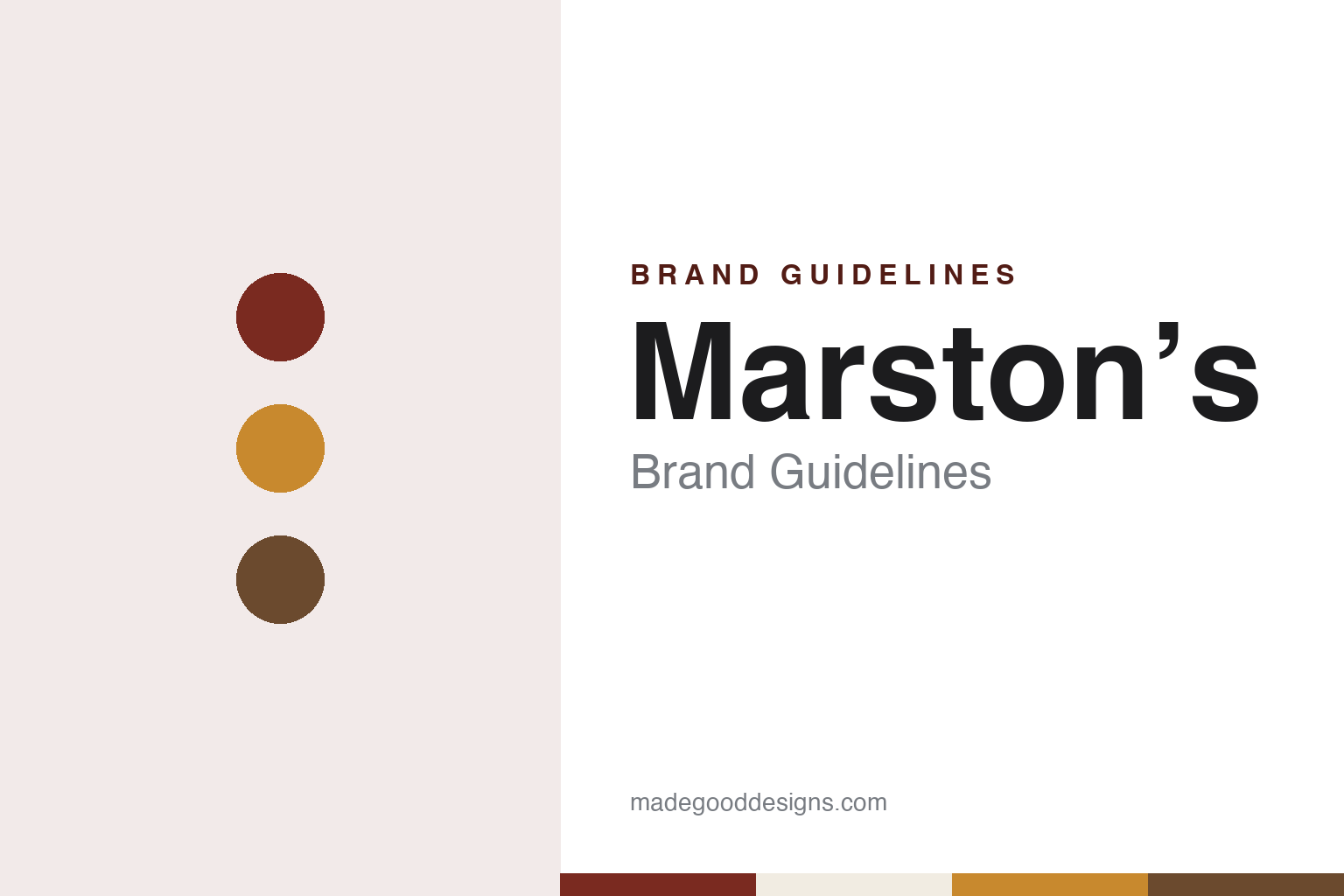
Marston’s Brand Guidelines
The Burton brewery of Pedigree and the Union sets.
Aa
Two constants: a Burton brick, pale ale amber and union oak palette and a brewery slab serif register. Abstract homage — not a Marston’s product or mark; no label, pump clip or logo is reproduced.
From Horninglow to Shobnall Road
John Marston, a Burton brewery and a move across town in 1898.
The Marston’s name goes back to 1834, when John Marston established J. Marston & Son at the Horninglow Brewery in Burton upon Trent, English Wikipedia says. The business was registered as a limited company in 1890, and in 1898 it amalgamated with John Thompson & Son and moved to the Albion Brewery on Shobnall Road. The Press Association, reporting in October 2026, gave the same outline: a brewing business founded in Burton in 1834 that moved to its current Shobnall Road site in 1898.
A third family name joined in 1905, when the company merged with Sydney Evershed to form Marston, Thompson & Evershed, English Wikipedia says. It was under that name that the brewery changed hands in 1999.
Burton is the setting the brand has always leaned on. When Marston’s overhauled its packaging in 2016, The Morning Advertiser reported that the new designs put the brewing heritage story at the front, highlighting the town’s gypsum-rich water and the company’s history. The brewery’s most distinctive piece of kit told the same story: Marston’s was one of the last major brewers to use Burton Union sets, linked fermentation barrels and troughs joined by pipework, English Wikipedia says. Food Manufacture reported that the unions were used to ferment Marston’s Pedigree.
Colour
A pale ale renamed by staff, a 2016 overhaul and the end of the unions.
Pedigree itself began under another name. The Morning Advertiser reported in November 2016 that the beer was formerly called Burton pale ale and was renamed Pedigree in 1952, and that the new name came from a staff competition. English Wikipedia also records a long sporting link: from 2007 to 2017 Marston’s sponsored the England and Wales Cricket Board, and Pedigree was the official beer of the England cricket team.
The 2016 overhaul was the brand’s most visible change of the past decade. The Morning Advertiser said the new look went live across the UK on 1 November 2016 and would be rolled out over twelve months, with packaging designs that now complemented one another. Several beers were renamed along the way: Oyster Stout became Pearl Jet, after its style and colour, and Burton Bitter became Saddle Tank, after a locomotive that used to bring hops and malt into the brewery. A new pale ale, 61 Deep, joined the range. Lee Williams, then marketing manager, told the paper the packaging had “lost its mojo,” and the managing director at the time, Richard Westwood, said that the consumer was behaving very differently from even five or six years earlier.
The brewery’s most photographed equipment went next. Food Manufacture reported that in January 2024 the owner said it would retire the four remaining Burton Union sets. Some of the equipment went to Thornbridge in Derbyshire and Epochal in Glasgow, and another set was preserved at the Burton site, the magazine said. Protz on Beer reported in July 2024 that the union rooms had closed that January. By 2026 the cask beers brewed at Burton included the Hobgoblin range, Wainwright Golden Beer and Marston’s Pedigree, and the site also brewed Draught Bass under contract for AB InBev, Food Manufacture reported.
Typography
Design and documentation.
The seven brewers in this group are all English regional and family names: St Austell, Timothy Taylor, Marston’s, Wadworth, Hook Norton, Black Sheep and Harvey’s. Most of them are Victorian or older. John Marston set up in Burton upon Trent in 1834, English Wikipedia says; Hook Norton dates from 1849 in the Oxfordshire village of the same name; Walter Hicks founded what became St Austell Brewery in Cornwall in 1851; Timothy Taylor began brewing in Keighley in 1858 and moved to Knowle Spring in 1863, the company says; and Wadworth has brewed in Devizes since 1875. Harvey’s of Lewes dates itself to 1790. Black Sheep is the newcomer: English Wikipedia says Paul Theakston set it up in Masham in 1991, after his family’s brewery in the same town had been taken over.
Their ownership has gone in different directions. Several still describe themselves as family businesses: Timothy Taylor says the brewery remains in the Taylor family; Wadworth says it passed from Henry Wadworth to his founding partner John Smith Bartholomew and is now in the fifth generation of Bartholomew family ownership; Hook Norton’s managing director James Clarke is a fifth-generation descendant of the founder, John Harris, according to an interview with The Morning Advertiser that the brewery republishes; and Harvey’s says it has been in the custodianship of John Harvey’s descendants since 1790. St Austell says it was founded as a family-owned company, and on 1 July 2016 it bought Bath Ales, English Wikipedia says. Marston’s went the other way: in 2020 its brewing business joined Carlsberg’s UK arm in the Carlsberg Marston’s Brewing Company, Carlsberg bought out Marston’s remaining stake in July 2024, and since January 2025 the breweries have been part of Carlsberg Britvic, according to English Wikipedia. Black Sheep entered administration in May 2023 and was bought by the London investment firm Breal Capital, The Caterer reported on 31 May 2023; in January 2026 its owner, Keystone Brewing Group, was sold in a pre-pack deal to the newly formed Great British Drinks Company, The Caterer reported on 22 January 2026.
A brewer’s identity is usually carried less by a single bottle than by a pump clip, a name and the town it promises, because the company behind the name may have changed hands or changed how and where it brews. Each guide separates what independent sources record from what the brewery says about itself — its founding story, its owners over time, where its beer is brewed and how its pump clips and labels have changed — and marks plainly what rests only on the company’s own word.
Aa
A sturdy slab serif for a brewery built on Burton water and oak. (Specimen set in Bitter, a slab-serif STAND-IN; NOT the Marston’s logo.)
Marston’s
From Wolverhampton & Dudley to Carlsberg, and a proposed closure.
The ownership story has two separate threads, because the beer and the pub company parted ways. In 1999 Marston, Thompson & Evershed was bought by Wolverhampton & Dudley Breweries, and in 2007 that parent company renamed itself Marston’s plc, English Wikipedia says. In 2020 Marston’s plc put its brewing business into a joint venture with Carlsberg UK, the Carlsberg Marston’s Brewing Company, in which Marston’s held 40 per cent and Carlsberg 60 per cent; the Competition and Markets Authority approved the deal in October 2020. In July 2024 Marston’s agreed to sell its remaining stake to Carlsberg, and the deal completed on 21 July 2024, the Express & Star reported, leaving Marston’s plc to concentrate on its pubs. Carlsberg has owned the brewery and the Marston’s beers outright since then.
The owner’s name changed again after Carlsberg bought the soft-drinks company Britvic. Food Manufacture says Carlsberg Britvic was formed in January 2025, bringing Carlsberg’s UK business together with Carlsberg Marston’s Brewing Company. Its headquarters are in Hemel Hempstead, English Wikipedia says.
On 8 October 2026 Carlsberg Britvic announced plans to close the Marston’s Brewery in Burton and its main logistics operation at the site in summer 2027, with around 310 jobs at risk, the Press Association reported. The company cited “structural decline in the ale category.” It said it would keep the Hobgoblin, McEwan’s and Brooklyn brands and would look for new owners for some other cask and regional ale brands, without saying which; the brewery is due to keep running through a consultation and transition period. Paul Davies, the chief executive, said smaller ale brands could thrive under more specialist or local ownership. The proposal concerns Carlsberg Britvic’s brewery, not the pubs run by Marston’s plc.
For a design guide, Marston’s shows how a brewery can make its town, its water and its fermenting equipment into the brand story, and how a 1952 staff competition can name a beer for generations. Compare Fuller’s, another brewery separated from its pub company, and Greene King, a brewer that kept its pubs. For this guide we use Burton brick, pale ale amber and union oak with a slab serif, an unofficial interpretation; no product or logo is reproduced.
Explore & save
Keep Marston’s’s identity on hand — save it to a board in the Made Good inspiration library.
Marston’s identity set
Pin the Marston’s Burton brick, pale ale amber and union oak palette and the brewery slab serif register to your own board.