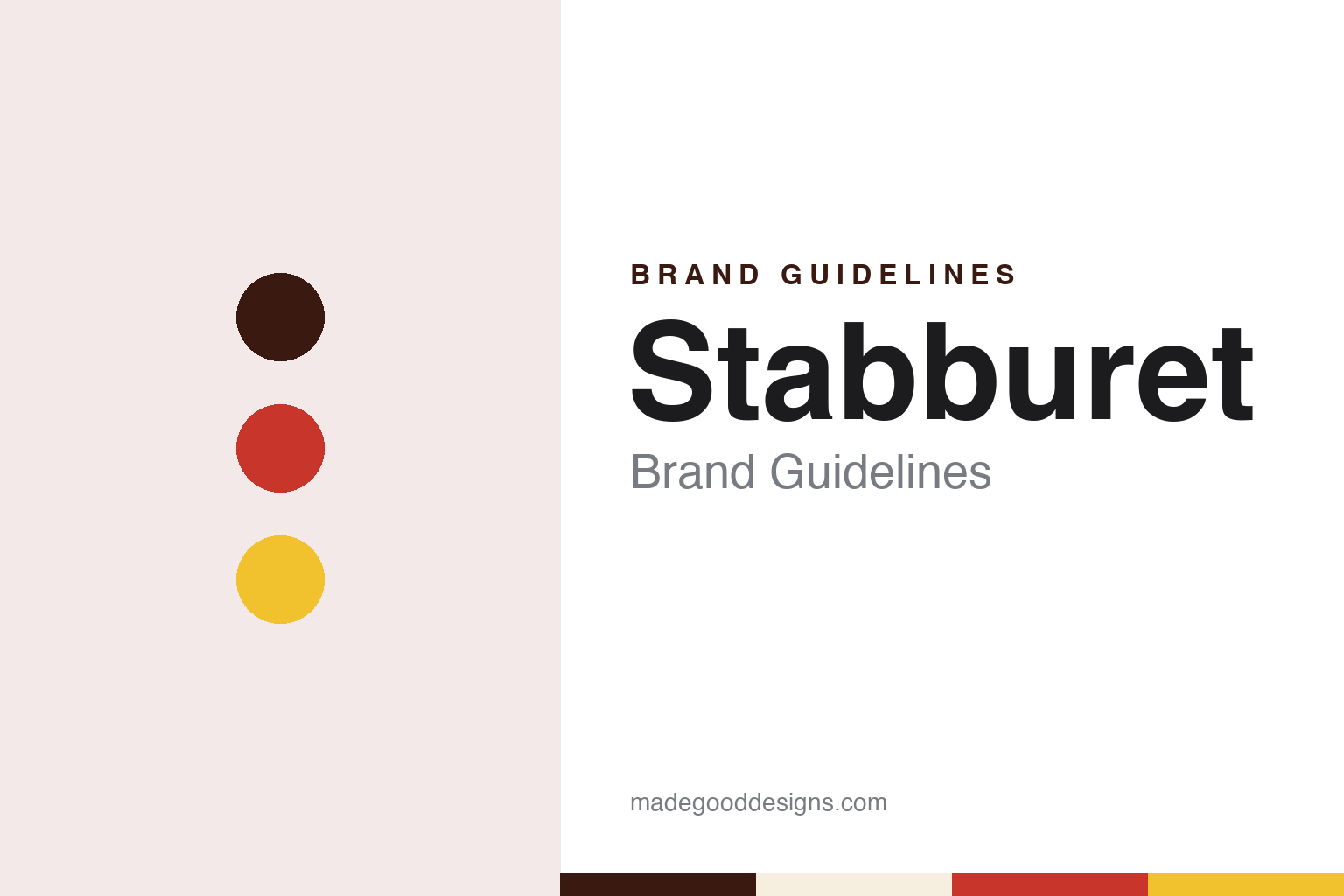
Stabburet Brand Guidelines
Stabbur-Nilsen’s Fredrikstad liver pâté and mackerel tins.
Aa
Two constants: a tomato red, mackerel-tin yellow and timber brown palette and a sturdy slab serif register. Abstract homage — not a Stabburet product or mark; no tin, label or logo is reproduced.
Stabbur-Nilsen
A cigar shop, a naming competition and a cellar kitchen.
Stabburet began as a shop in Fredrikstad in south-eastern Norway. Its founder was Gunnar Nilsen, later known across Norway as “Stabbur-Nilsen.” According to the Norwegian encyclopedia Store norske leksikon, Nilsen opened his first business, a cigar shop called Yo-Yo, in 1933, when he was 20. Three years later, in 1936, he opened a speciality shop for ready-made food, and after a naming competition it was called Stabburet, the Norwegian word for the traditional raised storehouse found on farms.
The shop sold smoked fish, herring and mackerel and fish farce that Nilsen at first minced himself in the back room, Store norske leksikon says. The cellar of the building became a small “factory” where he and his wife, Hjørdis, boiled jam and marmalade in the evenings and at night to sell in the shop by day. Norwegian Wikipedia, citing a company history published by Stabburet in 1993, adds that Nilsen bought an old smithy and turned it into a smokehouse.
Factory production started in 1943, during the German occupation. Store norske leksikon says Nilsen began manufacturing alongside his shop and made whatever the available ingredients allowed, mostly fish products; the company’s 1993 history, as cited by Norwegian Wikipedia, says the first factory opened that year with nine employees. After the war distribution widened: by 1947, the same history says, Stabburet supplied 2,000 retailers in eight counties and was Norway’s largest producer of fresh fish food. Meat was still rationed after the war, and Store norske leksikon says Nilsen bought up stocks of canned pork left behind by the German occupiers and, with American corned beef, made sausages that became sought after in eastern Norway.
Colour
A boy on the pâté tin and a mackerel on the lid.
Canning made the brand national. In the late 1940s Stabburet expanded its canned range with fishballs, fish cakes and whale-meat products, and when meat rationing ended in 1950 its canned meat production grew, Store norske leksikon says. From 1950, according to the company’s 1993 history as cited by Norwegian Wikipedia, canned food became the firm’s main business; the Fredrikstad factory grew to 150 staff, and from 1954 Stabburet products reached the whole country. That history also says the company put weight on eye-catching packaging and was the first in Norway to print colour directly onto tinplate.
Two tins became fixtures. Stabburet Leverpostei, a liver pâté, was launched in 1949. In 1955 its tin was given the face of Per Christensen, the son of one of Stabburet’s employees, and the encyclopedia says the tin has looked much the same ever since. The second came from the sea. In 1957 Stabburet took over East Norway Canning Co. in Fredrikstad, which packed small summer-caught mackerel, known as pir, in tomato sauce. In the summer of 1958 the pir catch failed, and Nilsen and his operations manager, Svein Jervell, decided to use fillets of large mackerel instead. The result was Stabbur-Makrell, mackerel in tomato sauce. Store norske leksikon says the first tin of 1958 differs little from today’s: it is still yellow and red, with a mackerel on the lid.
The company kept buying. It took over the Rygge Preserving factory in 1960, which moved to year-round production with sauerkraut among its lines, and the firm Fredrikstad Preserving in 1961. Five years later Stabburet built its plant at Råbekken, which Store norske leksikon describes as the largest Stabburet production site today.
Typography
Design and documentation.
The seven brands in this group are all Nordic food and dairy names: Kalles Kaviar, Felix, Estrella, Valio, Arla, Stabburet and Nidar. Nordic food brands in general sit at many different points in the trade, from names that still carry a founder’s story to brands that now belong to much larger food groups or farmer-owned co-operatives, and a single brand can be sold everywhere from a corner shop to a supermarket shelf.
A food brand’s identity is usually carried less by a single product than by a pack, a name and the meal or snack it promises, because the company behind the name may have changed hands, moved its factory or grown far beyond the town where it started. That makes the questions behind each name worth asking plainly: who started it, who owns it now, and where its food is actually made and packed.
Each guide separates what independent sources record from what the company says about itself — its founding story, its owners over time, where its products are made and how its packaging has changed — and marks plainly what rests only on the company’s own word.
Aa
A sturdy slab serif for a brand named after a timber storehouse. (Specimen set in Bitter, a slab-serif STAND-IN; NOT the Stabburet logo.)
Stabburet
From Denofa Lilleborg to Orkla, and Grandiosa.
Stabburet passed through several owners after its founder sold it. In 1969 Gunnar Nilsen sold Stabburet to Denofa Lilleborg, Store norske leksikon says. In 1975 it became part of the Borregaard group; in 1984 Borregaard and Nora combined their food divisions, and in 1986 the business was taken over by Orkla. Norwegian Wikipedia says Nora Industrier itself merged with Orkla in 1991. Orkla Foods Norge was formed on 1 October 2013, combining Stabburet with Rieber & Søn, which Orkla had bought, Norwegian Wikipedia says, and since 2020 Stabburet has been a brand within Orkla rather than a company of its own.
Orkla has moved some production between countries. Store norske leksikon says Stabbur-Makrell was moved in 2008 from Øyenkilen, near Fredrikstad, to the large Abba plant at Kungshamn on Sweden’s west coast, which Orkla took over in 1995. Norwegian Wikipedia lists Orkla Foods factories at Fredrikstad, Stranda, Arna and Elverum.
The best-known product under the Stabburet name today did not start there. Pizza Grandiosa, a frozen pizza, was launched by Nora Industrier on 11 February 1980, Norwegian Wikipedia says; it was developed over several years by Ruth Romskaug, head of Nora’s test kitchen in Brumunddal, and is made at Stranda in western Norway. In 2006 a Grandiosa advertising song, “Respekt for Grandiosa,” topped the VG-lista chart for eight weeks. Norwegian Wikipedia says Grandiosa has been a Stabburet product since 2020.
For a design guide, Stabburet shows how far a tin can carry a brand: a boy’s face on the liver pâté since 1955 and a yellow-and-red mackerel tin that has changed little since 1958. Compare it with Nidar, the Trondheim confectioner, and with Kalles Kaviar, the Swedish cod-roe spread. For this guide we use tomato red, mackerel-tin yellow and storehouse timber brown with a sturdy slab serif, an unofficial interpretation; no product or logo is reproduced.
Explore & save
Keep Stabburet’s identity on hand — save it to a board in the Made Good inspiration library.
Stabburet identity set
Pin the Stabburet tomato red, mackerel-tin yellow and timber brown palette and the sturdy slab serif register to your own board.