Prince Polo Brand Guidelines
The Cieszyn wafer that became Iceland’s favourite bar.
Aa
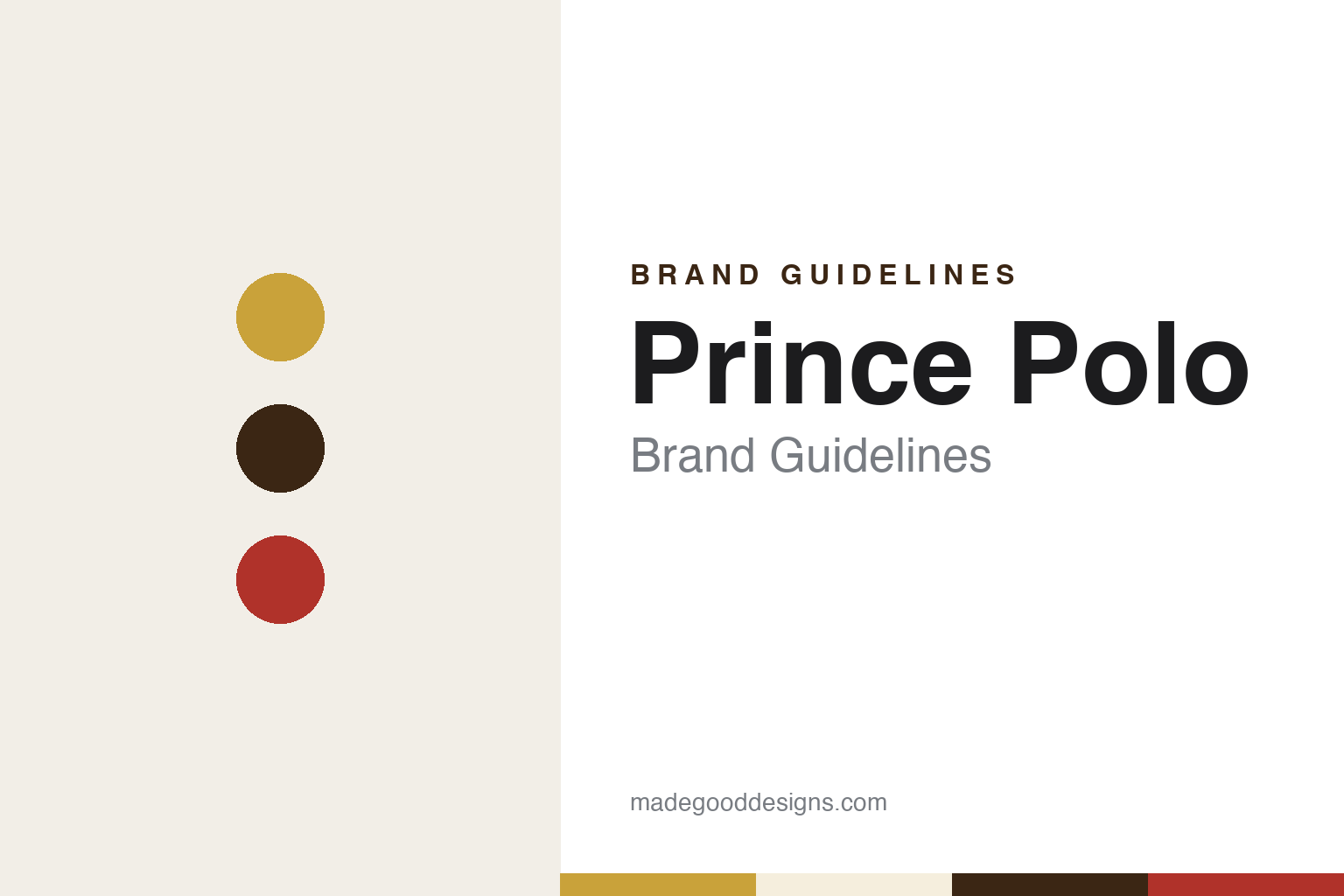
Two constants: a wrapper gold, cocoa and seal red palette and a regal display serif register. Abstract homage — not a Prince Polo product or mark; no wrapper, logo or bar is reproduced.
A wafer from Cieszyn
A border town, a 1920 company and a 1955 launch.
Prince Polo comes from Cieszyn, the town on the Olza river in southern Poland that faces Český Těšín across the Czech border. Polish Wikipedia says the bar was introduced in 1955, in the years of the Polish People’s Republic, by the Cieszyn confectioner Olza, a company it dates to 1920.
The product itself is simple and has stayed so. Polish Wikipedia describes it as four layers of wafer joined by a chocolate filling and covered in a chocolate coating; English Wikipedia describes three layers of chocolate-flavoured filling between the four wafers. English Wikipedia says it was first known by its metallic gold wrapper, and gold still features in the brand’s promotions: in 2026 the brand’s own website, princepolo.pl, ran a promotion built around buying the “Złote” (golden) Prince Polo alongside other varieties.
The bar was an early export. Icelandic Wikipedia says it quickly became popular in Poland and was soon sold in neighbouring countries, where it held a strong share of the market, and it travels today under several names. According to Polish and English Wikipedia, the same wafer is sold as Siesta in markets that include the Czech Republic, Slovakia, Hungary, Lithuania and Latvia, and as Ekstra-55 in markets that include Estonia, Greece, Romania and Bulgaria. Its reach goes well beyond Central Europe: Polish Wikipedia also lists the Siesta name for Ukraine, Belarus, Russia and Kazakhstan, and the Ekstra-55 name for Indonesia, the Philippines, Georgia, Iraq and Libya. In Iceland it is Prins Póló, and that is where the bar found its most famous following.
Colour
Fish, “biscuits” and a nation’s favourite bar.
Prince Polo’s Icelandic story begins with trade. Icelandic Wikipedia says that in 1955, the year the bar was launched, Iceland and Poland agreed a trade arrangement under which Poland bought Icelandic fish and paid in Polish consumer goods. The Reykjavík wholesaler Ásbjörn Ólafsson secured the right to import Prince Polo, and because Iceland then tightly restricted imports of foreign sweets, the bar was brought in classed as a biscuit rather than as chocolate, the same source says.
It stayed. Polish Wikipedia, citing Nielsen measurements, says Prins Póló has been Iceland’s best-selling chocolate bar for decades. Consumption figures quoted by Icelandic and Polish Wikipedia — the latter citing a 2014 report in the Icelandic newspaper Vísir — put Icelanders’ average intake at about one kilogram of the bar per person a year at its peak around 1970, falling to roughly half a kilogram by 2014. During a visit to Poland in 1999, Iceland’s president Ólafur Ragnar Grímsson said that a whole generation of Icelanders had grown up on two things, American Coca-Cola and Polish Prince Polo, according to a report in Gazeta Podróże cited by Polish Wikipedia.
The bar also passed into Icelandic popular culture. Icelandic and English Wikipedia note a song about it by the Icelandic band Sumargleðin, and the musician Svavar Pétur Eysteinsson recorded and performed as Prins Póló, taking the bar’s Icelandic name for his indie-pop project. Icelandic Wikipedia describes the bar as a symbol of the trade and cultural ties between Iceland and Poland.
Typography
Design and documentation.
The seven brands in this group all make food or drink, and all of them come from Central Europe — from Poland, Hungary, Croatia and the Czech Republic: Prince Polo, Tymbark, Hortex, Pick, Podravka, Vegeta and Kofola. Food and drink brands from the region in general sit at many different points in the trade, from names that began in state enterprises to names that now belong to much larger food groups, and a single brand can be sold everywhere from a village shop to a supermarket shelf.
A food or drink brand’s identity is usually carried less by a single product than by a pack, a name and the meal or snack it promises, because the company behind the name may have changed hands, moved its factory or grown far beyond the town where it started. That makes the questions behind each name worth asking plainly: who started it, who owns it now, and where its products are actually made and packed.
Each guide separates what independent sources record from what the company says about itself — its founding story, its owners over time, where its products are made and how its packaging has changed — and marks plainly what rests only on the company’s own word.
Aa
A regal display serif for a bar named for a prince. (Specimen set in Playfair Display, a serif STAND-IN; NOT the Prince Polo logo.)
Prince Polo
From a Cieszyn factory to a global snacks group.
Prince Polo changed hands with its maker. Polish and English Wikipedia say Kraft Jacobs Suchard, then the European coffee and confectionery arm of Kraft, bought Olza in 1993, four years after the end of communist rule in Poland. The brand followed Kraft’s confectionery business into Mondelēz International, the snacks company created when Kraft Foods split in 2012; Polish Wikipedia dates Mondelēz’s ownership of the Olza business from 2013. In 2026 the princepolo.pl website named Mondelēz Europe Services’ Polish branch, in Warsaw, as the party running its promotions.
Under Kraft the bar was redesigned. Polish Wikipedia, citing the brand-history series of Superbrands Polska, says that in 1995 Prince Polo was given a new logo, new packaging and new flavours, and English Wikipedia adds that the wrapper moved from paper to plastic at the same time. A hazelnut version followed in 1996, Polish Wikipedia says, and later variants have included milk-chocolate, coconut and premium versions and an XXL size, alongside short-lived flavours such as apple, caramel and gingerbread.
The brand’s identity therefore rests less on a single designed mark than on a small set of constants: the name, which has stayed the same in Poland for seven decades; the long, flat bar of layered wafer; and the gold that English Wikipedia ties to its original wrapper and that the brand still uses for its “golden” edition. Its regional names — Siesta, Ekstra-55 and Prins Póló — show the same product carrying different identities across borders.
For a design guide, Prince Polo shows how a gold wrapper and a plain layered wafer can carry one bar from a 1955 factory in Cieszyn to supermarket shelves in Reykjavík. Compare Wawel, the Kraków chocolate maker, and Marabou, another Mondelēz-owned national favourite. For this guide we use wrapper gold, cocoa brown and a seal red with a serif, an unofficial interpretation; no product or logo is reproduced.
Explore & save
Keep Prince Polo’s identity on hand — save it to a board in the Made Good inspiration library.
Prince Polo identity set
Pin the Prince Polo wrapper gold, cocoa and seal red palette and the regal display serif register to your own board.