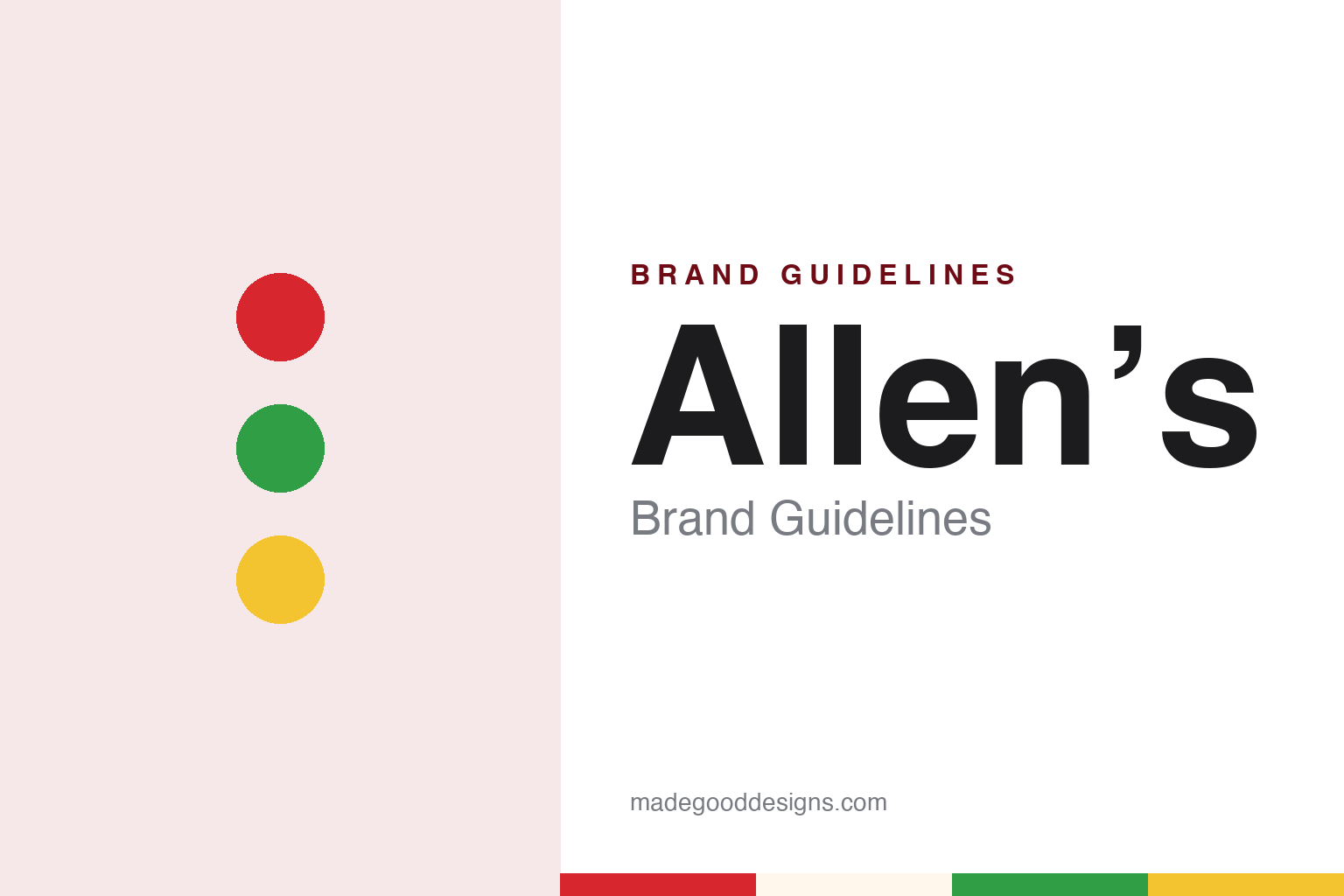
Allen’s Brand Guidelines
The Melbourne lolly maker behind the red frogs.
Aa
Two constants: a frog red, mint green and banana yellow palette and a rounded lolly-shop sans register. Abstract homage — not an Allen’s product or mark; no pack, logo or lolly is reproduced.
A Fitzroy sweet shop
A confectioner’s apprentice, a back room and a merger.
Allen’s began in the back of a Melbourne sweet shop. The Australian Dictionary of Biography, in an entry by the historian John Lack published in 2005, says Alfred Weaver Allen was born in 1870 at Emerald Hill, now South Melbourne, spent part of his childhood in Dunedin, New Zealand, and from the age of 17 worked for the confectioner Macpherson Robertson, founder of MacRobertson’s, where he gained a reputation as “a tiger for work.” In 1891 he went into business on his own account, making sweets at the rear of his confectionery shop in Fitzroy and supplying a brother’s shop in North Fitzroy and a stall at the Eastern Market.
The business grew quickly. Between 1896 and 1899, the Dictionary says, Allen took over the premises of two North Melbourne confectionery makers, and in 1903 he took on A. J. Burroughs as a partner. By 1909 theirs was the third-largest confectionery business in Melbourne, after MacRobertson’s and Abel Hoadley’s. In 1911 the two men travelled to Britain and Europe to inspect modern plant and came home with machinery for making milk chocolate. The First World War disrupted imports and, the Dictionary says, put them in a position to enlarge their share of the market.
In 1917 Allen persuaded a group of established confectionery makers, and a dentist, to amalgamate as A. W. Allen Pty Ltd; the Dictionary counts eight makers, among them Long & Smith, Clark Luke and the National Candy Co., while the Encyclopedia of Melbourne describes five specialist sweet makers. Allen held the largest, though not a controlling, interest and became chairman and managing director. The company was launched as a public company, A. W. Allen Ltd, in 1922, and acquired a site in South Melbourne across the Yarra from Flinders Street Station. Its popular lines then included Cure-’Em Quick and Irish Moss Gum Jubes. Allen died in 1925. Around that time, the Dictionary says, the company cut production and gave up making chocolate, but during and after the Second World War it flourished as one of Australia’s biggest makers and distributors of confectionery.
Colour
A neon sign, cartoon mints and a pond of red frogs.
For three decades the company’s best-known piece of design hung over the river. The neon historian Adam Dimech, drawing on Ellen Downard’s 1986 history The Sweetest of Them All and a 1986 Time Australia article, records that the first Allen’s Sweets sign went up at the South Melbourne factory in 1955, and that in 1969 Claude Neon built a far more elaborate animated version. Its overlays spelled out “Allen’s Sweets,” “Cool Cool Kool Mints” and the Anticol cough-drop name, with a firework burst and lozenges that appeared to fall from the Anticol packet; the whole sequence ran for 35 seconds, and the sign measured about 30 metres wide and 12 metres high. The Australian Dictionary of Biography calls it Melbourne’s largest. When the company left South Melbourne in 1987 and the factory was demolished for the Southbank development, the sign was dismantled despite calls to keep it.
Several of the brand’s best-known names came from elsewhere. English Wikipedia, citing the Sydney Morning Herald and Sydney’s Daily Telegraph, says Minties and Jaffas were first made by Sweetacres, the Sydney firm of James Stedman–Henderson Sweets at Rosebery. Minties were invented in 1922 by James Noble Stedman, and from late 1926 their wrappers and advertisements carried single-panel cartoons with the line “It’s moments like these you need Minties.” Stedman–Henderson was taken over by Hoadleys in 1968, which was itself acquired by the British confectioner Rowntree in 1971, English Wikipedia says; Minties are now sold under the Allen’s name.
The modern Allen’s range includes jelly lollies such as Snakes Alive, Frogs Alive and Killer Pythons. When Allen’s dropped its green frogs and Spearmint Leaves in 2015, a Nestlé spokesperson told the Courier-Mail that the red frogs outsold the green ten to one. Names have been revised too: in November 2020, the ABC reported, Allen’s renamed two long-standing lines, with Red Skins becoming Red Ripperz and Chicos becoming Cheekies. In June 2023 the brand said it would stop making Fantales, its chocolate-coated caramels, because of falling sales, English Wikipedia says.
Typography
Design and documentation.
The seven brands in this group all come from Australia, and between them they cover ice cream, confectionery, snacks and dairy: Peters, Streets, Allen’s, Twisties, Smith’s, Sanitarium and Pauls. Australian food brands in general sit at many different points in the trade, from names that grew out of a single local business to names that now belong to much larger food groups, and a single brand can be sold everywhere from a corner shop to a supermarket shelf.
A food brand’s identity is usually carried less by a single product than by a pack, a name and the treat or staple it promises, because the company behind the name may have changed hands, moved its factory or grown far beyond the town where it started. That makes the questions behind each name worth asking plainly: who started it, who owns it now, and where its products are actually made and packed.
Each guide separates what independent sources record from what the company says about itself — its founding story, its owners over time, where its products are made and how its packaging has changed — and marks plainly what rests only on the company’s own word.
Aa
A rounded, chewy sans for a brand of jelly snakes and frogs. (Specimen set in Fredoka, a sans STAND-IN; NOT the Allen’s logo.)
Allen’s
A sale abroad, a Nestlé brand and a country factory.
Allen’s stayed Australian-owned for almost a century. In 1985, the Australian Dictionary of Biography says, the firm was sold to overseas interests; English Wikipedia, citing The Age of 28 June 1985, names the buyer as the UK-based Rothmans Holdings and says that two years later, in 1987, Allen’s was sold to Nestlé. The same year the company left its South Melbourne riverside site. Allen’s is now one of Nestlé Australia’s brands.
Its lollies are made in the country. Allen’s has been produced in Broadford, a town in central Victoria, since 1982, according to a Victorian Government media release of 16 March 2023, which describes the Nestlé Broadford factory as the home of Allen’s lollies and says it runs 24 hours a day, five days a week. That release announced state support for a $12 million expansion of the plant, after which chew lollies including Minties, Red Ripperz and Sherbies would also be made at Broadford, adding more than 2,000 tonnes a year to its output; the government said the factory employed more than 200 people and was the largest private employer in Mitchell Shire. “We’re proud to make Australia’s favourite lollies right here in Broadford,” the factory manager, Emily Bradbury, said in the release.
The range keeps turning over. Spearmint Leaves, dropped in 2015, returned in 2020 and again in 2024, and Allen’s has added sour versions of its snakes and frogs and miniature chocolate-coated versions of lollies such as its raspberries and bananas, English Wikipedia says, citing Australian food and consumer press.
For a design guide, Allen’s shows how a Melbourne sweet maker’s name, a riverside neon sign and a pond of jelly frogs can hold one brand together across owners and factories. Compare Darrell Lea, the Sydney liquorice and chocolate maker, and Rowntree’s, the York confectioner that bought Hoadleys, the later owner of Minties, in 1971. For this guide we use a frog red, a mint green and a banana yellow with a rounded sans, an unofficial interpretation; no product or logo is reproduced.
Explore & save
Keep Allen’s’s identity on hand — save it to a board in the Made Good inspiration library.
Allen’s identity set
Pin the Allen’s frog red, mint green and banana yellow palette and the rounded lolly-shop sans register to your own board.


