Walkers Brand Guidelines
The Leicester crisp maker that traded a crisp for a sun.
Aa
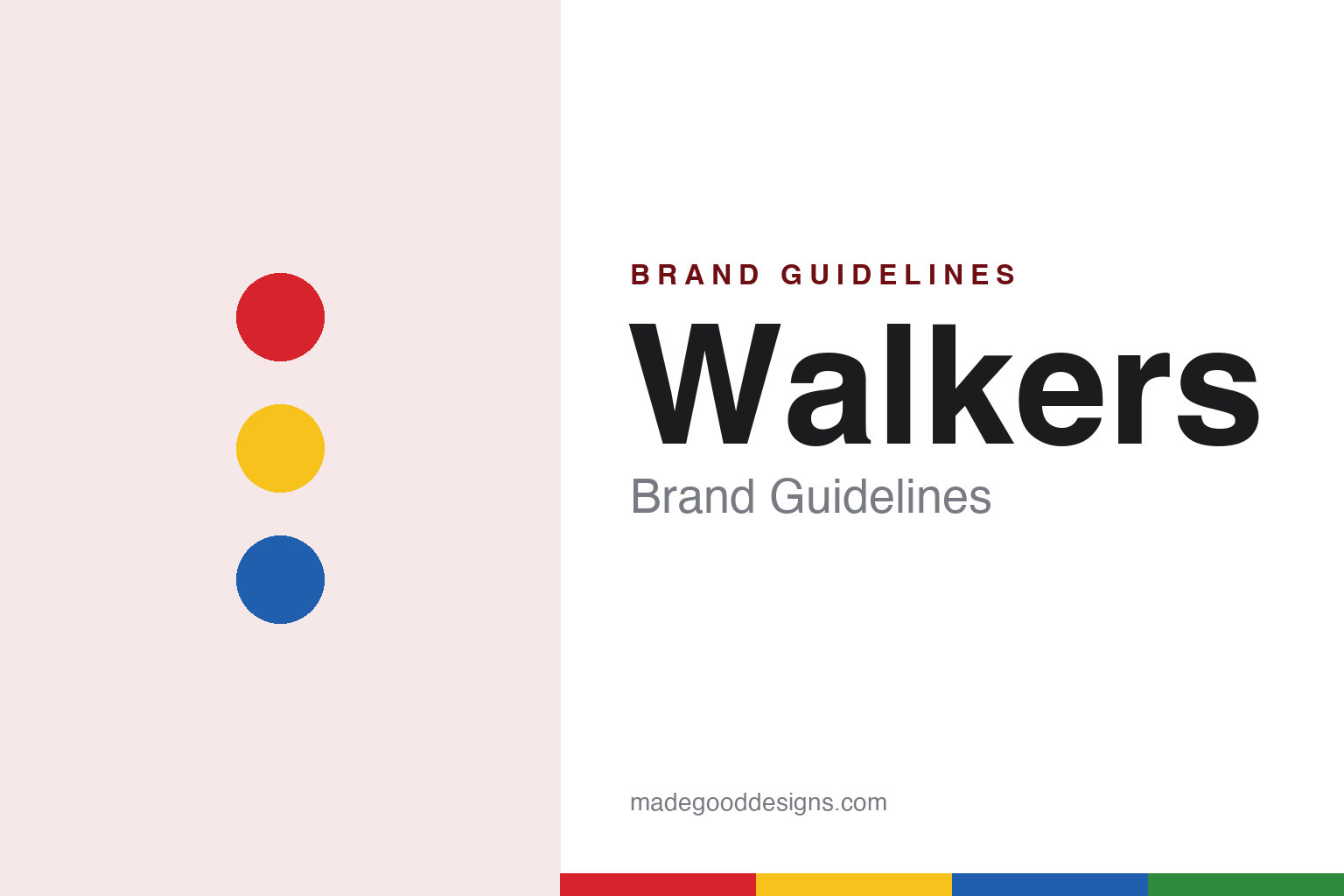
Two constants: a ribbon red, sun yellow and flavour blue palette and a bold friendly sans register. Abstract homage — not a Walkers product or mark; no pack, logo or crisp is reproduced.
A Leicester butcher’s
Meat rationing, a new product and threepenny bags.
Walkers is a Leicester company, and its story starts in a butcher’s shop. English Wikipedia, citing local histories, says Henry James Walker moved from Mansfield, in Nottinghamshire, to Leicester in the 1880s to take over an established butcher’s shop on the city’s High Street. After the Second World War, meat rationing cut the family factory’s output sharply, and in 1948 the firm, then Walkers & Sons, began looking for something else to make. Potato crisps were growing in popularity, and Wikipedia says the managing director, R. E. Gerrard, moved the company into hand-slicing and frying potatoes. The first Walkers crisps were simply salted and sold for threepence a bag.
Flavour came in the 1950s. Wikipedia credits Joe “Spud” Murphy of Ireland’s Tayto with developing a way to add cheese-and-onion seasoning during production in 1954; Walkers brought out its own Cheese & Onion later that year, followed by Salt & Vinegar in 1967, with Prawn Cocktail and Roast Chicken arriving in the 1970s. Walkers packs Cheese & Onion in blue and Salt & Vinegar in green, the reverse of many other British brands, and Wikipedia says Walkers has stated that it has always used that colour scheme.
The Walker family sold the business in 1970 to the American food group Standard Brands, which merged with Nabisco in 1981 to form Nabisco Brands. Walkers then sat alongside Smiths and Tudor as one of Nabisco’s three British crisp brands, with Tudor sold mainly in the north of England and Smiths in the south, Wikipedia says. After Kohlberg Kravis Roberts bought RJR Nabisco in a leveraged buyout in 1988, several businesses went to the French group BSN, now Danone, which sold Walkers and Smiths on to PepsiCo in 1989. At the time Walkers held about a third of the British crisp market. Under PepsiCo the Tudor name was dropped and Smiths became a secondary brand.
Colour
Lineker, flavour votes and foil bags.
Walkers’ best-known advertising face is the Leicester-born footballer Gary Lineker, who has appeared in its campaigns since 1995, Wikipedia says. In the 1990s the company sold limited-edition “Salt & Lineker” crisps, and in 2000 Lineker’s Walkers commercials were ranked ninth in Channel 4’s poll of The 100 Greatest TV Ads. The brand also tied itself to its home-town football club: it was Leicester City’s shirt sponsor for 14 years, and the club’s ground was named the Walkers Stadium from its opening in 2002 until 2011.
Many of its campaigns have invited the public in. The “Do Us a Flavour” competition of 2008 asked people to invent new flavours, with six finalists sold as special editions in 2009 and a public vote choosing the winner; it returned in 2014, fronted by Lineker. The 2010 “Flavour Cup” and a 2015 “Bring Me Back” vote for retired flavours followed, the second restoring Beef & Onion to the range. Not every promotion landed: the Advertising Standards Authority banned a 2016 “Spell and Go” competition after finding elements of it misleading.
The products have changed in ways that shaped the bag itself. Walkers moved to foil bags in 1993 and began filling them with nitrogen instead of air in 1996 to keep crisps fresh, Wikipedia says. The range widened from 1997 as snacks such as Quavers and Monster Munch moved under the Walkers name, with Walkers Max ridged crisps from 1999 and the black-bagged Sensations range, aimed at the top end of the market, from 2002. Walkers also bought the Wotsits cheese puffs from its rival Golden Wonder. Crisp packets made the company a target too: in 2018 campaigners urged people to post empty packets back to Walkers, prompting an appeal from Royal Mail, and in December 2018 Walkers launched a recycling scheme for crisp packets.
Typography
Design and documentation.
The seven brands in this group all make crisps, and all of them come from Britain and Ireland: Walkers, Kettle Chips, Tyrrells, Pipers, Golden Wonder, Seabrook and Tayto. British and Irish crisp brands in general sit at many different points in the trade, from family firms that still carry a founder’s name to names that now belong to much larger food groups, and a single brand can be sold everywhere from a village pub to a supermarket shelf.
A crisp brand’s identity is usually carried less by a single product than by a packet, a name and the flavour or snack it promises, because the company behind the name may have changed hands, moved its factory or grown far beyond the town where it started. That makes the questions behind each name worth asking plainly: who started it, who owns it now, and where its crisps are actually made and packed.
Each guide separates what independent sources record from what the company says about itself — its founding story, its owners over time, where its crisps are made and how its packaging has changed — and marks plainly what rests only on the company’s own word.
Aa
A bold friendly sans for a crisp brand built on a sunny emblem. (Specimen set in Poppins, a sans STAND-IN; NOT the Walkers logo.)
Walkers
From a crisp to a sun.
The Walkers logo has mostly evolved rather than been replaced. Wikipedia describes the mark as a red ribbon around a yellow sun, similar to the logo of PepsiCo’s American brand Lay’s and derived from the Walkers logo of 1990. The company changed its label and typeface in February 2006, returned in June 2007 to a look reminiscent of its 1998–2006 logo, and introduced another new pack design and typeface in early 2013, Wikipedia says. In January 2019 a redesign of the main range moved the logo to the centre of each pack and surrounded it with illustrations laid out in the shape of a Union Jack, including Big Ben, red telephone boxes and Liverpool’s Liver Building.
The biggest change came in January 2026. Walkers unveiled what its marketing director, Wayne Newton, called its biggest redesign in years, Packaging Scotland reported on 12 January 2026: a modern, sun-inspired logo, with each bag carrying the signature of Henry Walker as a nod to the brand’s heritage. Creative Boom reported that the yellow crisp at the centre of the old mark had given way to a radiating sun, meant to stand for “real ingredients” and British potatoes, and gathered comment from branding agencies on whether the new look kept enough of the brand’s Britishness.
Walkers is still made in Leicester. The Leicester factory produces more than 11 million bags of crisps a day from about 800 tons of potatoes, according to Wikipedia, citing the BBC programme Inside the Factory; Leicestershire Live reported in 2018 that Walkers had opened what was then the world’s largest crisp plant in Leicester in 1982 and that it remained the largest. The business trades as Walkers Snack Foods Limited, a PepsiCo subsidiary based in Leicester, and Wikipedia puts its share of British savoury-snack sales at 17.3% in 2024; The Grocer ranked Walkers Britain’s third-biggest grocery brand in 2022.
For a design guide, Walkers shows how a crisp brand can hold on to the same red, yellow and flavour colours for decades while redrawing its emblem around them. Compare Doritos, its PepsiCo stablemate, and Golden Wonder, the rival Walkers overtook. For this guide we use a ribbon red, a sun yellow and a flavour blue with a bold sans, an unofficial interpretation; no product or logo is reproduced.
Explore & save
Keep Walkers’s identity on hand — save it to a board in the Made Good inspiration library.
Walkers identity set
Pin the Walkers ribbon red, sun yellow and flavour blue palette and the bold friendly sans register to your own board.