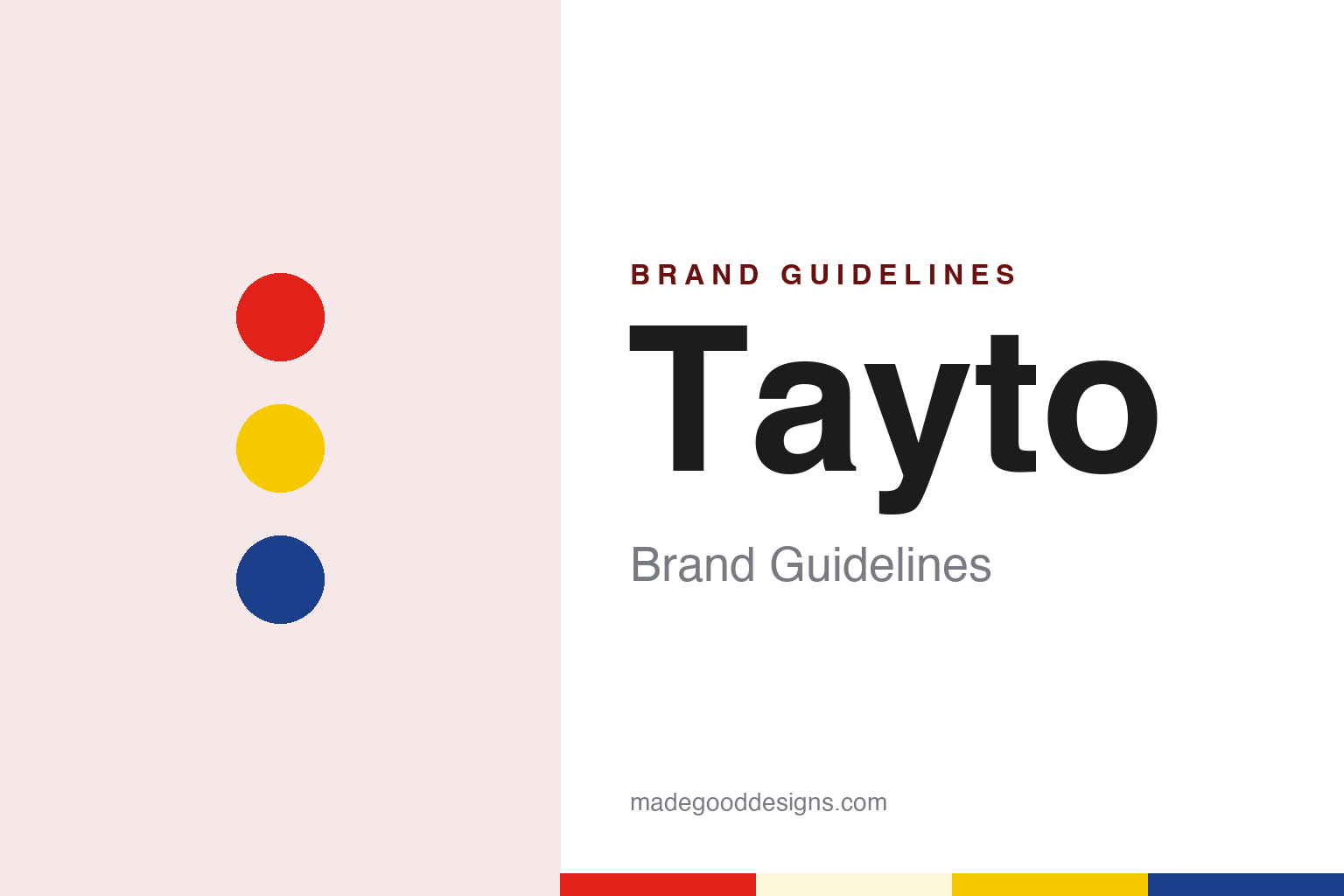
Tayto Brand Guidelines
The Dublin cheese & onion crisp with two owners.
Aa
Two constants: a packet red, crisp gold and jacket blue palette and a bold friendly sans register. Abstract homage — not a Tayto product or mark; no pack, logo or character is reproduced.
One van and eight employees
A Dublin crisp-eater, a kitchen-table flavour and a neon sign.
Tayto began with a complaint about plain crisps. Joe Murphy, a Dublin businessman who had imported goods such as Ribena and ball-point pens during the war years, was fond of crisps but found the ones on sale dull, The Irish Times wrote in its obituary of him in October 2001; the only seasoning, The Daily Telegraph added in its own obituary, was salt sold in a little bag inside the packet. In 1954 he started his own crisp company, Tayto, on O’Rahilly’s Parade, off Moore Street in Dublin, with one van and eight employees, both papers reported. Friends maintained, The Irish Times said, that he was the original “Spud Murphy”.
The flavour came from one of those first employees. Seamus Burke experimented on what was essentially a kitchen table until he arrived at a cheese and onion seasoning his employer judged acceptable, the Telegraph reported. The Irish Times credited Murphy with inventing the world’s first cheese and onion flavour; Tayto Snacks, today’s owner of the Dublin business, says he invented what is believed to be the world’s first flavoured crisp. To reach shops, the Telegraph wrote, Murphy approached the Findlater family, whose grocery and wine stores agreed both to stock the crisps and to sell them on to other outlets through their travelling salesmen.
The business grew quickly. Within two years it had moved to Mount Pleasant Avenue in Rathmines, and in 1960 it added premises in Harold’s Cross, according to The Irish Times (the company’s own history dates the Harold’s Cross move to 1961). Murphy was, at heart, a marketing man, the paper said: Tayto was one of the first sponsors of a programme on Radio Éireann, and he rented space for a neon sign at the junction of D’Olier Street and Westmoreland Street that became one of Dublin’s landmarks in the 1960s and 1970s.
Colour
American owners, a drinks group and a Meath snack maker.
Ownership of the Dublin Tayto moved early. In 1964 Beatrice Foods of Chicago bought a majority stake, The Irish Times and the Telegraph reported, and by the early 1970s the company employed about 300 people, most of them at a factory in Coolock, north Dublin. Tayto bought the King crisps company in 1972 and the Smiths Food Group factory at Terenure in 1981, and it was the first company to make and market extruded snacks in Ireland, The Irish Times said. Murphy sold his stake in 1983 and retired to Spain. He died in September 2001, aged 78.
In 1999 the drinks group Cantrell & Cochrane (C&C) won Tayto with a £68 million bid after the US holding company TLC Beatrice, its owner since 1987, put it up for sale, The Irish Times reported in May 2000; at the time Tayto held 60% of the Irish crisp market. In 2005 C&C outsourced production to Largo Foods, the Co Meath snack maker founded by the farmer-turned-entrepreneur Raymond Coyle, and in 2006 Largo bought the Tayto and King brands from C&C for €62 million, the Irish business site Fora reported in 2017. The German snack group Intersnack took a 15% stake in Largo in 2007, became its majority owner, and bought Coyle’s final 25% in 2015, Fora and The Irish Times reported. In February 2019 Largo renamed itself Tayto Snacks, now wholly owned by Intersnack, The Irish Times reported; it makes its crisps in an 80,000 sq ft facility at Ashbourne, Co Meath.
The brand’s face is Mr Tayto, a character the company calls its brand ambassador. In 2007 he ran a mock campaign in the Irish general election, and in 2009 he “published” an autobiography, The Man Inside the Jacket. In 2010 Coyle opened Tayto Park, a theme park across the road from the factory at Kilbrew, Co Meath, which he continued to own after selling the crisp business. In February 2022 Tayto Snacks and the park announced that the title sponsorship would end that December, The Irish Times reported, and from January 2023 the park became Emerald Park, RTÉ reported. That May, packs of Tayto Cheese & Onion appeared without Mr Tayto under the line “Where is Mr Tayto?”, the start of a campaign in which he was said to be travelling the world.
Typography
Design and documentation.
The seven brands in this group all make crisps, and all of them come from Britain and Ireland: Walkers, Kettle Chips, Tyrrells, Pipers, Golden Wonder, Seabrook and Tayto. British and Irish crisp brands in general sit at many different points in the trade, from family firms that still carry a founder’s name to names that now belong to much larger food groups, and a single brand can be sold everywhere from a village pub to a supermarket shelf.
A crisp brand’s identity is usually carried less by a single product than by a packet, a name and the flavour or snack it promises, because the company behind the name may have changed hands, moved its factory or grown far beyond the town where it started. That makes the questions behind each name worth asking plainly: who started it, who owns it now, and where its crisps are actually made and packed.
Each guide separates what independent sources record from what the company says about itself — its founding story, its owners over time, where its crisps are made and how its packaging has changed — and marks plainly what rests only on the company’s own word.
Aa
A bold friendly sans for a crisp with a character on the pack. (Specimen set in Rubik, a sans STAND-IN; NOT the Tayto logo.)
The other Tayto
A castle in Co Armagh and a licence from Dublin.
North of the border there is a second Tayto, owned by a different family. Tayto Group says it was founded by Thomas Hutchinson in 1956 at Tandragee, Co Armagh, where its crisps are still made beside Tandragee Castle, which the company calls “Tayto Castle”. English Wikipedia, citing the company’s founding papers, names Walter Gracey and Frederick John McKinney as co-founders. The company says it started with six staff and made 972 packets on its first day, and that its flavours, Cheese & Onion included, are mixed in a closely guarded room in the castle grounds to the original recipe.
The two businesses are separate. English Wikipedia’s articles on both say the Northern Irish company licensed the Tayto name and recipes from the Dublin firm, which owns the name and the Mr Tayto character; Tayto Group uses both under that licence. The same articles say Tayto Snacks’ crisps are sold in the Republic, while the Hutchinsons’ Tayto is sold in Northern Ireland and in Great Britain. Each company makes its own cheese & onion crisps, and both use Mr Tayto.
The Hutchinson business has grown into a group. In February 2006 it bought Golden Wonder, the Edinburgh-born crisp brand, after it went into administration, BBC News reported; it then added Real Crisps in 2007 and, in March 2008, the Birmingham firm Red Mill Snack Foods, maker of Mr Porky pork scratchings. At that point, managing director Stephen Hutchinson told the BBC, Tayto was the UK’s third-biggest crisp and snacks business, with 1,400 staff at five sites. Today the company describes itself as the largest British-owned crisp and snack maker, family-owned and producing more than five million bags a day across five UK sites, and says Tayto is Northern Ireland’s leading crisp brand. It gave Tayto a new look in 2019.
For a design guide, Tayto shows how one name, one flavour and one cartoon character can serve two companies in two jurisdictions for seventy years. Compare Golden Wonder, the Hutchinsons’ British brand, and Walkers, which entered the Irish market in 2000, The Irish Times reported. For this guide we use a packet red, a crisp gold and a jacket blue with a bold rounded sans, an unofficial interpretation; no product or logo is reproduced.
Explore & save
Keep Tayto’s identity on hand — save it to a board in the Made Good inspiration library.
Tayto identity set
Pin the Tayto packet red, crisp gold and jacket blue palette and the bold friendly sans register to your own board.