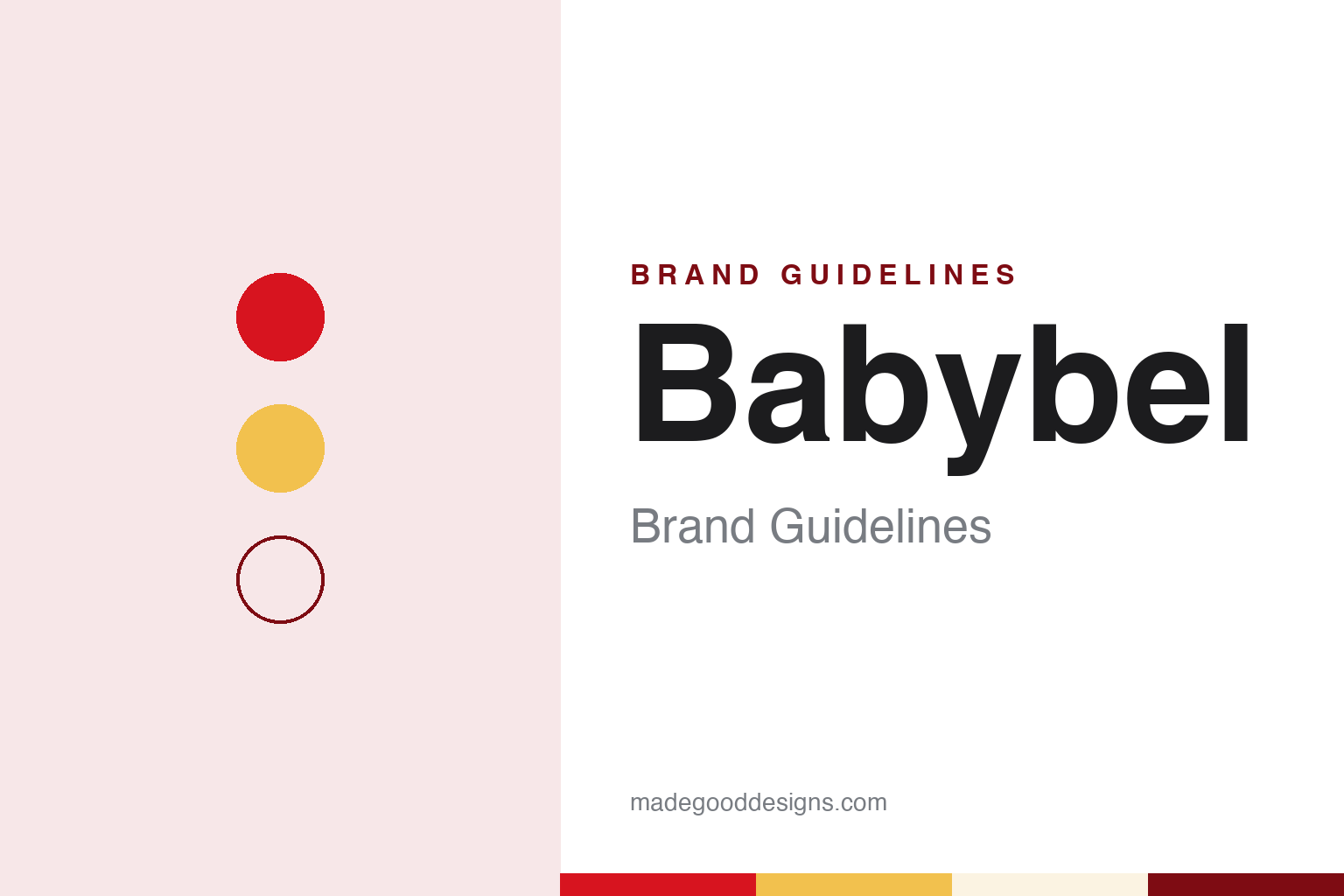
Babybel Brand Guidelines
A small cheese in a red wax shell, opened with a tab.
Aa
Two constants: a wax red, yellow and cream palette and a rounded sans register. Abstract homage — not a Babybel product or mark; no cheese, wax shell or logo is reproduced.
A cheese from Bel
From a Jura cheese trader to a portion-cheese group.
Babybel belongs to Bel, a French cheese group with roots in the Jura. French Wikipedia says the business began in 1865 as the Établissements Jules Bel, a firm in Orgelet that ripened and traded wheels of comté. Bel’s own UK timeline gives the same date and describes Jules Bel as a comté ripener and trader. His son Léon Bel took over in 1904, according to French Wikipedia, and in 1921 trademarked The Laughing Cow, the processed cheese that made the company’s name.
Bel added brands across the following decades. French Wikipedia lists Bonbel in 1947, Babybel in 1952, Apéricube in 1960 and Kiri in 1966. Its Babybel article says the first cheese of the line was developed in 1931 but first sold only in 1952, at first regionally, and across all of France from 1964. Bel’s foodservice division also dates the launch of the original, larger Babybel in France to 1952.
The cheese is a mild, semi-hard type. English Wikipedia describes Babybel as an Edam-style cheese made from pasteurised milk, with a vegetarian rennet in its recipe.
The product most people know is the small one. Mini Babybel, a single portion in its own wax shell, is dated to 1977 by Bel, both on its UK timeline and on its French foodservice site. French Wikipedia gives 1976 for the launch of the red Mini Babybel, and France Bleu Mayenne reported in 2022 that the factory at Évron had made Mini Babybel exclusively since 1976.
Bel is controlled by its founding family. French Wikipedia says the group has been 94.70% owned by the family holding Unibel since 25 January 2022, and that the Fiévet-Bel families hold 80% of Unibel. English Wikipedia names Antoine Fiévet as chairman and Cécile Béliot as chief executive since 2022.
Colour
A red shell, a tab and a song.
Babybel’s whole identity hangs on its wrapper. French Wikipedia describes the cheese as recognisable by its red wax shell that opens with a pull tab, and Bel’s foodservice site calls the red wax a playful shell. English Wikipedia says the coating is a blend of paraffin and microcrystalline wax.
Colour also does the work of a variant system. French Wikipedia says different varieties are identified by different wax colours, and lists flavours added over the years, among them Maasdam in 1998, a goat’s cheese with a green shell in 2003, a light version in 2006 and Gouda in 2013. English Wikipedia also records a plant-based Babybel made with coconut oil and starch.
The red shell has an outer wrapper too, and Bel is changing it. France Bleu Mayenne reported in November 2025 that the clear cellophane around each Mini Babybel would be replaced by paper, starting with production in Mayenne in mid-2026 and worldwide by the end of 2027. The broadcaster said the choice of paper had taken five years of work, that Bel puts the saving at 2,500 tonnes of carbon dioxide a year, and that the red wax itself stays.
Advertising gave the brand a tune. French Wikipedia says Babybel became known through advertising based on “Marylène”, a 1975 song by the French band Martin Circus, chosen for the way its sound echoed the product’s name; English Wikipedia says English-language advertising of the late 1970s used the melody of “Barbara Ann.” In the UK, Bel’s timeline says Mini Babybel first supported Comic Relief in 1999.
Typography
Design and documentation.
The seven brands in this group all sell butter, cheese or other dairy products, and they come from Denmark, Ireland, France, the United States and Britain: Lurpak, Kerrygold, Président, Babybel, Philadelphia, Cathedral City and Yeo Valley. Dairy brands in general sit at many different points in the trade, from farmer-owned co-operatives and family firms to names that now belong to much larger food groups, and a single brand can be sold everywhere from a corner shop to a supermarket chiller.
A dairy brand’s identity is usually carried less by a single product than by a pack, a name and the kitchen or table it promises, because the company behind the name may have changed hands, licensed its name to another maker or grown far beyond the place where it started. That makes the questions behind each name worth asking plainly: who started it, who owns it now, and where its butter, cheese or yoghurt is actually made and packed.
Each guide separates what independent sources record from what the company says about itself — its founding story, its owners over time, where its products are made and how its packaging has changed — and marks plainly what rests only on the company’s own word.
Aa
A soft, rounded sans for a small cheese in a red shell. (Specimen set in Fredoka, a sans STAND-IN; NOT the Babybel logo.)
Babybel
Made in Mayenne, and now in America.
Babybel’s home is Évron, in Mayenne, the same department as Président’s home town of Laval. French Wikipedia calls Évron the first and main Babybel factory in France. France Bleu Mayenne reported in 2022, for the plant’s sixtieth anniversary, that it opened in 1960, employed about 600 people and made some five million Mini Babybel a day; in November 2025 the broadcaster put Évron’s output at about two billion a year, half of world production, with around 30% exported to the United States.
Bel also makes Babybel at Sablé-sur-Sarthe. The trade title Agro Media reported in May 2026 that Bel had stopped making the large-format Babybel there at the end of 2025 and was investing €60 million in a second Mini Babybel line at the site, due to run by June 2026 and adding 50 jobs; Bel told the publication its existing capacity was fully used.
Outside France, English Wikipedia says Bel opened a Babybel plant in South Dakota in March 2016 and announced a plant in Quebec in 2018. French Wikipedia said in 2015 that Babybel was sold in 76 countries. Ownership around Bel has also shifted: in March 2021, French Wikipedia says, Bel agreed to sell its Leerdammer brand to Lactalis, the owner of Président, in a deal that also ended Lactalis’s shareholding in Bel.
For a design guide, Babybel shows how one material, a coloured wax shell with a tab, can carry a brand on its own, with the colour of the wax doubling as a flavour code. Compare Président, also from Mayenne, and Philadelphia, another cheese brand defined by its pack. For this guide we use wax red, cheese yellow and cream with a rounded sans, an unofficial interpretation; no product or logo is reproduced.
Explore & save
Keep Babybel’s identity on hand — save it to a board in the Made Good inspiration library.
Babybel identity set
Pin the Babybel wax red, yellow and cream palette and the rounded sans register to your own board.