Daddies Brand Guidelines
Birmingham’s other brown sauce, from Aston Cross to Kraft Heinz.
Aa
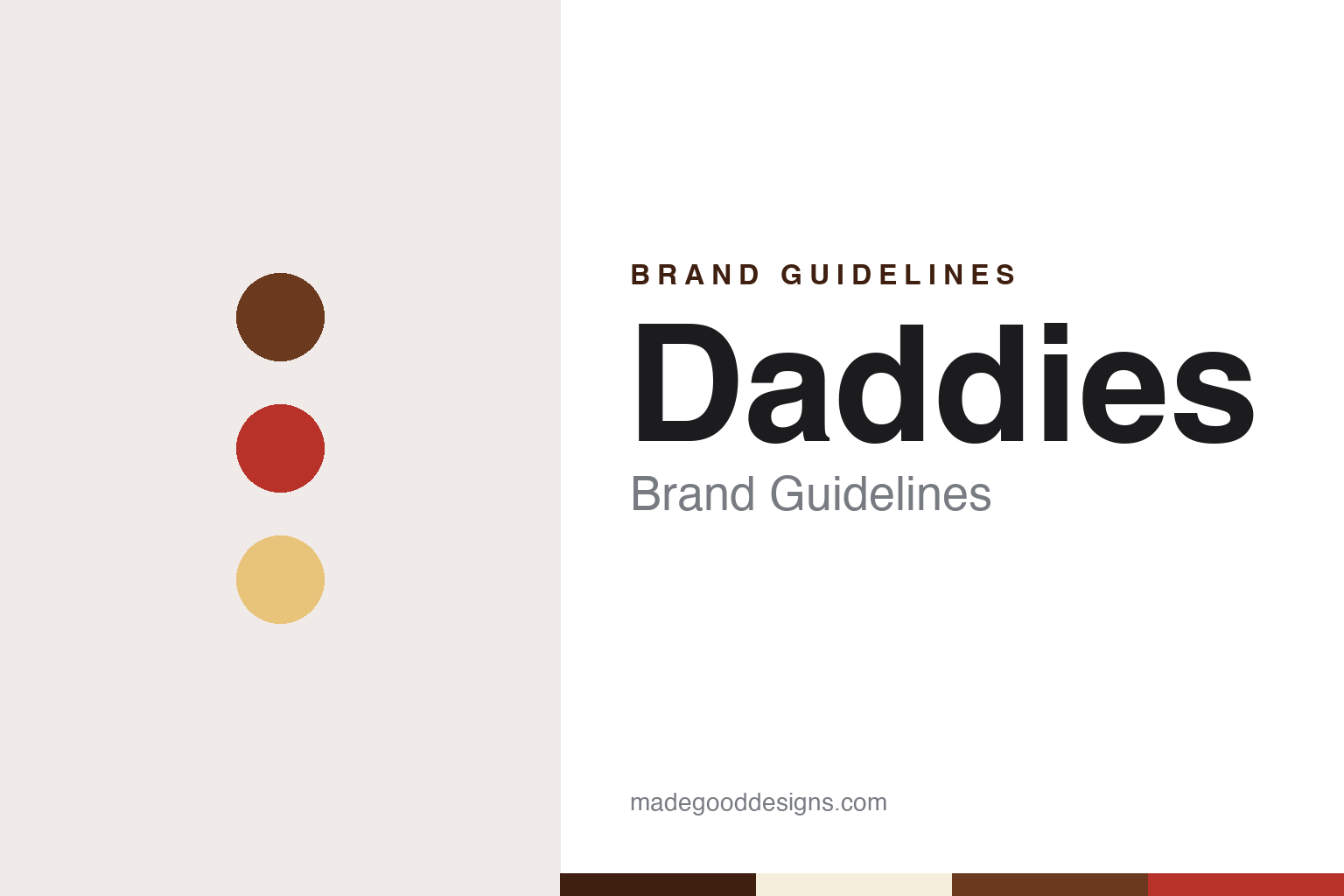
Two constants: a brown sauce, tomato red and label cream palette and a sturdy slab serif register. Abstract homage — not a Daddies product or mark; no bottle, label or logo is reproduced.
A vinegar maker’s second sauce
Aston Cross, a Nottingham grocer and a cheaper brown sauce.
Daddies grew up in the same Birmingham business as HP Sauce. English Wikipedia’s history of HP Foods says Edward Eastwood and his nephew Edwin Samson Moore set up the Midland Vinegar Company at Aston, Birmingham, in 1875, and the vinegar works at Aston Cross became the home of both sauces. Brown sauce came to Moore through a customer. English Wikipedia says that in 1899 he went to see Frederick Gibson Garton, a Nottingham grocer who made sauces in a small factory, and paid him £150 for his recipes; on English Wikipedia’s HP Sauce page, Garton had registered the H.P. Sauce name in 1895, and the sale required him to leave the sauce business, citing The Guardian in 2010. English Wikipedia’s Daddies page counts the Daddies recipe among those Moore bought.
The brown sauce that became Daddies went on sale in 1904, English Wikipedia says, and the industrial-history site Grace’s Guide also dates the launch to 1904 under Moore. It was a second brown sauce from the maker of HP, and today the brown sauce is sold as Daddies Favourite, the name Campaign used for it in 2007. Grace’s Guide says it was made by H.P. Sauce Ltd once that company was incorporated in 1925.
A ketchup followed. English Wikipedia dates Daddies tomato ketchup to 1930, and from then the name covered both a brown sauce and a red one. English Wikipedia’s Daddies page cites the Competition Commission’s 2006 report on Heinz and HP Foods for its account of the brand, and among the overlaps that report examined was Daddies tomato ketchup against Heinz Tomato Ketchup.
Colour
Imperial, Hanson, Danone and a competition inquiry.
Daddies changed hands with the HP business rather than on its own. English Wikipedia says HP Foods became part of the food division of Imperial Group, the tobacco company, and stayed with Hanson after Hanson bought Imperial; in 1988 Hanson sold the sauce business to the French group BSN, later Groupe Danone, for £199 million. Under Danone, HP Foods carried HP Sauce, Lea & Perrins Worcestershire sauce and Daddies.
In 2005 Danone sold HP Foods to H.J. Heinz. Heinz’s annual report for fiscal 2006 put the price at about $877 million and listed HP and Lea & Perrins among the brands, along with a perpetual licence to market Amoy Asian sauces; FoodNavigator gave the price as £470 million and said the deal brought three factories, two in the UK and one in the US. The purchase was completed on 16 August 2005, a note by the law firm CMS says, and on 26 October the Office of Fair Trading referred it to the Competition Commission. Daddies was at the heart of the inquiry: FoodNavigator reported in December 2005 that the commission would examine Daddies as a rival to Heinz Tomato Ketchup. The commission decided that ketchup and brown sauce were separate markets, differing in who bought them and in the foods they were eaten with, the CMS note says, and that the takeover would not substantially lessen competition; Heinz reported that the commission formally cleared the deal in March 2006.
Life inside Heinz was quieter. Campaign, in a brand health check written in 2007, reported that sales of Daddies Favourite brown sauce had fallen 16% to £4.5 million in the year to 6 October 2007, that the brand had received no marketing support since the takeover while Heinz spent on its other bottled sauces, and that Premier Foods had extended its Branston brand into table sauces in 2006, with Branston’s tomato sauce overtaking Daddies’.
Typography
Design and documentation.
The seven brands in this group all make sauces, pestos, soups or cooking sauces, and they come from Italy, Britain and Hong Kong: Sacla’, Bertolli, Sharwood’s, Amoy, Baxters, Daddies and Dolmio. Sauce and soup brands in general sit at many different points in the trade, from family firms that still carry a founder’s surname to names that now belong to much larger food groups, and a single brand can be sold everywhere from a corner shop to a supermarket shelf.
A sauce brand’s identity is usually carried less by a single product than by a jar, a bottle, a name and the meal it promises, because the company behind the name may have changed hands, moved its factory or grown far beyond the town where it started. That makes the questions behind each name worth asking plainly: who started it, who owns it now, and where its sauces are actually cooked and packed.
Each guide separates what independent sources record from what the company says about itself — its founding story, its owners over time, where its products are made and how its packaging has changed — and marks plainly what rests only on the company’s own word.
Aa
A sturdy slab serif for a workaday table sauce. (Specimen set in Roboto Slab, a slab serif STAND-IN; NOT the Daddies logo.)
Daddies today
From Aston Cross to the Continent.
The biggest change for Daddies was where it was made. In May 2006 Heinz announced that it would move production from the Aston factory to its plant at Elst, in the Netherlands, English Wikipedia says, citing the BBC; the Aston works stopped production on 16 March 2007, ending more than a century of sauce-making at Aston Cross, and the factory was later demolished. English Wikipedia’s history of HP Foods says the production of both HP and Daddies went to the Netherlands at that point.
Daddies has since moved again. English Wikipedia’s Daddies page says its production has been moved to Poland, and product listings for Daddies tomato ketchup and Daddies Favourite brown sauce record Poland as the place of manufacture or origin. The brand belongs to Kraft Heinz, the company formed when Heinz merged with Kraft in 2015, which also owns HP, the brown sauce Daddies was launched beside in 1904.
Its owners across more than a century run from a Birmingham vinegar business and H.P. Sauce Ltd to the food arm of a tobacco group, the Hanson conglomerate, the French food group Danone and finally an American food company. Through each change the Daddies name stayed on two products, a brown sauce and a ketchup; after the Heinz takeover, Campaign noted in 2007, Heinz put its advertising behind its other bottled sauces rather than Daddies.
For a design guide, Daddies shows how a plain family-sounding name can carry a table sauce through a century of changing owners and three countries of manufacture. Compare Grey Poupon, a Kraft Heinz mustard in the US, and Amoy, the Asian sauces HP Foods marketed under licence. For this guide we use a brown-sauce brown, a tomato red and a label cream with a slab serif, an unofficial interpretation; no product or logo is reproduced.
Explore & save
Keep Daddies’s identity on hand — save it to a board in the Made Good inspiration library.
Daddies identity set
Pin the Daddies brown sauce, tomato red and label cream palette and the sturdy slab serif register to your own board.