Seabrook Brand Guidelines
The Bradford chip-shop crisp, crinkle-cut and owned by Calbee.
Aa
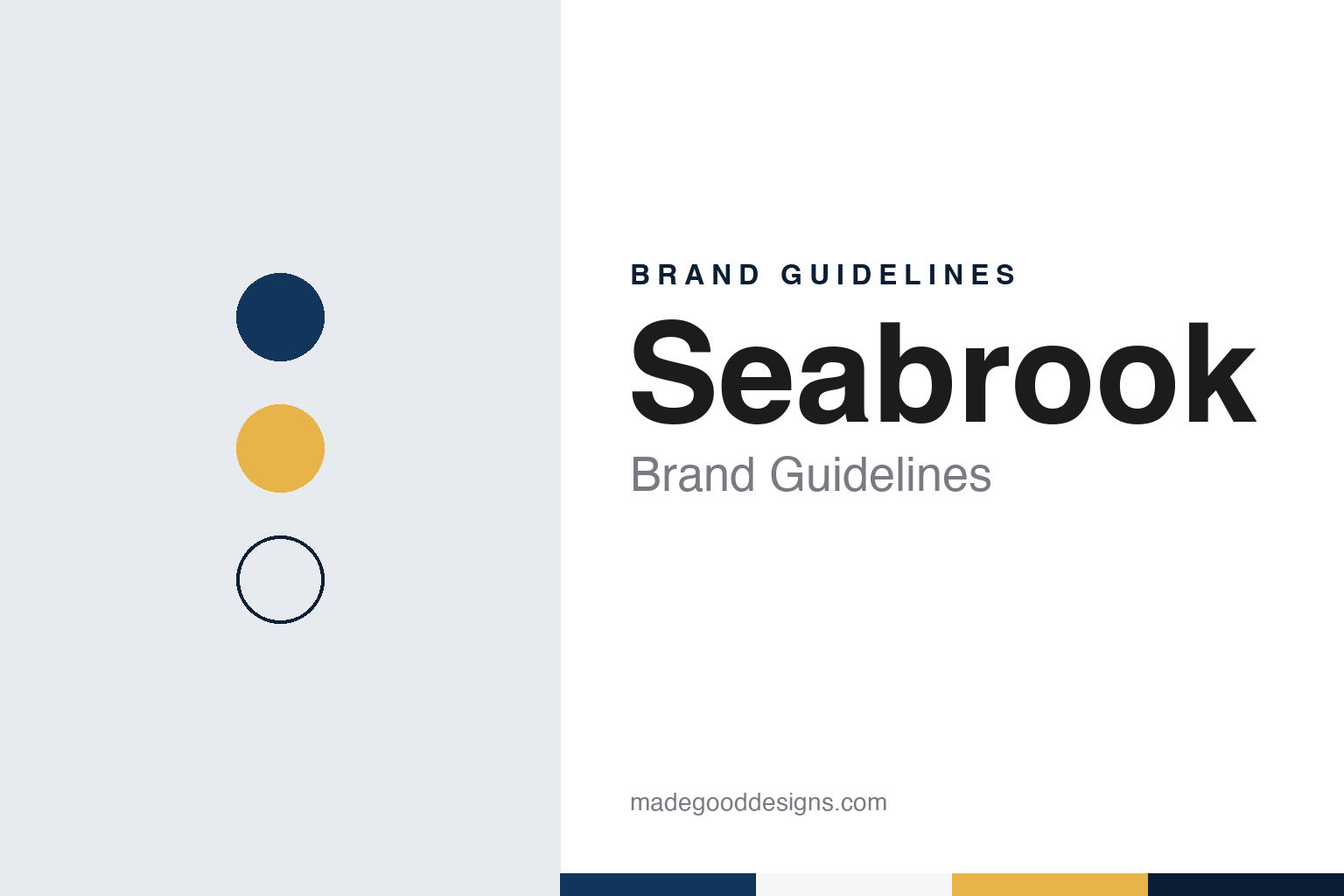
Two constants: a Seabrook blue, gold and white palette and a Northern grotesque register. Abstract homage — not a Seabrook product or mark; no pack, logo or crisp is reproduced.
A chip shop in Bradford
A misspelt name, a fryer and a queue of customers.
Seabrook started in a fish & chip shop. The company says Charles Brook opened his first chip shop in Bradford in 1939 and named it “Seabrook” after a mistake: photographs he had left to be developed came back labelled Seabrook instead of “C. Brook.” English Wikipedia tells the same story of a clerk’s slip. The crisps came later. In 1945, the company says, Charles’s son Colin returned from the Navy, and together they found that their fryer could do more with the potato than make chips. The Yorkshireman, reporting on the brand’s 75th anniversary in 2020, said the Brooks fried salted crisps for customers waiting in the queue, and that the crisps proved so popular they became the main business.
The company dates the brand to that year. Seabrook describes its crisps as Britain’s original crinkle-cut crisps, and its timeline says that after moving production into its first factory, a terraced house in Bradford, in 1950, it delivered crisps door to door before launching what it calls the UK’s first crinkle-cut crisp.
The business grew in stages, all within Bradford. In 1956, the company says, Charles and Colin converted the old Allerton Liberal Club into a new factory and incorporated the company, and the same year Seabrook sponsored a World Crisp Eating Competition in the city. English Wikipedia says crisps were made at Allerton, on the western edge of Bradford, until 2004.
Colour
Princeville, prawn cocktail and sea salt.
A larger factory followed at the end of the 1970s. The company says it bought a site on Duncombe Street and opened its Princeville factory in 1978–79; English Wikipedia dates the opening to 1979–80. In 1979, the company says, it made its first Prawn Cocktail crinkle-cut crisp and became the first crisp maker to cook in sunflower oil. The crisps are seasoned with sea salt, and English Wikipedia says most of the potatoes come from within about 50 miles of the Bradford headquarters.
Later changes were about ingredients. The company says it removed MSG from its crisps in 2007, and that in 2013 its crisps were certified gluten-free by Coeliac UK, with every product suitable for vegetarians.
Ownership changed twice in the 2010s. In July 2015 the private equity firm LDC, part of Lloyds Banking Group, backed a management buyout of Seabrook in a deal reported at £35 million, taking a majority stake alongside the management team. LDC says that during its ownership Seabrook began selling in markets including the United Arab Emirates, China, France, Spain and Australia, and PotatoPro reported that LDC put more than £5 million into the Bradford factory. In October 2018 LDC sold Seabrook to Calbee (UK) Ltd, the British arm of the Japanese snack company Calbee, for an undisclosed sum. At the time, LDC says, the business employed 160 people in Yorkshire and had revenue of £29.8 million in the year to March 2018. PotatoPro reported that Seabrook would run as a standalone company alongside Calbee UK’s existing brands, including Harvest Snaps, and quoted Calbee UK’s managing director saying the deal was designed “not for cost savings but to generate growth.”
Typography
Design and documentation.
The seven brands in this group all make crisps, and all of them come from Britain and Ireland: Walkers, Kettle Chips, Tyrrells, Pipers, Golden Wonder, Seabrook and Tayto. British and Irish crisp brands in general sit at many different points in the trade, from family firms that still carry a founder’s name to names that now belong to much larger food groups, and a single brand can be sold everywhere from a village pub to a supermarket shelf.
A crisp brand’s identity is usually carried less by a single product than by a packet, a name and the flavour or snack it promises, because the company behind the name may have changed hands, moved its factory or grown far beyond the town where it started. That makes the questions behind each name worth asking plainly: who started it, who owns it now, and where its crisps are actually made and packed.
Each guide separates what independent sources record from what the company says about itself — its founding story, its owners over time, where its crisps are made and how its packaging has changed — and marks plainly what rests only on the company’s own word.
Aa
A Northern grotesque for a Bradford maker of crinkle-cut crisps. (Specimen set in Bricolage Grotesque, a sans STAND-IN; NOT the Seabrook logo.)
Seabrook
Still made in Bradford, now under Calbee.
Under Calbee, Seabrook has stayed in Bradford. In April 2024 Food Manufacture reported that Calbee Group UK had won planning permission for a £12 million investment in the Seabrook factory, a two-phase project adding a 3,000-square-metre cooking and preparation building and a 1,000-square-metre warehouse that it said would raise output by 70 per cent. Calbee UK’s other site, at Deeside in north Wales, had received £3 million earlier that year, the magazine said. In 2025 Decision Marketing reported that the company had invested £15 million across the two sites.
The brand’s look and voice have been refreshed several times. For the 75th anniversary in 2020, The Yorkshireman reported, Seabrook released a limited-edition Fish & Chip flavour in a nostalgic newspaper-print pack made with the Yorkshire Post, a nod to the chip shop where the business began. In March 2021 it launched an integrated campaign, “Brilliant By The Bagful,” created by the agency Principles, which says the television advert was shot in Manchester and ran on ITV. The company says it introduced new packaging in 2023. In 2024 it sponsored the ITV series In For A Penny, and in August 2025 Decision Marketing reported that the agency Quiet Storm had been appointed to create Seabrook’s first major creative platform since “Brilliant By The Bagful,” with the marketing director saying it would build on the brand’s “proud Northern roots.”
For a design guide, Seabrook shows how a regional crisp can keep a founding story, a city and a cut at the centre of its identity through changes of owner. Compare Walkers, the national market leader, and Tyrrells, a younger British crisp brand from Herefordshire. For this guide we use a deep blue, a crinkle gold and a sea-salt white with a sans, an unofficial interpretation; no product or logo is reproduced.
Explore & save
Keep Seabrook’s identity on hand — save it to a board in the Made Good inspiration library.
Seabrook identity set
Pin the Seabrook blue, gold and white palette and the Northern grotesque register to your own board.