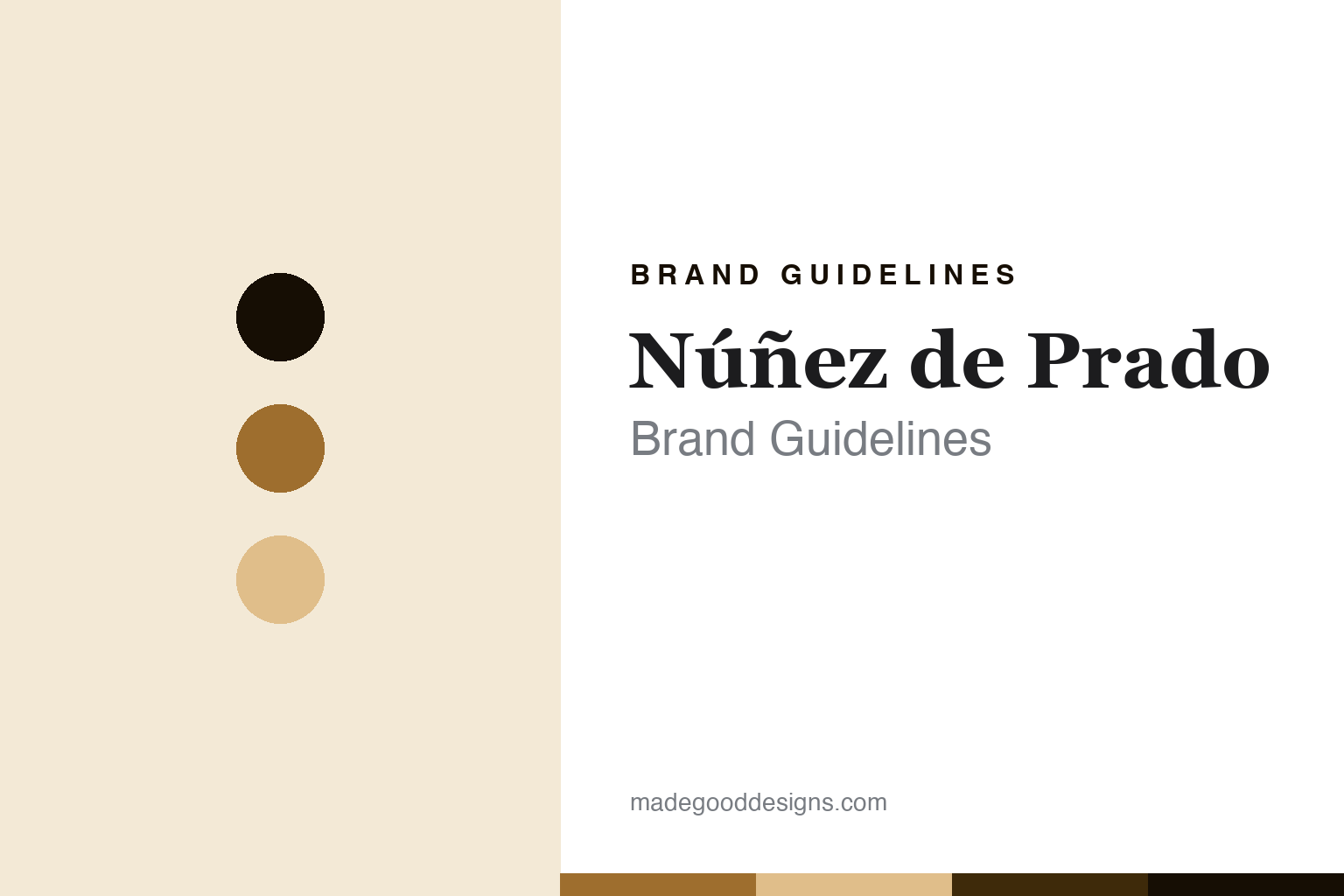
Núñez de Prado Brand Guidelines
The organic olive oil of Baena, the flower of the oil.
Aa
Two constants: an amber palette and a heritage-serif register. Abstract homage — not a Núñez de Prado asset or mark.
The organic olive oil of Baena
Núñez de Prado is the family-owned organic Spanish olive oil of Baena — famed for its Flor de Aceite, the flower of the oil.
Núñez de Prado brings the round its heritage house — the family-owned organic olive oil made in Baena, in Córdoba, milled the traditional way on a stone mill, and famed for its Flor de Aceite, the flower of the oil that runs free before pressing. Núñez de Prado makes organic extra-virgin olive oil, and its answer to a round about the pantry shelf is tradition and place: an organic Andalusian oil under a protected designation, drawn drop by drop. A brand, heritage.
Its identity is the organic olive oil of Baena. Núñez de Prado’s Flor de Aceite, its D.O.P. Baena origin and its family tradition are the story here. A brand, heritage. The organic olive oil of Baena, the flower of the oil.
(Honest notes, so the story stays precise. Núñez de Prado, at nunezdeprado.com, makes organic extra-virgin olive oil in Baena, and it is famous for its Flor de Aceite, the free-run oil that separates by gravity, drip by drip, before any pressing, alongside its standard organic extraction, in hand-labelled, numbered bottles. On its heritage, the family traces its roots in Baena to 1795 and cites more than two hundred and fifty years of oil-making, which we attribute to the family as their own claim rather than a hard founding date. On where it is made, a star theme of this round, it is grown and milled in Baena, in Córdoba, Andalusia, under the D.O.P. Baena protected designation, and milled traditionally on a stone mill, so we name Baena and the designation, both of which are geographic terms, not brand property. On its status, it is widely described as an organic pioneer, said to be among the first certified organic Spanish producers, which we attribute as the house’s own narrative. On ownership, it is family-owned and independent. Flor de Aceite is a descriptive technique term used by others too, so we present it as a technique, not a trademark. Its name and numbered labels are IP we describe but do not reproduce; there is no official brand hex; these tones are an unofficial interpretation.)
Colour
Núñez de Prado lives in an amber. Click a swatch to copy the hex.
Núñez de Prado’s identity is heritage, organic and traditional — an amber, an ink, a wheat, a deep amber, and a paper. The palette leans amber and wheat: a warm, traditional register that nods to golden Baena oil and a stone mill rather than a loud palette. It signals a heritage organic oil. The honest caveat: with no published brand hex, these values are an original, unofficial interpretation, not first-party colours.
The lesson is an amber signals a heritage, traditional identity. Núñez de Prado’s world is a traditional, made object. For designers, it is a reminder that an amber and a soft wheat can carry a pantry brand — the tone of a traditional Andalusian oil. Because these tones can fail as small text, keep type dark and let the colour live in the accents, palette and band. The takeaways: root in a place; keep a tradition; attribute the heritage; and treat any single hex as unofficial.
Typography
The register is a heritage serif — traditional, organic, refined.
Núñez de Prado’s identity carries a traditional, organic, refined spirit — a heritage oil, not a fashion. A heritage serif captures the mood: refined, traditional and confident, the register of an Andalusian house. Set in an amber palette, the heritage serif feels traditional and organic — exactly the personality Núñez de Prado carries. It is a tradition rather than a logo, mirroring an olive and a mill. (Núñez de Prado’s real numbered bottle is a thing we describe but do not reproduce, and the exact typeface is not ours to use.) Because it is not ours to use, the honest description is “a heritage-serif oil,” shown here in a stand-in. The type behaves like the brand: traditional, organic and refined.
Aa
A heritage-serif oil — traditional and organic. (Specimen set in Playfair Display, a heritage-serif STAND-IN; NOT the Núñez de Prado logo.)
The pantry shelf
Núñez de Prado stands for the organic olive oil of Baena.
Núñez de Prado brings the round its heritage house. An amber palette, a heritage serif and a traditional method make one thing — the organic olive oil of Baena — the whole identity: heritage, organic and traditional. The Flor de Aceite is the signature, and Baena is the place. The point is a family-owned organic oil from Córdoba, under a protected designation, drawn drop by drop.
Put to work, the identity is a tradition and a place told straight, as design. A maker in this spirit would root in a place, keep a tradition, and attribute the heritage. A reader in this spirit would keep the facts right: Núñez de Prado makes organic extra-virgin olive oil in Baena, famed for its Flor de Aceite, the free-run oil; the family traces its roots to 1795 and cites two hundred and fifty years, as their own claim; it is grown and milled in Baena, in Córdoba, under the D.O.P. Baena designation, on a stone mill; it is described as an organic pioneer, as the house’s own narrative; and it is family-owned and independent. Núñez de Prado anchors the round’s heritage thread with Castillo de Canena and Marina Colonna, and its D.O.P. Baena status is the counterpoint to Castillo’s estate-bottled, no-PDO approach. The honest editorial moves are to attribute the 1795 heritage to the family, to name Baena and the designation as geographic, to present Flor de Aceite as a technique, and to attribute the organic-pioneer claim. The lesson Núñez de Prado teaches is that a tradition can be a whole identity, and attributing the heritage honestly keeps it credible.
For designers and brand-builders, Núñez de Prado continues the pantry shelf: root in a place — and keep a tradition. The lessons: make within a protected designation; keep a traditional method, like a stone mill and free-run oil; attribute an old date to the family; present a technique term as a technique, not a trademark; and never reproduce a numbered label. It is also a reminder to stay precise: Núñez de Prado is the family-owned organic Spanish olive oil of Baena, famed for its Flor de Aceite — with the palette here an unofficial interpretation. Read that way, Núñez de Prado is less a bottle than a tradition: an organic oil of Baena. The lesson for a brand is that a place and honest heritage reinforce each other, and naming D.O.P. Baena keeps the story earned. Núñez de Prado made the-organic-olive-oil-of-Baena the identity — proof that a tradition can define a brand.
Explore & save
Keep Núñez de Prado’s identity on hand — save it to a board in the Made Good inspiration library.
Núñez de Prado identity set
Pin the amber palette and the heritage-serif register to your own board.