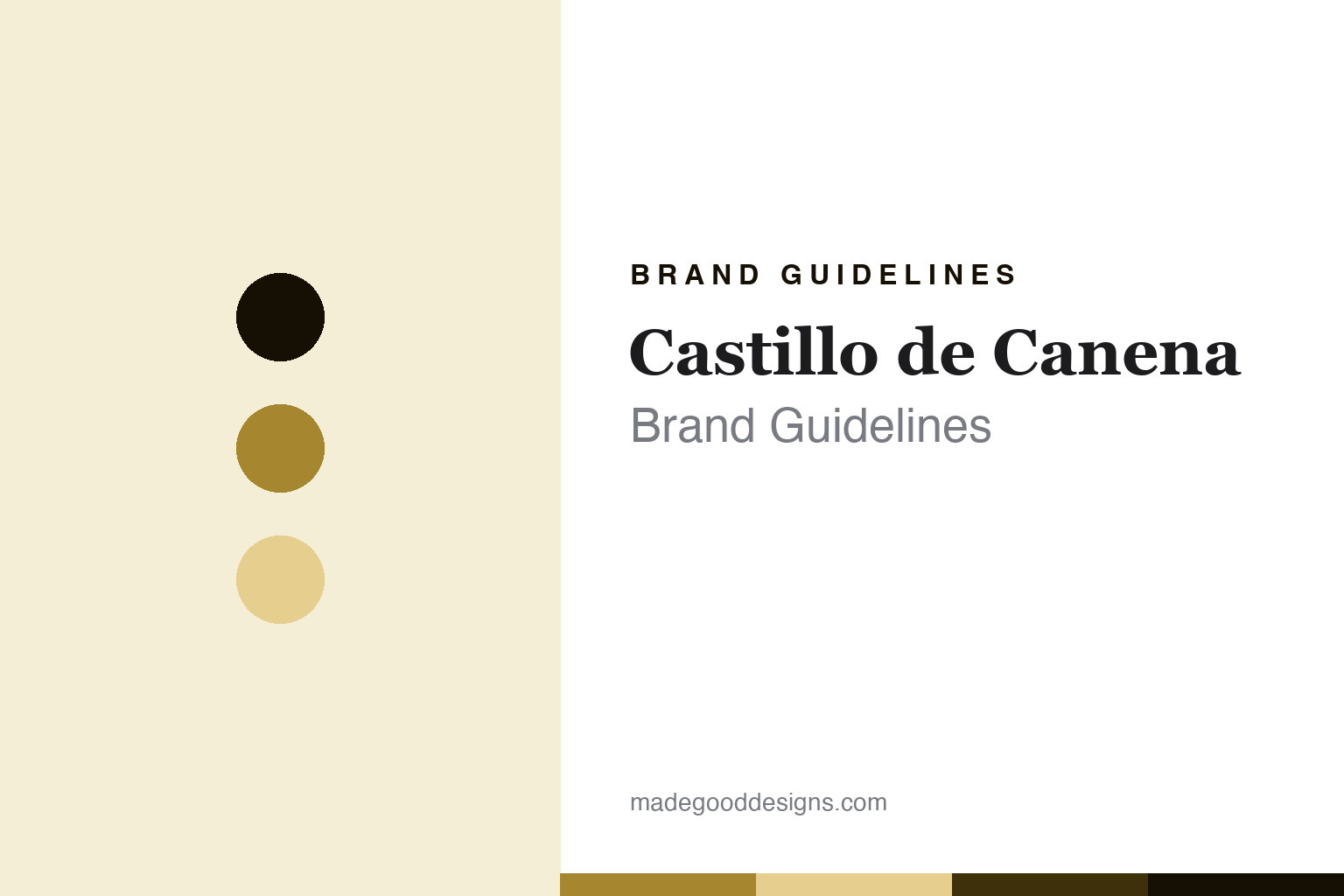
Castillo de Canena Brand Guidelines
The single-estate olive oil of Jaén.
Aa
Two constants: an estate-gold palette and an estate-serif register. Abstract homage — not a Castillo de Canena asset or mark.
The single-estate olive oil of Jaén
Castillo de Canena is the design-led, family-owned single-estate Spanish olive oil from Canena, in Jaén.
Castillo de Canena brings the round its Spanish estate — the design-led, family-owned single-estate olive oil grown and milled at the family’s own grove in Canena, in Jaén, the heart of Spanish olive oil. Castillo de Canena makes premium single-estate extra-virgin olive oil, and its answer to a round about the pantry shelf is estate and design: a Picual and an Arbequina from one Andalusian estate, in bottles known for their design. A brand, single-estate.
Its identity is the single-estate olive oil of Jaén. Castillo de Canena’s own estate, its Vañó family and its design-led bottles are the story here. A brand, estate. The single-estate olive oil of Jaén.
(Honest notes, so the story stays precise. Castillo de Canena, at castillodecanena.com, makes premium single-estate extra-virgin olive oils, including a Family Reserve Picual and Arbequina, a First Day of Harvest early-harvest, a Biodynamic and an oak-smoked Arbequina. The modern premium brand was relaunched in 2003 by the siblings Rosa and Francisco Vañó, who left corporate careers to do it, and the family traces its olive-growing tradition to 1780, which we attribute to the family as their own claim, distinct from the young 2003 brand. On where it is made, a star theme of this round, the olives are grown in the family’s own grove and milled in their own mill at Canena, in Jaén, Andalusia, so we say single-estate, and we note that it presents as estate-bottled, not under a protected designation, so we do not claim a specific PDO. On ownership, it is family-owned and independent, controlled by the Vañó family. It is richly awarded and widely regarded as design-forward, though we do not name a specific designer collaboration we could not verify. Its name, its castle imagery and its bottle design are IP we describe but do not reproduce; there is no official brand hex; these tones are an unofficial interpretation.)
Colour
Castillo de Canena lives in an estate gold. Click a swatch to copy the hex.
Castillo de Canena’s identity is estate, Spanish and considered — an estate gold, an ink, a wheat, a deep gold, and a paper. The palette leans estate gold and wheat: a warm, premium register that nods to golden Andalusian oil and a design-led bottle rather than a loud palette. It signals a single-estate oil. The honest caveat: with no published brand hex, these values are an original, unofficial interpretation, not first-party colours.
The lesson is an estate gold signals an estate, considered identity. Castillo de Canena’s world is a considered, made object. For designers, it is a reminder that an estate gold and a soft wheat can carry a pantry brand — the tone of a premium Spanish oil. Because these tones can fail as small text, keep type dark and let the colour live in the accents, palette and band. The takeaways: own the estate; design the bottle; attribute the heritage; and treat any single hex as unofficial.
Typography
The register is an estate serif — Spanish, considered, refined.
Castillo de Canena’s identity carries a Spanish, considered, refined spirit — a single-estate oil, not a fashion. An estate serif captures the mood: refined, premium and confident, the register of an Andalusian estate. Set in an estate-gold palette, the estate serif feels Spanish and considered — exactly the personality Castillo de Canena carries. It is an estate rather than a logo, mirroring an olive and an oil. (Castillo de Canena’s real bottle is a thing we describe but do not reproduce, and the exact typeface is not ours to use.) Because it is not ours to use, the honest description is “an estate-serif oil,” shown here in a stand-in. The type behaves like the brand: Spanish, considered and refined.
Aa
An estate-serif oil — Spanish and considered. (Specimen set in Cormorant Garamond, an estate-serif STAND-IN; NOT the Castillo de Canena logo.)
The pantry shelf
Castillo de Canena stands for the single-estate olive oil of Jaén.
Castillo de Canena brings the round its Spanish estate. An estate-gold palette, an estate serif and a single estate make one thing — the single-estate olive oil of Jaén — the whole identity: estate, Spanish and considered. The own grove and mill are the substance, and the design-led bottle is the signature. The point is a family-owned single-estate oil from Canena, in the heart of Spanish olive country.
Put to work, the identity is an estate told straight, as design. A maker in this spirit would own the estate, design the bottle, and attribute the heritage. A reader in this spirit would keep the facts right: Castillo de Canena makes premium single-estate oils, a Picual and an Arbequina, plus early-harvest, biodynamic and smoked expressions; the modern brand was relaunched in 2003 by Rosa and Francisco Vañó, with the family tracing its tradition to 1780 as their own claim; it is grown and milled at the family’s own estate at Canena, in Jaén; it presents as estate-bottled, not under a specific PDO; and it is family-owned and independent. Castillo de Canena leads the round’s European heritage thread with Núñez de Prado and Marina Colonna, and its single-estate, estate-bottled status contrasts with Núñez de Prado’s D.O.P. Baena. The honest editorial moves are to date the brand to 2003, to attribute the 1780 heritage to the family, to say single-estate not a PDO, and to skip an unverified designer. The lesson Castillo de Canena teaches is that an estate can be a whole identity, and attributing the heritage honestly keeps it credible.
For designers and brand-builders, Castillo de Canena continues the pantry shelf: own the estate — and attribute the heritage. The lessons: grow and mill your own; make the bottle a design object; attribute an old date to the family rather than the brand; say estate-bottled when there is no PDO; and never reproduce a bottle or a crest. It is also a reminder to stay precise: Castillo de Canena is the design-led, family-owned single-estate Spanish olive oil from Canena, in Jaén — with the palette here an unofficial interpretation. Read that way, Castillo de Canena is less a bottle than an estate: a single-estate oil of Jaén. The lesson for a brand is that an estate and honest heritage reinforce each other, and saying single-estate keeps the story earned. Castillo de Canena made the-single-estate-olive-oil-of-Jaén the identity — proof that an estate can define a brand.
Explore & save
Keep Castillo de Canena’s identity on hand — save it to a board in the Made Good inspiration library.
Castillo de Canena identity set
Pin the estate-gold palette and the estate-serif register to your own board.