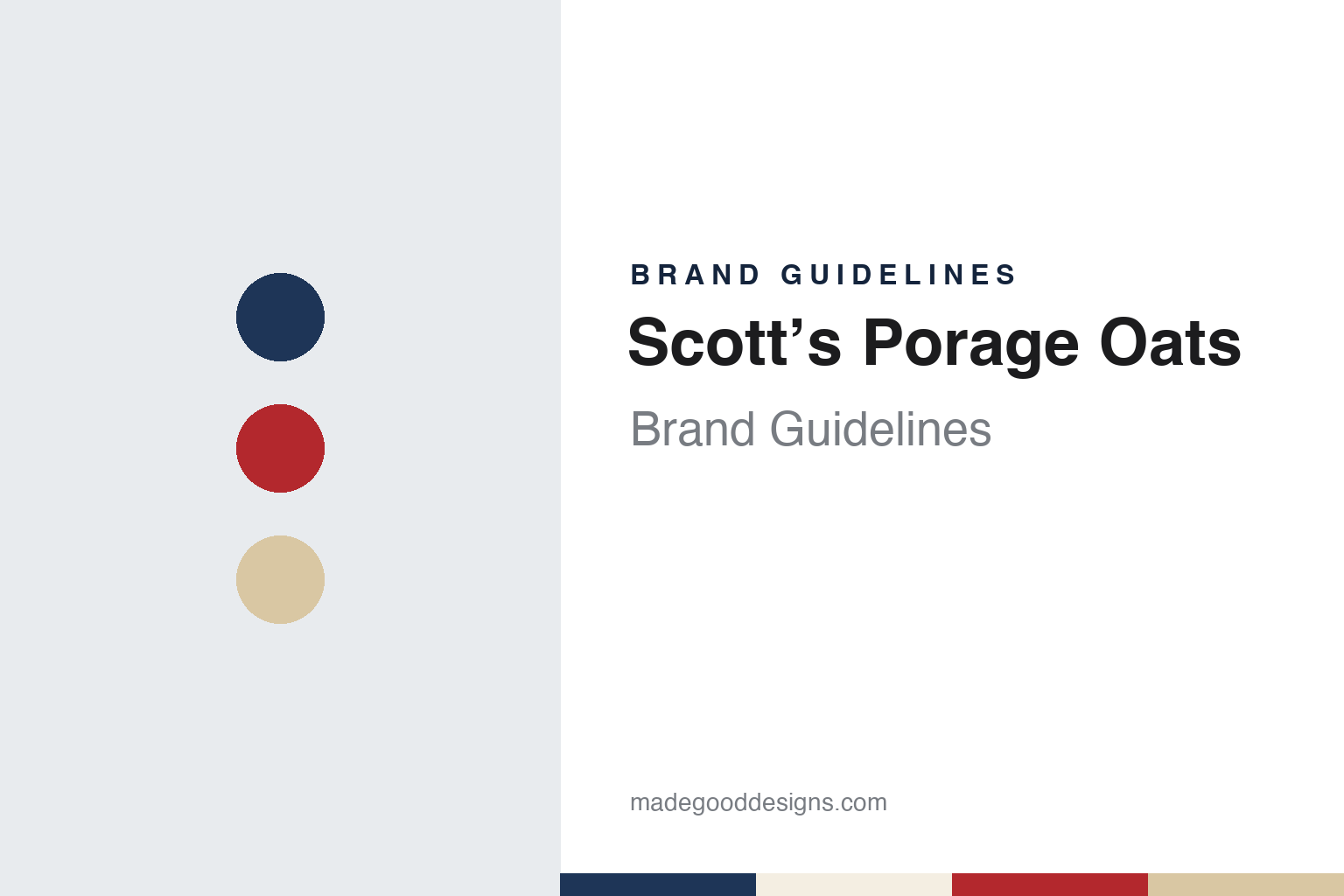
Scott’s Porage Oats Brand Guidelines
The Glasgow oat brand with a kilted shot-putter.
Aa
Two constants: a Highland navy, tartan red and oat flake palette and a traditional bookish serif register. Abstract homage — not a Scott’s Porage Oats product or mark; no pack, logo or figure is reproduced.
Midlothian Oat Flour
Two brothers, a Glasgow mill and a new spelling.
Scott’s Porage Oats began in Glasgow in 1880. The brand’s own heritage page, archived in 2017, says that two brothers, A & R Scott, started making Scott’s Midlothian Oat Flour that year in the Kingston Dock area of the city. The company itself says little is known of the brothers, and that from an early date the business was run by two partners: Robert Lauder, who looked after the technical side, and William Allen, who controlled the finances.
The early firm milled oat flour and baked with it. The company says the trade journal The Mercantile Age praised its milling machinery in 1884, the year it also began making oat biscuits, and that by 1893 it had premises in Buchan Street, Glasgow, and was sending out tens of thousands of oatcakes a week. It became a limited company in the late 1880s; the company’s own timeline and narrative give 1887 and 1888.
In 1909 the firm moved east, to larger premises at West Mills, Colinton, on the edge of Edinburgh. Its oat flakes needed a name that set them apart from rivals, and in 1914 the description Scott’s Porage Oats was introduced, English Wikipedia and the company agree. The company says the spelling “Porage” mixes the old Scots word “poray” with the French “potage,” and that the name remains a trademark. A fire in 1928 destroyed much of the production area at Colinton, the company says, but the mill was working again within seven weeks.
Colour
A Highlander, a kilt and a few haircuts.
The brand’s best-known image arrived in 1924, when, the company says, the figure of a Highlander putting the shot was added to the packaging. The company says it has been suggested that the figure was modelled on a non-commissioned officer of the King’s Own Scottish Borderers, whose barracks were not far from the Colinton mill, and that he has changed only a little since, as marketing managers have lengthened and shortened his hair and, occasionally, his kilt. The Cupar Museum and Heritage Centre, which describes him as a kilted shot-putter, notes that the Scott’s name and the kilted Highlander have both been kept through every change of owner.
In January 2010 the trade title Packaging News reported that the brand was resting the figure for the first time in more than 50 years. For the Six Nations rugby championship, two million limited-edition packs, designed with the agency Initial in a partnership with Scottish Rugby, showed the Scotland players Chris Paterson, Thom Evans and Ross Ford; standard packs kept the stone-putter in his white vest and kilt. “We have always championed Scottish sport,” said Sean Summers, Quaker’s marketing director at the time.
On screen, the brand had its own kilted strongman. In the late 1990s and early 2000s Scott’s ran a cinema and television campaign starring the actor Rory McCann in a kilt, and he became widely seen as the face of the brand, English Wikipedia says, citing The Scotsman.
The pack figure itself was redrawn in 2021. The trade site Talking Retail reported in February 2021 that Scott’s Oats was unveiling a new pack design for its Original Porridge Oats and Old-fashioned Oats, on sale from 22 February. Heather Doyle, the brand’s portfolio and innovation brand manager, said the new look would give its traditional image “a modern twist for added stand-out on shelf.” The Scotsman later reported that the new, less muscular shot-putter upset some long-time buyers, and that Scott’s said the design was inspired by recent images of Scottish shot-putters at the Highland games.
Typography
Design and documentation.
The seven brands in this group all make breakfast cereals or oats, and all of them come from Britain: Weetabix, Jordans, Dorset Cereals, Alpen, Ready Brek, Shreddies and Scott’s Porage Oats. British breakfast cereal and oat brands in general sit at many different points in the trade, from names that still carry a founder’s surname to names that now belong to much larger food groups, and a single brand can be sold everywhere from a village shop to a supermarket shelf.
A cereal brand’s identity is usually carried less by a single product than by a box, a name and the breakfast it promises, because the company behind the name may have changed hands, moved its mill or grown far beyond the town where it started. That makes the questions behind each name worth asking plainly: who started it, who owns it now, and where its cereals and oats are actually milled and packed.
Each guide separates what independent sources record from what the company says about itself — its founding story, its owners over time, where its cereals are made and how its packaging has changed — and marks plainly what rests only on the company’s own word.
Aa
A traditional bookish serif for a brand that has kept its 1914 name. (Specimen set in Libre Baskerville, a serif STAND-IN; NOT the Scott’s Porage Oats logo.)
Cupar
A flax mill in Fife and a chain of owners.
Scott’s Porage Oats have been milled at Cupar, in Fife, since 1947. That year, the company says, A & R Scott acquired a former flax mill there; English Wikipedia names it the Uthrogle Mills, and the Cupar Museum and Heritage Centre describes it as an abandoned wartime flax mill just west of the town. The museum says Cupar became the company’s only operational base in the early 1970s, when work at the Colinton mill ceased.
The brand has changed hands several times. The company says A & R Scott was taken over by the salt maker Cerebos in 1955, while the industrial-history site Grace’s Guide dates the Cerebos acquisition to 1951. Both companies were then acquired by Rank Hovis McDougall in 1969, the company says. In 1982 A & R Scott was bought by Quaker Oats Ltd, one of its main competitors, according to the company and English Wikipedia. PepsiCo won the contest to buy the Quaker Oats Company in December 2000, BBC News reported, and the merger was completed in 2001, bringing Scott’s into PepsiCo.
Under Quaker, Cupar grew from a Scottish mill into a European one. The company says that in 1989 Quaker announced Cupar would become the main centre of its oat milling in Europe, with a large expansion of the mill, and that from 1996 Cupar was the company’s sole supplier of rolled oats for European, African and Middle Eastern markets. In February 2012 PepsiCo announced a £14.4 million investment to expand capacity at Cupar, creating about 30 jobs and adding a new sachet line and bagging line, Food Manufacture and Just Food reported; the site makes both Quaker Oats and Scott’s Porage Oats.
For a design guide, Scott’s Porage Oats shows how one spelling and one kilted figure, kept since 1914 and 1924, can carry a brand through four changes of owner. Compare Nairn’s, the Scottish oatcake maker, and Ready Brek, another British oat cereal. For this guide we use Highland navy, a tartan red and an oat-flake beige with a serif, an unofficial interpretation; no product or logo is reproduced.
Explore & save
Keep Scott’s Porage Oats’s identity on hand — save it to a board in the Made Good inspiration library.
Scott’s Porage Oats identity set
Pin the Scott’s Porage Oats Highland navy, tartan red and oat flake palette and the traditional bookish serif register to your own board.