Seitenbacher Brand Guidelines
The muesli maker whose founder voices the radio ads.
Aa
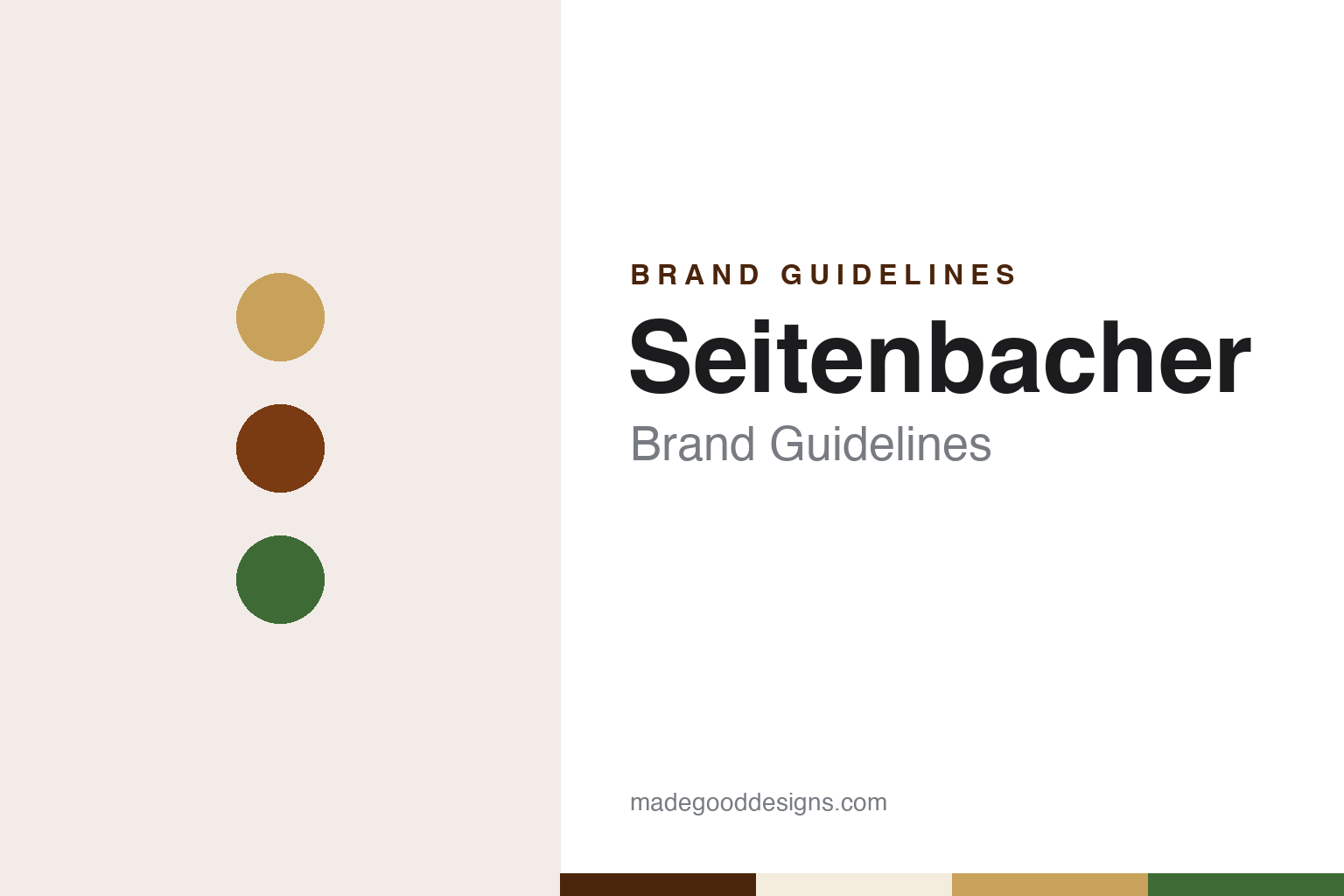
Two constants: a toasted oat, rye brown and meadow green palette and a sturdy slab serif register. Abstract homage — not a Seitenbacher product or mark; no pack, logo or sweet is reproduced.
A miller’s son and a stream
Wholegrain instead of white flour, in a Swabian mill town.
Seitenbacher is made in Buchen, a small town in the Odenwald in northern Baden-Württemberg, but it was founded further south, in Swabia. German and English Wikipedia, citing the Frankfurter Allgemeine Zeitung, say the trained miller Willi Pfannenschwarz started the business in 1980 in Waldenbuch, a Swabian town south of Stuttgart, and named it after the Seitenbach, a stream that runs there. The FAZ described him in 2013 as the offspring of a milling dynasty: rather than keep selling only white flour from his father’s mill to the farmers of the region, he wanted to sell wholegrain flour and grain mixtures.
The company tells the start as a story of trial and error. It says a first attempt, a wholegrain flour for Spätzle dough, failed, because many people still dismissed wholegrain flour as animal feed. Pfannenschwarz then rolled whole grains into large flakes and mixed them with whole nuts, dried fruit and seeds, and the Seitenbacher muesli was born; the first batches, the company says, were mixed in a converted concrete mixer. He told the FAZ that he named his first mixture “Müsli” after the Swiss Bircher muesli, and that this original special mix was still in the range in 2013.
The business grew out of the warehouse of the family mill. The company says its premises in Waldenbuch soon became too small, and that building in the town’s protected Mühlental valley was out of the question, so the firm moved north to Buchen. There, the FAZ reported, it makes all of its products. Pfannenschwarz built the company with his wife, Marion Pfannenschwarz, whom German Wikipedia names as a co-founder; in 2013 the FAZ reported that she looked after the finances while he handled strategy, and that he still programmed almost all of the factory’s machinery himself.
Colour
A cellar studio, a dialect and “lecker, lecker, lecker.”
Seitenbacher is known less for a pack than for a voice. Its radio spots are mostly spoken by Willi Pfannenschwarz himself and recorded in his own studio in the basement of his house, German Wikipedia says, citing Die Welt in 2008. The FAZ reported in 2013 that he wrote, produced and voiced the spots at night, and that he had recorded more than 300 of them. He told the paper that market research was money thrown away.
The spots stand out for their broad Swabian dialect, their sing-song delivery and their very simple slogans. The best known, “Seitenbacher-Müsli – lecker, lecker, lecker!”, was spoken in 1996 by his daughter, then ten years old, RP Online reported in 2003. Another, delivered by Pfannenschwarz himself, runs “Seitenbacher-Müsli, woisch, des isch des Müsli von dem Seitebacher!” — roughly, “you know, that’s the muesli from Seitenbacher.” Many spots address a friend called Karle; by 2013 the FAZ called the figure a cult, while reporting that Pfannenschwarz was wondering whether Karle had begun to wear thin. In the United States, the paper added, he voices the spots in English too, under the line “easy to eat, hard to spell.”
The ads divide listeners. A 2012 report by the SWR consumer programme Marktcheck found them polarising, and the company itself calls them both celebrated and, viewed critically, polarising. They have also entered popular culture. German Wikipedia records parodies by the comedians Andreas Müller, Willy Astor and Paul Panzer — Seitenbacher went on to sponsor Müller’s comedy tour, the Schwäbische Zeitung reported in 2012 — and a sample of the line “Woisch Karle” in the song “West Berlin” by the band Die Ärzte.
Typography
Design and documentation.
The seven brands in this group all make food, and all of them come from Germany or France: Dr. Oetker, Hengstenberg, Leibniz, Kühne, Seitenbacher, Bonduelle and Lesieur. German and French food brands in general sit at many different points in the trade, from family firms that still carry a founder’s surname to names that now belong to much larger food groups, and a single brand can be sold everywhere from a village grocer to a supermarket shelf.
A food brand’s identity is usually carried less by a single product than by a pack, a name and the meal or snack it promises, because the company behind the name may have changed hands, moved its factory or grown far beyond the town where it started. That makes the questions behind each name worth asking plainly: who started it, who owns it now, and where its food is actually made and packed.
Each guide separates what independent sources record from what the company says about itself — its founding story, its owners over time, where its products are made and how its packaging has changed — and marks plainly what rests only on the company’s own word.
Aa
A sturdy slab serif for a miller’s muesli. (Specimen set in Bitter, a serif STAND-IN; NOT the Seitenbacher logo.)
Seitenbacher
A family firm, an oil mill and a US arm.
Seitenbacher has stayed in the founder’s hands. German Wikipedia says the company is owned by Willi Pfannenschwarz and run as a family business, and the FAZ reported in 2013 that his twin daughters and his son worked in the firm. The business magazine wir described it in 2014 as a family “combo,” with the founder’s wife and three children part of the management, but with only one voice speaking for the company in public. The company says it remains purely family-owned.
The range has spread well beyond muesli. German Wikipedia lists pasta, sourdough, baking mixes, grain burgers, fruit gums, bars, seeds, snacks, chocolate cereals, honey, coffee, biscuits, soups and cooking oils, and the FAZ counted more than 250 products in 2013, when the company employed about 140 people in Buchen. The oils came through a purchase: in 2010 Seitenbacher took over the insolvent Grünsfelder Ölmühle, an oil mill in nearby Grünsfeld, the Fränkische Nachrichten reported at the time; the company says it rebuilt the mill to its own plans. Pfannenschwarz told the FAZ that most of the grain came from farmers in the surrounding area and that Seitenbacher did not supply discount supermarkets.
Abroad, German Wikipedia names Seitenbacher America LLC, based in Florida, alongside the two Buchen companies. Not every headline has been friendly: in 2020 a public vote run by the Hamburg consumer advice centre gave a Seitenbacher fruit muesli its “Mogelpackung des Jahres” award, a negative prize for packs judged misleading, after the contents were reduced while the shelf price rose, German Wikipedia says, citing WirtschaftsWoche.
For a design guide, Seitenbacher shows how a founder’s own voice and a single repeated line can do the work of a logo. Compare Alpen, another Swiss-style muesli, and Katjes, the German fruit-gum maker. For this guide we use a toasted oat, a rye brown and a meadow green with a slab serif, an unofficial interpretation; no product or logo is reproduced.
Explore & save
Keep Seitenbacher’s identity on hand — save it to a board in the Made Good inspiration library.
Seitenbacher identity set
Pin the Seitenbacher toasted oat, rye brown and meadow green palette and the sturdy slab serif register to your own board.