Maison Dandoy Brand Guidelines
The Brussels speculoos house on Rue au Beurre since 1829.
Aa
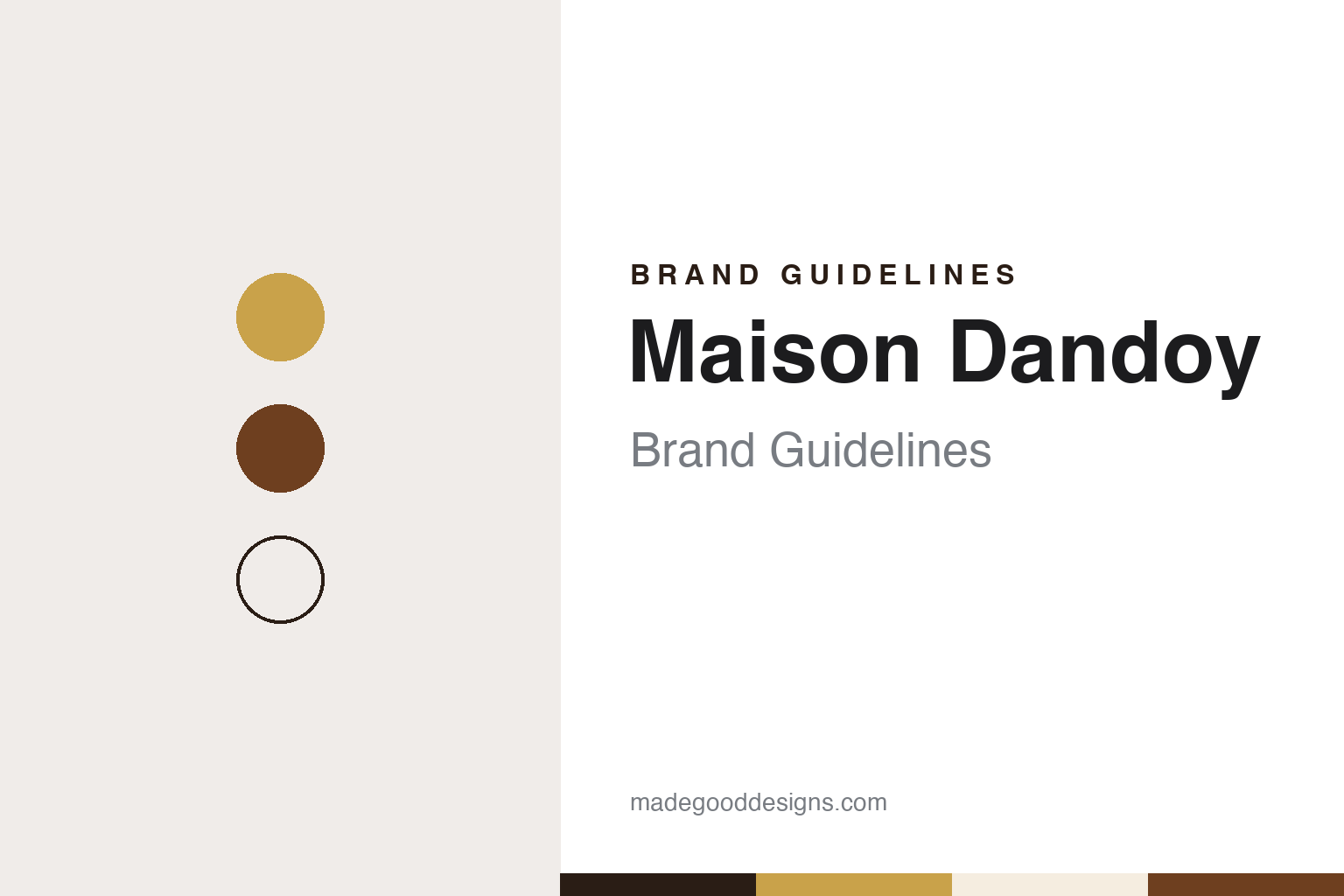
Two constants: a speculoos brown, gold and cream palette and an old-style serif register. Abstract homage — not a Maison Dandoy product or mark; no pack, logo or biscuit is reproduced.
Butter Street
A baker’s shop near the Grand-Place.
Maison Dandoy traces itself to 1829, when Jean-Baptiste Dandoy, a baker, opened his first shop in the centre of Brussels. English Wikipedia and the Belgian magazine Members Only (2024) place that shop on the Rue du Marché aux Herbes and describe him as a baker from Uccle; the Food and Wine Gazette reported in 2015 that he was the brother of the mayor of Uccle at the time. The business trades as Maison Dandoy; English Wikipedia gives the company name as Biscuiterie Dandoy, and the Belgian business magazine Trends-Tendances described it in 2017 as older than Belgium itself, which became independent in 1830.
In 1858 the shop moved to 31 Rue au Beurre — Butter Street — a 17th-century house on the street linking the Grand-Place and the Bourse, according to the Food and Wine Gazette; the company says Jean-Baptiste taught the trade to his son Philippe there, and the street remains its headquarters. English Wikipedia, citing the food site Ideemiam, says the poet Charles Baudelaire was reportedly a customer during his stay in Brussels in the 1860s. It also cites the Dictionnaire d’histoire de Bruxelles (2013) for the formation of a company in 1905 and the registration of the brand name and logo in 1907.
Speculoos is the house’s best-known product. Members Only reported in 2024 that it makes up more than half of the biscuit production, that the recipe is attributed to the founder, and that the dough is still kneaded by hand and pressed into wooden moulds. The range also takes in pain à la grecque, sugared rusks, marzipan, waffles and cakes.
Colour
Rusks in wartime, NASA turned down.
The family steered the business through the 20th century. Philippe’s son Jean-Philippe came next, followed by his daughter Fernande and her husband Valère Rombouts. During the Second World War, when flour was rationed, the only biscuit the house could still make was its sugared rusk, the “biscotte sucrée”; of that rusk the company says, “It really is thanks to her that all our biscuits still exist today!” It says Valère waited until 1948, when butter and sugar that met his standards were available again, to bring back the full range.
In the 1970s, according to the company and Members Only, their son Jean Rombouts-Dandoy, an engineer by training, and his wife Christiane gave the business new life; the company says Jean turned down a job offer from NASA to keep making biscuits, and Members Only credits him with the pain à la grecque that is still a bestseller. The Food and Wine Gazette reported that the couple introduced a new design and modern packaging, that a larger workshop was built a few hundred yards from Rue au Beurre near the Port of Brussels, and that a second shop opened on Rue Charles Buls in 1984. English Wikipedia, citing the Dictionnaire d’histoire de Bruxelles, says the present company structure dates from 1990. Their daughter Christine Dandoy and her husband Bernard Helson then took over and opened new boutiques.
Typography
Design and documentation.
The seven brands in this group all bake biscuits, and they come from two countries: Royal Dansk, Kjeldsens, Karen Volf and Bisca from Denmark, and Jules Destrooper, Dandoy and Vermeiren from Belgium. Biscuit brands in general sit at many different points in the trade, from tins stacked high in a supermarket at Christmas to paper bags filled over the counter of a single shop, and a name that began in one town’s bakery can now be owned by a group based a long way from it.
A biscuit brand’s identity is usually carried by a recipe, a shape and a pack — a tin, a wrapper, a mould pressed into the dough — more than by any single product, and the name on the lid does not always tell you who owns it or where the oven is. That makes the questions behind each name worth asking plainly: who started it, who owns it now, and where its biscuits are actually baked.
Each guide separates what independent sources record from what the company says about itself — its founding story, its owners over time and where its biscuits are made — and marks plainly what rests only on the company’s own word.
Aa
An old-style serif for a Brussels biscuit house. (Specimen set in Libre Caslon Text, a serif STAND-IN; NOT the Maison Dandoy logo.)
Maison Dandoy
Gold dots by Base Design.
The modern identity came from Base Design. Members Only reported that the Brussels studio was chosen in 2010 to redesign the graphic identity, and the company dates its “total makeover” to 2012 — “golden dots everywhere.” Base Design says the job grew from a modest identity redesign into packaging, digital, shop interiors and advertising: the logo works as a compact summary of the house’s story, the packaging is “sprinkled with gold polka dots,” the biscuits were given a cheeky, jester-like tone of voice, and the shops have marble counters and spherical brass lamps that echo the dots. The studio says sales rose by more than 50% after the rebrand, a figure we give as its claim. The Food and Wine Gazette reported a shop in Tokyo from 2012 — English Wikipedia places it in the Daimaru store at Tokyo Station — and a shop in Antwerp from November 2015.
Ownership has stayed in the family. Members Only reported in May 2024 that Bernard Helson had handed the business to his sons Alexandre and Antoine Helson, the seventh generation, two years earlier, after 37 years. The same article said Maison Dandoy had never chosen to industrialise or move away, and that all of its flour now comes from local farming. The company’s website says it is B Corp certified, which we could not check against the B Lab register, and English Wikipedia counts 13 shops in 2026.
For a design guide, Maison Dandoy shows how a family bakery tied to one Brussels street was given a full brand system without moving or changing hands. Compare Neuhaus, another old Brussels confectionery house, and Lotus Biscoff, the speculoos and Biscoff maker from Lembeke in East Flanders. For this guide we use speculoos brown, gold and cream with a serif, an unofficial interpretation; no product or logo is reproduced.
Explore & save
Keep Maison Dandoy’s identity on hand — save it to a board in the Made Good inspiration library.
Maison Dandoy identity set
Pin the Maison Dandoy speculoos brown, gold and cream palette and the old-style serif register to your own board.