Caffè Vergnano Brand Guidelines
The Piedmont roaster that grew from an 1882 grocery.
Aa
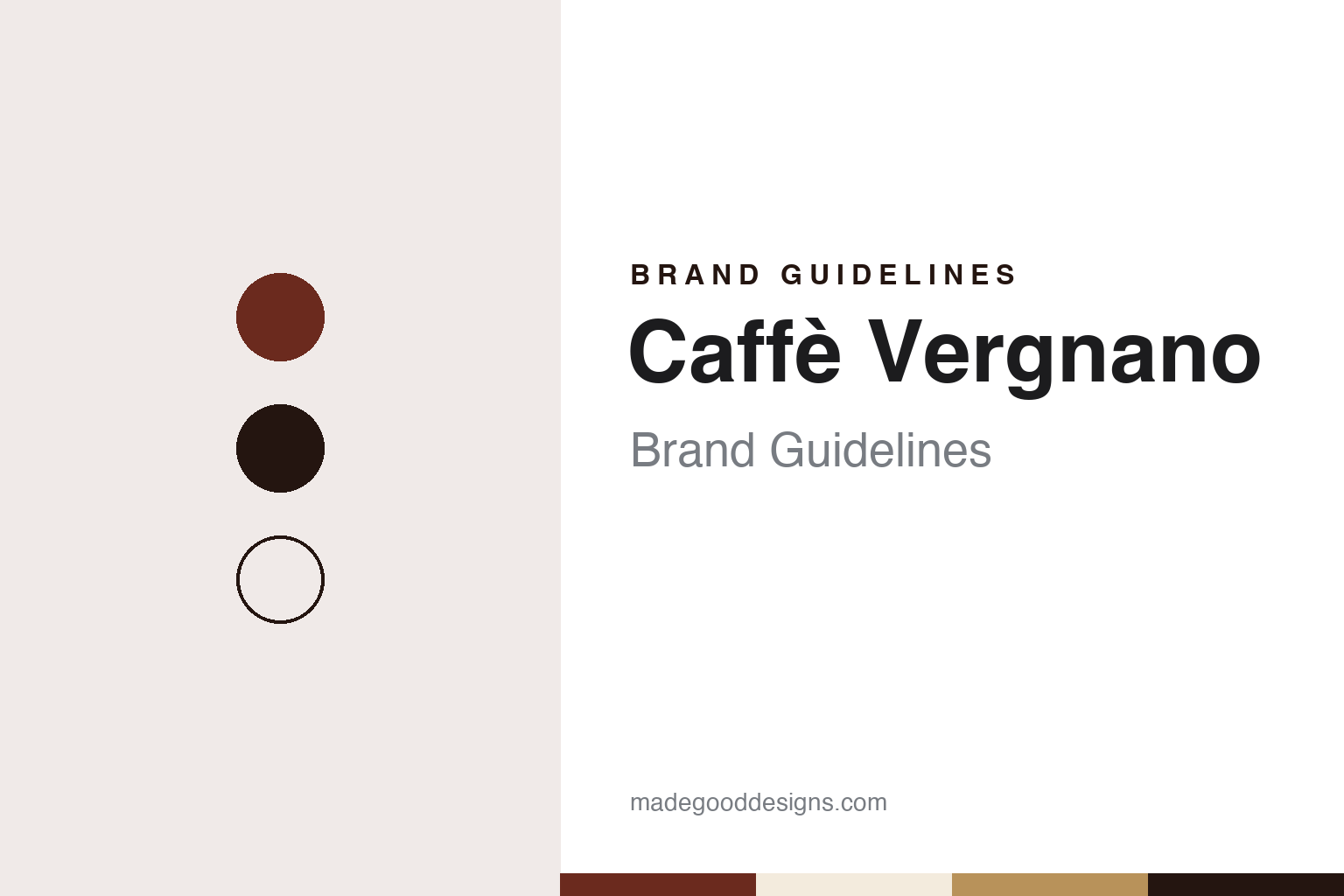
Two constants: a Caffè Vergnano espresso, red and cream palette and an Italian serif register. Abstract homage — not a Caffè Vergnano product or mark; no pack, logo or café sign is reproduced.
A grocery in Chieri
From a shop on the Turin hills to a roastery in Santena.
Caffè Vergnano began as a shop. In 1882, the company says, Domenico Vergnano opened a small grocery in Chieri, a town in the hills east of Turin in Piedmont. Italian Wikipedia says the business grew quickly, opening its first three warehouses in Turin, Alba and Chieri, and that its real leap came in the 1930s, when it bought a coffee farm in Kenya. The company dates that step to 1930, when, it says, Enrico Vergnano travelled to Kenya to learn about coffee at its origin and acquired a plantation there.
The company’s own timeline marks 1955 as the year its logo was unveiled, describing it as the start of an “aesthetic expression” of the company’s values; it does not name a designer. In 1970, it says, Franco and Carlo Vergnano took over and built the production plant at Santena, south-east of Turin, where the company is still based. In 1986 it acquired the historic Casa del Caffè brand for the hotel and restaurant trade — a name that survives in the company’s legal title, Casa del Caffè Vergnano S.p.A. — and in 1996, the company says, it began selling in France and Germany.
Italian Wikipedia describes a plant of 13,500 square metres with 24 automated production lines, and gives the company’s revenue as €64 million in 2013, €75.5 million in 2015 and €82 million in 2017. In 2021 Coca-Cola HBC said Caffè Vergnano had sold about 7,000 tonnes of coffee in more than 90 countries the year before, and referred to the four generations of the family who had built the brand.
Colour
Coffee shops, capsules and a court case.
The brand’s most visible form is its café. In 2000, the company says, the first branded coffee shop, Caffè Vergnano 1882, opened in Chieri, where the business began. Italian Wikipedia says the hundredth opened in Singapore in 2016 and that there were more than 130 by 2017, helped by a partnership with the Eataly food halls that took the brand to cities including Toronto, New York, Chicago, Los Angeles, São Paulo, Istanbul, Seoul and Tokyo. It credits the café format to the architect Roberto Ferrero, with eco-design furniture, untreated wood and imitation-leather seating. From 2016 the company opened cafés in airports — Bari first, then Rome Fiumicino and, in 2018, Munich — and in July 2018 at Rome’s Termini station, Italian Wikipedia says. Today the company’s website counts more than 180 cafés on one page and more than 200 coffee shops in over 45 countries on another; it offers franchise partners a dedicated designer and Italian-made furnishings.
Television made the name familiar at home. The company says that in 2005 it hired the Oscar-winning actor Dustin Hoffman for a campaign in which he played a student learning to make the perfect espresso; Italian Wikipedia adds that the brand sponsored the Giro d’Italia for some years.
Capsules brought a legal fight. The company says it launched, in 2011, the first capsule compatible with Nespresso machines for Italian consumers, stressing that Nespresso is a third-party brand with no connection to it; Italian Wikipedia says the retail capsules were sold as Èspresso1882. In February 2012 Nestlé began urgent proceedings, alleging infringement of three Nespresso patents and of its trademark; in June 2012, Italian Wikipedia says, the court rejected Nestlé’s claims, while requiring Vergnano to remove explicit references to the Nespresso mark. The company says it launched compostable capsules in 2015.
Typography
Design and documentation.
The seven brands in this group all roast or sell coffee, and they come from four countries on two continents: Kicking Horse from Canada, Café du Monde from the United States, Löfbergs, Zoégas and Gevalia from Sweden, and Caffè Vergnano and Hausbrandt from Italy. Coffee brands in general sit at many different points in the trade, from vacuum packs on a supermarket shelf to espresso poured in a café under the roaster’s own sign, and a single company can work at both ends at once.
A coffee brand’s identity is usually carried less by a place of growth than by a blend, a pack and the cup it promises, because the beans inside will have been grown a long way from where the name on the front was roasted. That makes the questions behind each name worth asking plainly: who started it, who owns it now, where its coffee is bought, and where it is actually roasted and packed.
Each guide separates what independent sources record from what the company says about itself — its founding story, its owners over time, where its coffee comes from and where it is roasted — and marks plainly what rests only on the company’s own word.
Aa
An Italian serif — in the spirit of an espresso house. (Specimen set in Bodoni Moda, a serif STAND-IN; NOT the Caffè Vergnano logo.)
Caffè Vergnano
A family company with a bottler as partner.
Caffè Vergnano is no longer wholly family-owned. On 28 June 2021, Coca-Cola HBC, the Swiss-based Coca-Cola bottler, announced that a subsidiary had agreed on 25 June to buy a 30% stake in Casa del Caffè Vergnano S.p.A., with a seat on its board and an exclusive agreement to distribute Vergnano’s products in Coca-Cola HBC’s territories outside Italy; financial terms were not disclosed, and Coca-Cola HBC later announced that the purchase had been completed. At the time Coca-Cola HBC named Franco Vergnano as chief executive and Carlo Vergnano as chairman. The company says governance “remains firmly in the hands of the Vergnano family,” and its website now names Carolina Vergnano as chief executive.
The company says all its production is in Piedmont: two facilities in Santena, for coffee roasting and for capsules, and a site at Valfenera, opened in 2022, for storage, production and logistics. It says it buys green coffee from twelve origins, tastes every sample at Santena and roasts slowly, origin by origin — claims we give as its own. Through the Coca-Cola HBC distribution agreement, the company says, Caffè Vergnano was the official coffee of the Milano Cortina 2026 Winter Olympic and Paralympic Games.
The company says its Women in Coffee project, begun in 2018 from an idea of Carolina Vergnano’s and run with the International Women’s Coffee Alliance, supports women coffee farmers, and it marked its 140th anniversary in 2022 with a book on the family’s history.
For a design guide, Caffè Vergnano shows how a family roaster can carry its founding year — 1882 — from a grocery counter onto its coffee shops and capsules. Compare Lavazza, another Turin roaster, and illy. For this guide we use espresso brown, a roast red and cream with a serif, an unofficial interpretation; no product or logo is reproduced.
Explore & save
Keep Caffè Vergnano’s identity on hand — save it to a board in the Made Good inspiration library.
Caffè Vergnano identity set
Pin the Caffè Vergnano espresso, red and cream palette and the Italian serif register to your own board.