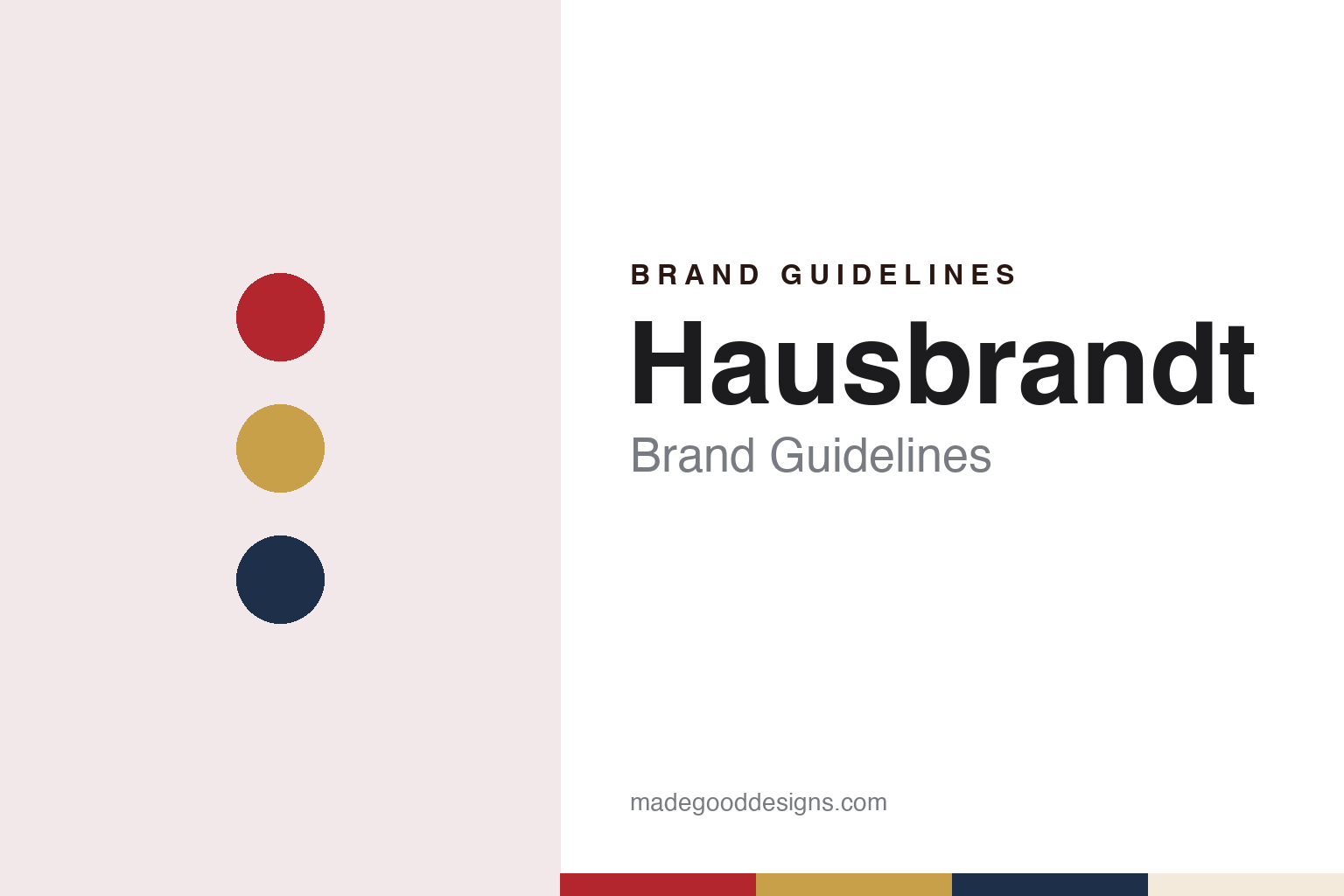
Hausbrandt Brand Guidelines
The Trieste coffee house of 1892, its Belle Époque posters and its smiling Moka.
Aa
Two constants: a Hausbrandt red, gold and Adriatic navy palette and a Liberty serif register. Abstract homage — not a Hausbrandt product or mark; no pack, cup, logo or poster is reproduced.
Hermann Hausbrandt
A sea captain’s coffee business in the port of Trieste.
Hausbrandt began in Trieste in 1892. Its founder, Hermann Hausbrandt, was a former commander in the Austrian merchant navy, according to the company and to Italian Wikipedia, which cites a 2009 history of the family in the Trieste newspaper Il Piccolo. Italian Wikipedia’s biography of his son Roberto says Hermann was born in Danzig in 1863 and was of German origin.
The company tells its early story as one of packaging. It says Hausbrandt was the first business to sell blends already roasted, sealed in metal containers and packed inside its own plant, which it presents as an answer to the problems of transporting and keeping coffee. It also says that a commercial letter of 10 November 1900 introduced a patented roasting system called Grevenbroich, driven by an electric motor and with a cooling system to keep the aroma of fresh-roasted coffee. Those are the company’s own accounts; we found no independent source to check them against.
The business stayed in the founder’s family for decades. The group’s history page says that after Hermann it passed to his eldest son Ermanno, to Ermanno’s brother Robert and to a son-in-law, Federico Dietrich, before it came to the Zanetti family. Roberto Hausbrandt also has a place in another Trieste coffee story: English Wikipedia, citing Fortune, says that in 1933 he and Francesco Illy, as equal partners, founded the company then called Illy & Hausbrandt, which became illy.
Colour
Dudovich, Metlicovitz and the Moka.
Hausbrandt has long built its name through advertising, and it is open about the artists it used. Its history names three poster artists of the Belle Époque who worked for the brand: Marcello Dudovich, Leopoldo Metlicovitz and Pietro Antonio Sencig. The slogan “Specialità Caffè Hausbrandt” was printed on packs and early company vehicles, the company says, and an early poster built around those three words showed a small figure in a turban.
The best-known of the early images are the “vecchietti” or “nonnetti”, an elderly couple sharing a cup of coffee. The company dates its first campaigns of scenes from everyday life to 1910; Italian Wikipedia and the group’s own history credit the elderly couple to Dudovich, the Trieste-born poster artist, and the company calls these images examples of Art Nouveau and the Italian Liberty style. Metlicovitz, also from Trieste, designed a backdrop and sign for Casa Hausbrandt, the brand’s pavilion at the Fiera Campionaria trade fair, in 1926, the company says, the same year it produced its first line of coffee cups carrying the Hausbrandt logo.
The symbol the brand still uses came later. In the 1960s Luciano Biban, a Venice-born graphic artist who worked in Friuli, drew the Moka, a smiling coffee pot that sips its own coffee and says “che piacere un buon caffè” — “what a pleasure, a good coffee.” Italian Wikipedia calls it Hausbrandt’s first animated logo. The company says the Moka was redrawn at the end of the 1980s in a more refined and sober way, “more intense in the colours of red and gold.”
The company lists two design prizes for this work, without dates: a Gold Award from the Brand Design Association of New York for the restyling of the Moka logo, and a gold medal from the Accademia Maestri Pasticceri Italiani for the best Italian espresso cup. For its 130th anniversary in 2022, it says, the Moka was shown climbing out of a stylised cup and exclaiming “Che caffè!”
Typography
Seven roasters, three regions.
The seven brands in this group all roast or sell coffee, and they come from four countries on two continents: Kicking Horse from Canada, Café du Monde from the United States, Löfbergs, Zoégas and Gevalia from Sweden, and Caffè Vergnano and Hausbrandt from Italy. Coffee brands in general sit at many different points in the trade, from vacuum packs on a supermarket shelf to espresso poured in a café under the roaster’s own sign, and a single company can work at both ends at once.
A coffee brand’s identity is usually carried less by a place of growth than by a blend, a pack and the cup it promises, because the beans inside will have been grown a long way from where the name on the front was roasted. That makes the questions behind each name worth asking plainly: who started it, who owns it now, where its coffee is bought, and where it is actually roasted and packed.
Each guide separates what independent sources record from what the company says about itself — its founding story, its owners over time, where its coffee comes from and where it is roasted — and marks plainly what rests only on the company’s own word.
Aa
A high-contrast serif with a poster-era flavour — the register of a Belle Époque coffee house. (Specimen set in Playfair Display, a serif STAND-IN; NOT the Hausbrandt logo or Moka mark.)
Hausbrandt
From Trieste to Nervesa della Battaglia.
The brand now belongs to the Zanetti family of Treviso. Martino Zanetti, a former officer in the Alpini, the Italian army’s mountain troops, chose not to work in the coffee business of his father, Virginio, the company says, and started his own in 1968 by renting a small roastery in the Treviso area. Italian Wikipedia gives a different date and place: it says that in 1970 he bought Silver, a long-established roastery in Conegliano, and moved production to Nervesa della Battaglia; a 2024 company statement published by the trade daily Comunicaffè says he opened his first plant in 1970. Both the company and Italian Wikipedia date his ownership of Hausbrandt to 1988, after a series of acquisitions.
Hausbrandt’s coffee is roasted at Nervesa, not in Trieste. The company says its roasting is concentrated in a single plant there, and the operating company keeps the city and year of its origin in its name: Hausbrandt Trieste 1892 S.p.A., with its head office at Nervesa. In April 2016 Comunicaffè reported that work had begun there on a new logistics centre designed by the architects Pio and Tito Toso, with a warehouse for coffee, beer and wine, and that the company planned to double its roasting capacity to more than 9,000 tonnes of coffee a year.
Around the coffee, Hausbrandt has become a drinks group. In 2000 Martino Zanetti founded the Theresianer brewery at Nervesa, Italian Wikipedia says, named after Trieste’s Borgo Teresiano, where a brewery was founded in 1766; its logo shows the Lanterna, Trieste’s old lighthouse. The group also owns the Col Sandago winery near Conegliano, the Zerocinquanta beers, Theresianer Gin and the Martin des Orsyn champagnes from the Montagne de Reims.
A new generation now leads it. Comunicaffè reported in January 2026 that Arianna Zanetti, Martino’s daughter and chief executive since 2024, had succeeded her father as president. In that interview she said the company exports to more than 90 countries, that coffee makes up nearly 80 per cent of group revenue, and that the group closed 2025 with revenue above €100 million.
For a design guide, Hausbrandt shows how a coffee name can carry a city, a poster tradition and a cheerful mascot through more than a century and a change of owners. Compare illy, the Trieste roaster Roberto Hausbrandt helped found, and Lavazza, another Italian family coffee house built on advertising. For this guide we use Moka red, gold and Adriatic navy with a serif, an unofficial interpretation; no product or logo is reproduced.
Explore & save
Keep Hausbrandt’s identity on hand — save it to a board in the Made Good inspiration library.
Hausbrandt identity set
Pin the Hausbrandt red, gold and Adriatic navy palette and the Liberty serif register to your own board.


