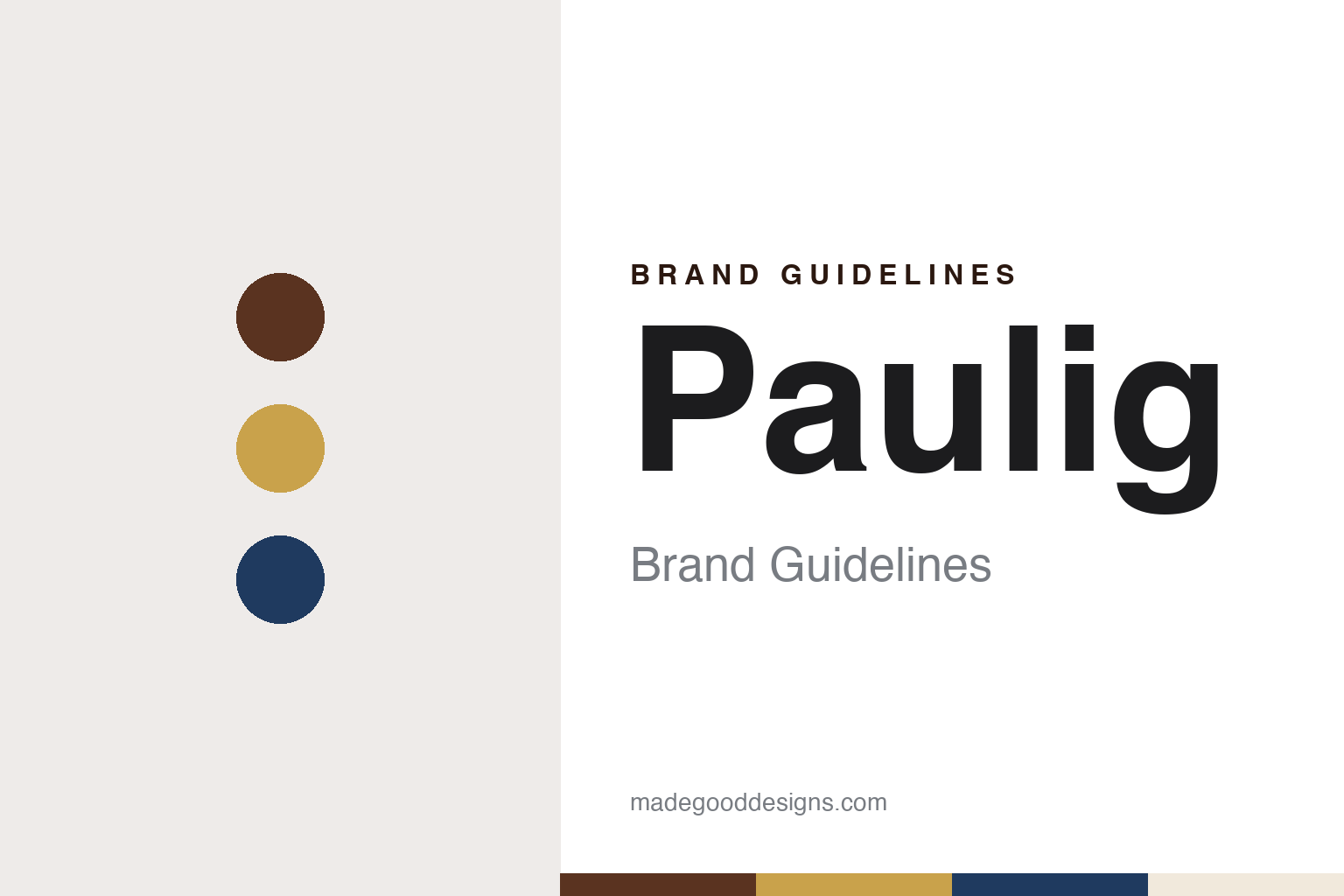
Paulig Brand Guidelines
The Helsinki roaster behind Juhla Mokka, Paula and the golden cup.
Aa
Two constants: a Paulig roast brown, gold and harbour blue palette and a warm serif register. Abstract homage — not a Paulig product or mark; no package, logo or golden cup is reproduced.
Gustav Paulig
A merchant from Lübeck and a trading house in Helsinki.
Paulig began in Helsinki in 1876, when Gustav Paulig, a merchant from Lübeck in Germany, opened a trading house importing coffee, spices, sugar and oils. Finnish Wikipedia says he had come to Finland in 1871 as a clerk at the Nokia company’s groundwood mill, and that the brewery owner Paul Sinebrychoff lent him his starting capital. The company says it imported more than 300,000 kilos of green coffee in its first year; English Wikipedia puts that at around seven per cent of Finland’s coffee imports.
At the time Finns bought their coffee green and roasted it at home. Finnish Wikipedia dates the start of roasting at Paulig’s warehouse on Katajanokka, by Helsinki’s harbour, to 1904, and says roasted coffee first outsold green coffee in Finland only in 1926. The company says Gustav Paulig himself designed a simple trademark built around the letter P in the 1880s; English Wikipedia says the “P” mark was officially registered in 1905.
After Gustav Paulig’s death in 1907 his widow, Bertha Paulig, ran the business until 1919; the company calls her one of Finland’s first female chief executives. Finnish Wikipedia says the firm bought the Nissen café and coffee-shop chain in 1909 and finished a new roastery and office building on Katajanokka in 1911. In 1919 it became a limited company, with her son Eduard Paulig as managing director until 1947. His son Henrik Paulig followed until 1973, and Henrik’s nephew Bertel Paulig then led the company until 2011, according to Finnish Wikipedia.
Colour
Juhla, Presidentti and a girl in national dress.
Roasted coffee went to shops in five- and ten-kilo packs until, Finnish Wikipedia says, a shopkeeper in Åland wrote in 1924 asking for coffee ready-packed in 250- and 500-gram packets; Paulig took up the idea and became the first in Finland to sell coffee in consumer packs. In 1929 it introduced its first branded blends, Juhla and Presidentti, the company says. Presidentti was launched as “Presidentin sekoitus,” the President’s blend, and took its short name in 1994, according to Finnish Wikipedia, which also says that in 1931 Paulig became the first roaster in Europe to print dates on its coffee packets. Between 1939 and 1946, Finnish Wikipedia says, green coffee could not be imported and coffee production stopped.
Juhla is sold today as Juhla Mokka, in light, dark, very dark and organic roasts. Finnish Wikipedia calls it Finland’s most popular coffee brand and records a long-running television campaign in which craftspeople demonstrated their trades — 47 different films between 1979 and 2007, all set to a theme written by the singer and composer Lasse Mårtenson.
The brand also had a face. The company says that in the 1920s a young woman in national dress served coffee at its fair stands, and that in 1926 she became “Paula,” drawn on posters and on 500-gram packages; Finnish Wikipedia says her costume is that of Sääksmäki, in Häme. In 1950, under Henrik Paulig, the first living Paula, Sinikka Kekki of Nurmijärvi, was chosen from 738 candidates; the prize, the company recalled in 2020, was two kilos of real coffee at a time when coffee was still rationed. Later Paulas toured events and gathered consumers’ opinions, the company says, and while the fourth held the post it set up its Paula consumer service. In early 2019, Finnish Wikipedia says, Paulig replaced the Paula girl with a “brand ambassador” whom anyone could apply to be. The company says the name Paula was dropped when Iinaroosa Kanth, “Paulig’s Inkku,” became its 20th Coffee Ambassador, working mainly on social media in clothes by Uhana Design inspired by the Sääksmäki costume.
Typography
Roasted close to home, sold across a region.
The seven brands in this group all roast coffee, and they come from five European countries: Segafredo Zanetti and Kimbo from Italy, Julius Meinl from Austria, Tchibo and Dallmayr from Germany, Douwe Egberts from the Netherlands, and Paulig from Finland. Coffee brands in general sit at many different points in the trade, from vacuum packs on a supermarket shelf to espresso poured in a café under the roaster’s own sign, and a single company can work at both ends at once.
A coffee brand’s identity is usually carried less by a place of growth than by a blend, a pack and the cup it promises, because the beans inside will have been grown a long way from where the name on the front was roasted. That makes the questions behind each name worth asking plainly: who started it, who owns it now, where its coffee is bought, and where it is actually roasted and packed.
Each guide separates what independent sources record from what the company says about itself — its founding story, its owners over time, where its coffee comes from and where it is roasted — and marks plainly what rests only on the company’s own word.
Aa
A warm, high-contrast serif — the register of a long-lived Nordic coffee house. (Specimen set in Fraunces, a serif STAND-IN; NOT the Paulig logo or P mark.)
Paulig
A golden cup from Vuosaari.
In the 1960s roasting moved from Katajanokka to Vuosaari, on Helsinki’s eastern shore. The company says the new roastery opened in 1968 as the largest of its kind in the Nordic region, that President Urho Kekkonen started its first batch of Presidentti, and that from then on every Paulig coffee pack carried a golden cup on the front; Finnish Wikipedia dates the new buildings to 1967. Finnish Wikipedia also says Paulig built a new roastery near Vuosaari harbour, which produced its first coffee in the summer of 2009 and opened officially in January 2010. In 2020 the Vuosaari roastery received CarbonNeutral® building certification; the company says it makes 100 million coffee packs a year there.
Paulig’s coffee is roasted in Finland. The company says its coffees are roasted at Vuosaari and at the Robert Paulig roastery in Porvoo. Finnish Wikipedia says Henrik Paulig’s son Robert set up his own roastery in 1987, and that in 2014 Paulig bought it and its brands, ending a long dispute over his use of the Paulig name. The company also opened a combined roastery and spice factory at Saue, outside Tallinn, in 1993, which Finnish Wikipedia says later concentrated on spices.
The company has documented several changes to its packaging. It says it was the first in Finland, in 1990, to drop the cardboard box around vacuum-packed coffee in favour of a laminate-only pack. In 2022 it announced a €25 million investment in new packing lines at Vuosaari, and from spring 2024 it sold coffees such as Paulig Mundo Original and Café New York in an easy-open, recyclable polypropylene vacuum pack with a white interior, which won a ScanStar award from the Scandinavian Packaging Association that year. For a limited Presidentti Special Blend in 2017, the pack was designed by the Indonesian artist Arif Wicaksono.
The coffee house is now part of a wider food company. Marking its 150th year in January 2026, Paulig said it was still 100 per cent owned by the Paulig family, with revenue of €1.2 billion, about 70 per cent of it from foods such as Tex Mex and spices under brands including Santa Maria, Poco Loco, Zanuy and Conimex.
For a design guide, Paulig shows how a letter, a gold cup and a character in national dress can carry one coffee name through generations of a family. Compare Melitta, the German filter maker whose collaboration helped popularise filter coffee in Finland in the 1950s, English Wikipedia says, and Lavazza, another family coffee house. For this guide we use roast brown, gold and harbour blue with a serif, an unofficial interpretation; no product or logo is reproduced.
Explore & save
Keep Paulig’s identity on hand — save it to a board in the Made Good inspiration library.
Paulig identity set
Pin the Paulig roast brown, gold and harbour blue palette and the warm serif register to your own board.