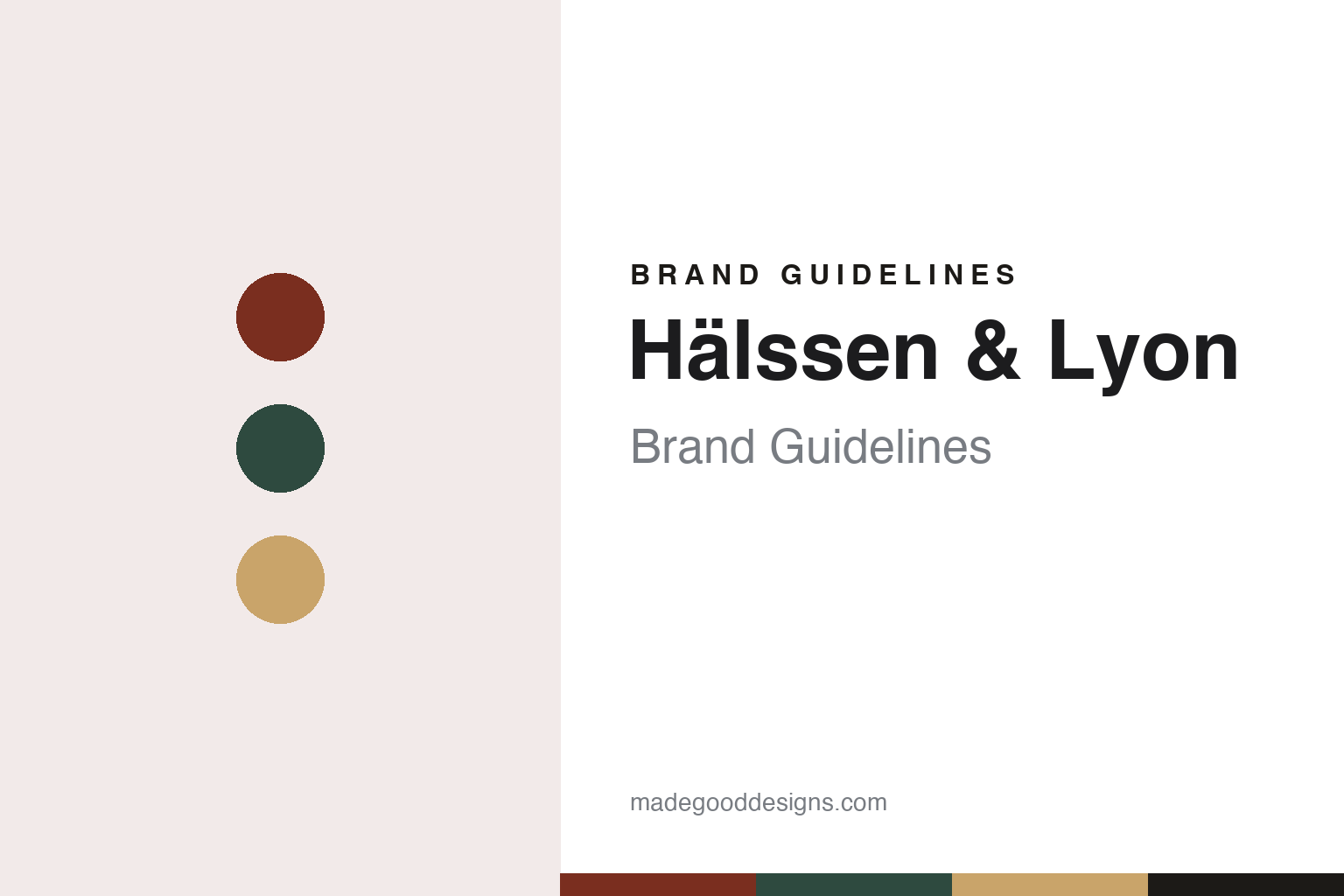
Hälssen & Lyon Brand Guidelines
The Hamburg tea house behind other people’s brands.
Aa
Two constants: a Hälssen & Lyon brick, green and gold palette and a Hanseatic sans register. Abstract homage — not a Hälssen & Lyon product or mark; no package, logo or label is reproduced.
Pickhuben 9
Two merchants and a warehouse on the canal.
Hälssen & Lyon was founded in Hamburg on 1 January 1879, when Alfred Moritz Lyon and Gustav Vincent Hälssen set up a tea-trading business together, according to the company and German Wikipedia. In 1887 it moved into the new Speicherstadt, the brick warehouse district built on the islands of Hamburg’s port, taking space at Pickhuben 9; the company says it was among the district’s first tenants and is now its oldest. That building is still its head office, although, as the company puts it, barges no longer tie up outside and the tea is no longer blended on the warehouse floors.
The firm did not stay with its founders’ families. The company says Johann Carl Ferdinand Ellerbrock joined in 1895 as an authorised officer, became a partner in 1907 and, after Lyon’s death in 1916, its sole owner; German Wikipedia dates the family ownership from 1916. Under his involvement the German tea association, now the Deutscher Tee & Kräutertee Verband, was founded in 1917. His son Carl Ellerbrock joined in 1923 and, the company says, founded a London subsidiary, Hälssen & Lyon Ltd, in 1927, which it says became Britain’s second-largest tea exporter within twelve years, followed in 1928 by bases in Calcutta, Cochin and Colombo.
Ownership has passed down the family since. The company says Olav C. Ellerbrock and Horst-Jürgen Ellerbrock acquired the business from their father in 1968; Olav C. Ellerbrock became honorary consul general of Sri Lanka in 1974 and chaired the German tea association until 1998. German Wikipedia describes Hälssen & Lyon as a family company in its fourth generation, and the company’s timeline records a reorganisation of the shareholding within that generation in 2026, with Olivier Ellerbrock becoming the main shareholder. Its imprint names Christian Meckel, as chairman, and Daniel Nowak as managing directors.
Colour
Trading, blending, flavouring and packing for others.
Hälssen & Lyon is a business-to-business company. German Wikipedia and the company describe it as trading tea and tea-like products such as herbs and fruit, which it also refines, flavours, blends and packs; its customers are tea brands, private-label clients, specialist retailers and wholesalers, the drinks industry and food service. The company says it sources raw materials from tea gardens and suppliers worldwide and offers everything from bulk loose tea to finished retail packs, extracts, instant powders and bottled ready-to-drink tea. Its slogan is “the world of tea under one roof.”
Its history is told as a list of firsts, most of them the company’s own claims. It says that in 1935 it founded Dr. Grethes Coffeinfreier Tee in Hamburg and introduced the world’s first decaffeinated tea, a claim German Wikipedia repeats; that in 1959 it built the first instant-tea factory in a tea-producing country, Sri Lanka; that from 1967 it promoted flavoured teas; that a 1978 joint venture with the Swiss company Haco brought the first decaffeinated tea to America; and that in 1991 it developed a high-pressure carbon-dioxide process for decaffeination. German Wikipedia adds that in 2003 it launched a pyramid tea bag for fine leaf teas.
The tea is handled in Hamburg. German Wikipedia says the raw materials are stored and processed at Hamburg-Allermöhe, where the company moved into a high-bay warehouse and production plant in 1995, the year it bought the tea packer Schmidt & Partner; the company says the warehouse now holds up to 25,000 tonnes of goods and calls it the world’s largest store of tea specialities, while herb and fruit components are kept at a partner site in Thuringia. It has also reached abroad: the company says it bought the Paris tea packer Compagnie Coloniale in 1957 and took a stake in Thé de l’Eléphant of Marseille in 1959, and it lists a North American subsidiary founded in New York in 2005, the bottler tbottlers in 2013 and a stake in a Dubai packer, Gourmet Tea DMCC, in 2015.
Typography
The Hamburg tea trade.
The seven brands in this group all sell tea, and they come from five countries: Taj Mahal Tea and Society Tea from India, Akbar and Mlesna from Sri Lanka, Betjeman & Barton from France, Hälssen & Lyon from Germany, and Nordqvist from Finland. Two of those countries grow tea on a large scale; the other three do not, so the tea sold under a brand from there was grown somewhere else.
That split makes the usual questions sharper. For a brand from a growing country, the label may promise a garden, a region or a national style of tea; for one from a country that grows none, the promise rests on the blend, the flavouring, the shop and the box. In both cases the name on the front and the place where the tea was grown, blended and packed can be several countries apart.
Each guide separates what independent sources record from what the company says about itself — who started it, who owns it now, where its leaf is bought and where its tea is actually blended and packed — and marks plainly what rests only on the company’s own word.
Aa
A plain Hanseatic sans for a trading house. (Specimen set in Inter Tight, a sans STAND-IN; NOT the Hälssen & Lyon logo.)
Hälssen & Lyon
A name most tea drinkers never see.
Hälssen & Lyon’s brand works mainly on other companies. Because it blends and packs for tea brands and private labels, its own name rarely reaches a shop shelf; its North American arm, which the company says now operates from Westport, Connecticut, offers brand owners help with recipes, packaging and design. Its public image is built instead on the Speicherstadt address, the 1879 date and the claim to be “the world of tea under one roof.” In 2010 the Hamburger Abendblatt called Hamburg “Europe’s tea capital” and described Hälssen & Lyon as one of the city’s oldest companies, noting that it had developed a takeaway tea cup to interest younger drinkers.
The company has used art to make the point. In February 2022 the marketing trade site Meedia reported a campaign with the composer and artist Sven Helbig in which one of his violins was largely overgrown, over eight months, by the mycelium of the reishi mushroom, under the theme “transformation and transience”; Hälssen & Lyon offered a limited-edition reishi blend alongside it. The company has also published its own history, a 2004 chronicle by Olav C. Ellerbrock and Pia Schlotfeldt titled Hälssen & Lyon Chronik. Eine Teegeschichte. A Tea History.
It is a large business for one most consumers have not heard of. German Wikipedia, citing the company register, gives turnover of about €151 million and almost 500 employees for the 2024–25 financial year, up from €145 million and 470 staff in 2021–22. The company calls itself one of Europe’s leading tea companies; it marked its 145th anniversary in 2024, and in 2018 converted old storage floors in the Pickhuben building into offices.
For a design guide, Hälssen & Lyon shows how a supplier brand can rest on an address and a founding date rather than a package. Compare Ronnefeldt and Teekanne, two German tea houses that sell under their own names. For this guide we use warehouse brick, harbour green and tea gold with a sans, an unofficial interpretation; no product or logo is reproduced.
Explore & save
Keep Hälssen & Lyon’s identity on hand — save it to a board in the Made Good inspiration library.
Hälssen & Lyon identity set
Pin the Hälssen & Lyon brick, green and gold palette and the Hanseatic sans register to your own board.