Guylian Brand Guidelines
The Sint-Niklaas chocolatier that turned a seaside souvenir into a marbled shell.
Aa
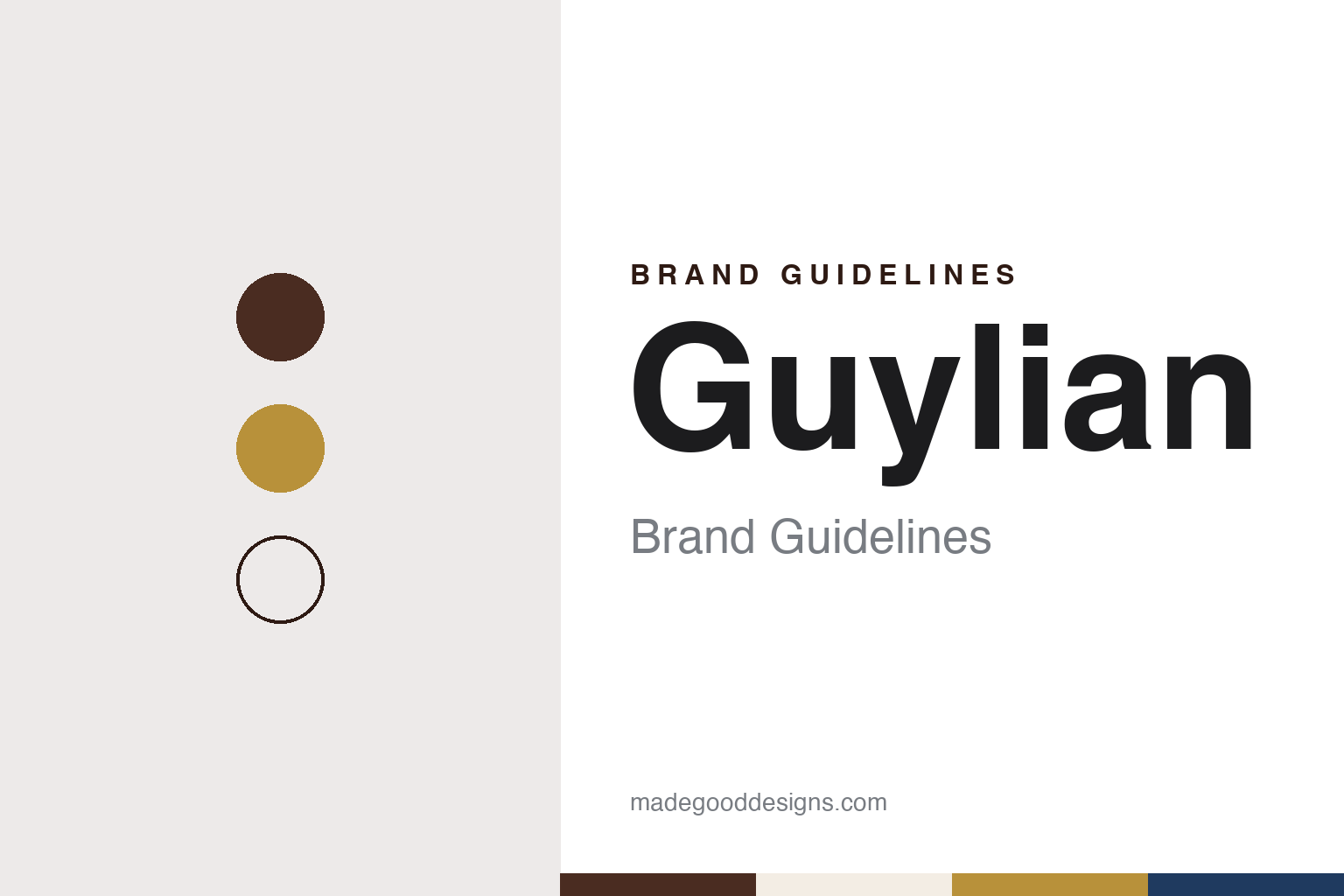
Two constants: a Guylian marbled brown, gold and sea blue palette and a romantic serif register. Abstract homage — not a Guylian product or mark; no chocolate, box, logo or G stamp is reproduced.
Guy and Liliane
A Sint-Niklaas chocolatier and a name made from two.
Guylian comes from Sint-Niklaas, in the Waasland district of East Flanders between Antwerp and Ghent. Its founder, Guy Foubert, was born there in 1938, the company says, and English Wikipedia, citing a 2017 profile in Duty-Free News International, describes him as a baker’s son who sold hand-made truffles at local markets while still at school, using skills learned at a school of confectionery and pâtisserie in Antwerp.
The name joins two first names. The company says that when Guy married Liliane in 1958, the couple combined their names into “Chocolaterie Guy-Lian”; English and Dutch Wikipedia both give 1958 as the founding year, while English Wikipedia, citing a 2017 MarketLine company profile, dates the establishment of the Guylian brand name to 1960.
The product that made the name came from the coast. The company says the idea for chocolate seashells came in 1967, after a holiday on the Belgian seaside, as a chocolate souvenir, and that Liliane was involved in the design, and in the marbling in white, milk and dark chocolate, of the 11 moulds. English Wikipedia’s account places the start of larger-scale seashell production earlier, around the 1958 founding, so the two versions differ on the date.
The company grew in its home town. A new factory was built in Sint-Niklaas in 1988, according to the MarketLine profile cited by English Wikipedia, and in 1998, the Moodie Davitt Report recalled in 2019, the then Crown Prince Philippe presented Guylian with a Belgian export award. When it was sold in 2008 the company was still family-owned and its chocolates were sold in more than 100 countries, the same trade title reported at the time.
Colour
Seashells, a seahorse and a G.
Guylian’s identity is built on a shape rather than a wrapper. Its signature product is the Sea Shells assortment: pralines moulded as shells and sea creatures in marbled white, milk and dark chocolate around a roasted hazelnut praliné filling. The marbling is the visual signature; Guylian’s Steven Candries, quoted by Duty-Free News International in 2017, described the white and dark chocolate as “intertwining like the lives of the two lovers.”
Two smaller marks recur. Every Sea Shell carries a “G” stamp, which Candries called, in the same article, “our quality signature and the mark of an artist,” and a seahorse serves as the company’s emblem — one whose chocolate tail, English Wikipedia notes, curls the opposite way to a real seahorse’s.
The seahorse also ties the brand to conservation. Since 1998 Guylian has supported Project Seahorse, the marine-conservation group based in Vancouver and London; Project Seahorse said in October 2019, when Guylian received a corporate-social-responsibility award from the Tax Free World Association in Cannes, that the support had lasted 20 years. The partnership has included a biennial Guylian Seahorses of the World photography competition, whose seventh edition Project Seahorse announced in 2018, and a conservation message printed on the back of the boxes, English Wikipedia says.
The brand has also used scale as publicity. In March 2005, a Business Wire release reported, 26 Guylian chocolatiers built what Guinness World Records recognised as the largest chocolate Easter egg sculpture, 8.32 metres tall, on the renovated market square of Sint-Niklaas; Dutch Wikipedia adds that it was auctioned for disadvantaged children in Congo. In 2003 Guylian opened a Belgian Chocolate Café in Antwerp, and from 2008 it took the café idea abroad, first to Sydney and later to Abu Dhabi and Dubai, according to the Sydney Morning Herald and trade press cited by English Wikipedia.
Typography
Belgian chocolate and its owners.
The seven brands in this group are all Belgian: Neuhaus, Leonidas, Godiva, Côte d’Or, Guylian, Galler and Wittamer. Together they show how wide the phrase “Belgian chocolate” has become, from a filled praline chosen piece by piece over a shop counter to a bar or a box sold in supermarkets and airport shops around the world.
The praline — in Belgium, a shell of chocolate around a filling such as ganache, nut paste or cream — is the country’s signature, and the ballotin, the small card box it is packed into, is part of the same ritual. At one end of the trade are names that grew into large groups, with factories, franchise shops and global distribution, and whose identity has to work on a shelf as well as in a window. At the other are pâtissier-chocolatiers on squares such as the Grand Sablon in Brussels, where the name rests on one address, a workshop nearby and a long local history.
Each guide separates what independent sources record from what the company says about itself — who founded it, who owns it now and where its chocolate is made — and marks plainly what rests only on the company’s own word.
Aa
A romantic serif — for a name made from two first names. (Specimen set in Playfair Display, a serif STAND-IN; NOT the Guylian logo.)
Guylian
A Belgian maker with a Korean parent.
The family sold the company in June 2008. Lotte Confectionery, the listed confectionery arm of South Korea’s Lotte Group, bought all of Chocolaterie Guylian NV and its subsidiaries for €105 million, the Moodie Davitt Report reported on 22 June 2008 — US$164 million in a Reuters headline the next day, and €106 million in De Tijd. The trade report said existing management would stay and that Lotte would invest in the brand; Lotte wanted a way into the European premium chocolate market and to grow Guylian in Asia, English Wikipedia says, and a Guylian café later opened in a Lotte department store in Seoul.
The parent has since changed its own name. Lotte Confectionery merged with Lotte Foods in 2022 and was renamed Lotte Wellfood in 2023, the news agency Yonhap reported, and Lotte Wellfood lists Belgium among the eight countries where it has overseas subsidiaries. It is Guylian’s owner in all the sources we checked.
Production stayed in Sint-Niklaas. Lotte financed new capacity there in 2016 — about €6.8 million, RetailDetail reported, putting 2015 turnover at €80 million — and ConfectioneryNews and just-food reported the investment as a boost to production in Belgium. The company says today that all Guylian chocolate is produced in Sint-Niklaas, up to 75 tons a day, and that it switched to 100% Fairtrade cocoa in all its products in 2022; those are its claims.
For a design guide, Guylian shows how a shape, a marbling pattern and a small stamped letter can carry a brand through a change of ownership and into more than a hundred markets. Compare Godiva, another Belgian chocolate name now owned abroad, and Côte d’Or. For this guide we use marbled browns, a gold and a sea blue with a serif, an unofficial interpretation; no product or logo is reproduced.
Explore & save
Keep Guylian’s identity on hand — save it to a board in the Made Good inspiration library.
Guylian identity set
Pin the Guylian marbled brown, gold and sea blue palette and the romantic serif register to your own board.