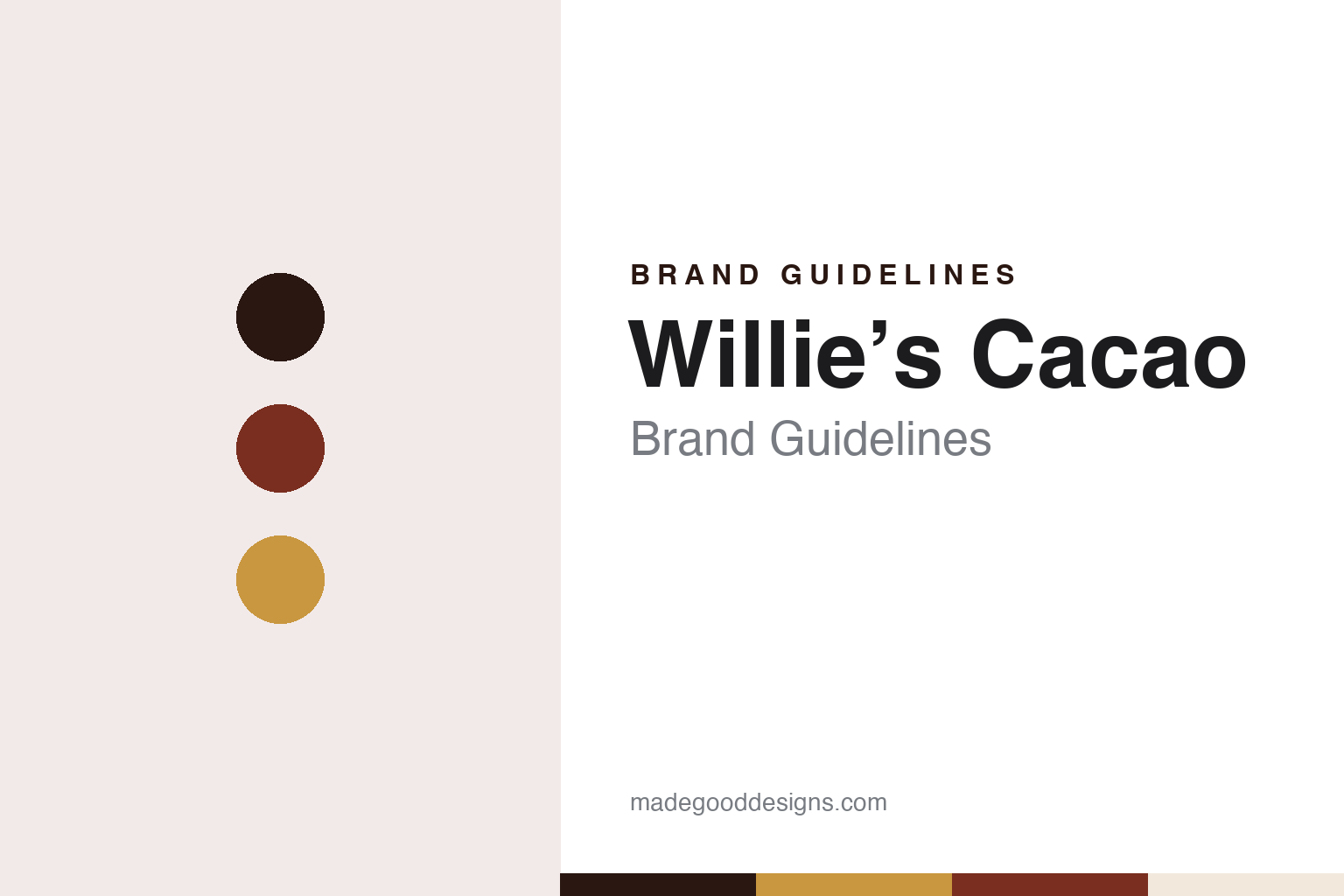
Willie’s Cacao Brand Guidelines
A Venezuelan cacao farm and a Devon bean-to-bar factory.
Aa
Two constants: a Willie’s Cacao pod, nib and cane-sugar palette and an adventurer’s display serif register. Abstract homage — not a Willie’s Cacao product or mark; no bar, cylinder, logo or photograph is reproduced.
From the cloud forest
A cacao farmer first, a chocolate maker second.
Willie’s Cacao is a bean-to-bar chocolate business in the south-west of England, and its name is its founder’s. Willie Harcourt-Cooze came to chocolate through a farm rather than a kitchen. English Wikipedia, citing The Sunday Times, says that in 1993, while travelling in Venezuela, he was directed by a man renting beach umbrellas to a cocoa farm for sale in the cloud forest of the Henri Pittier National Park, near Choroní. The farm was Hacienda El Tesoro. Great British Chefs, which visited him in 2018, reported that buying it took more than two years; the company says he has been growing cocoa there since 1996, and that the farm’s beans are Criollo.
Wikipedia says he moved to Venezuela, planted cacao, ran an eco-tourism business on the estate and, from 1998, made 100% cacao bars for local people in moulds cut from a clay pipe, a detail it takes from a 2009 Packaging News report. The company tells the turning point as a cup of hot chocolate: cacao from the farm, water and raw cane sugar, drunk on the mountainside, which it says showed him how far ordinary chocolate had drifted from the bean. It describes its founder as “a cacao farmer first, and an artisan chocolate maker second.”
In 2007 he returned to Britain to make chocolate himself. Wikipedia says production began that year in Uffculme, Devon, filmed by Channel 4; the company’s own account dates the factory to 2008 and calls it the first bean-to-bar chocolate factory in Britain “for hundreds of years,” which we give as its own description. Both dates appear in the sources, and we record both.
The business is still in its founder’s hands. Companies House shows that the trading company was incorporated in 2002 under the name El Tesoro Limited, after the farm, and took the name Willies Cacao Limited in December 2011. It lists Harcourt-Cooze as a director since incorporation and as the person with significant control, holding 75% or more of the shares and voting rights. In the sources we checked there is no sale, merger or outside parent company.
Colour
Old machines, slow chocolate.
The television came first in the public’s mind. In 2008 Channel 4 broadcast Willie’s Wonky Chocolate Factory, a fly-on-the-wall series that followed his attempt to grow, import and make his own chocolate, and Wikipedia lists a Christmas special the same year. A second series, Willie’s Chocolate Revolution: Raising the Bar, aired in April 2009 and followed his attempt to put a high-cacao dark bar on British shelves. Great British Chefs reported that he believes the first series is what got his products into twenty-five Waitrose stores when he was starting out; Waitrose and Ocado are still among the UK stockists the company names, alongside farm shops and delicatessens in Australia, Germany, Ireland and elsewhere. Open Library lists two cookbooks published by Hodder & Stoughton, Willie’s Chocolate Factory Cookbook and Willie’s Chocolate Bible.
The factory runs on old equipment. Lacking the money for new machines, Great British Chefs reported, Harcourt-Cooze spent years buying antique grinders, ball roasters and longitudinal conching tanks and rebuilding them himself, among them conches from the 1880s found in Menorca and a roaster bought from a bakery in France. The company says it roasts in a ball roaster almost a hundred years old, made by Victor Gruber of Bilbao, and in a 1940s Bath Sirocco; grinds its 100% cacao in a stone mill and conches it in century-old tanks with granite rollers; and conches its sweet chocolate for three weeks or more at low temperatures, where industrial chocolate takes a few hours.
The recipe is kept short on purpose. The company says its dark chocolate contains only cacao, raw cane sugar and cocoa butter, with no soya lecithin and no vanilla, which it argues mask the flavour of the bean, and that it roasts its own nuts and makes its own caramel. It says it buys beans directly from growers and never pays less than $500 a tonne over the world cocoa price.
Typography
Heritage names and new makers.
The seven brands in this group all make or sell chocolate, and they come from two countries: Fry’s, Rowntree’s, Terry’s, Paul A. Young and Willie’s Cacao from England, and Lily O’Brien’s and Butlers from Ireland. Together they span most of the history of chocolate on these islands, from names that were household words long before the modern supermarket to makers who started within living memory.
Some of the oldest names in British chocolate grew out of Quaker family firms, and several of them now belong to multinational groups, so the name on the wrapper and the company behind it can tell two different stories. Ireland has its own tradition of chocolatiers, whose boxes and bars carry an Irish identity to shoppers at home and abroad. And a newer generation of makers has grown up in London shops and Devon workshops, where the founder’s own name and story often do the work a corporate logo would do elsewhere.
Each guide separates what independent sources record from what the company says about itself — who founded it, who owns it now, where its cocoa comes from and where its chocolate is made today — and marks plainly what rests only on the company’s own word.
Aa
An adventurer’s display serif — cloud forest, hessian sacks and antique machines. (Specimen set in Playfair Display, a serif STAND-IN; NOT the Willie’s Cacao logo.)
Willie’s Cacao
Single estate, not single origin.
Willie’s Cacao sells its beans by place. It calls them single estate cacaos rather than single origin, saying that naming only a country is “as useful as saying wine from France,” and that each estate’s beans are grown by groups of smallholders under shade trees. It names its first three cacaos as Rio Caribe and Carenero Superior, Trinitario beans from Venezuela, and Chulucanas, a pale Criollo from Piura in Peru grown by the Norandino co-operative. Its range runs from single-estate dark bars and 100% cacao, which it sells in cylinders for cooking, to milk and white chocolate, hot chocolate, truffles and a no-added-sugar line sweetened with fruit and nuts.
One fact is new in 2026. Companies House shows that in June 2026 the company moved its registered office from Uffculme to a farm near Leominster, in Herefordshire, and the website now gives that farm as its contact address, while its factory pages still describe the chocolate being made in Uffculme. The sources we checked do not say whether production has moved, so we record the change of address and no more.
For a design guide, Willie’s Cacao shows how a founder’s own story can be the brand: a farm in the Venezuelan cloud forest, a television series and a shed of antique machines carry more weight than any wordmark, and the name of the estate on each bar does the rest. Compare Pump Street, a Suffolk bakery that became a bean-to-bar maker, and Montezuma’s, another independent English chocolate maker. For this guide we use cacao-pod red, roasted nib and cane-sugar gold with a display serif, an unofficial interpretation; no product or logo is reproduced.
Explore & save
Keep Willie’s Cacao’s identity on hand — save it to a board in the Made Good inspiration library.
Willie’s Cacao identity set
Pin the Willie’s Cacao pod, nib and cane-sugar palette and the adventurer’s display serif register to your own board.