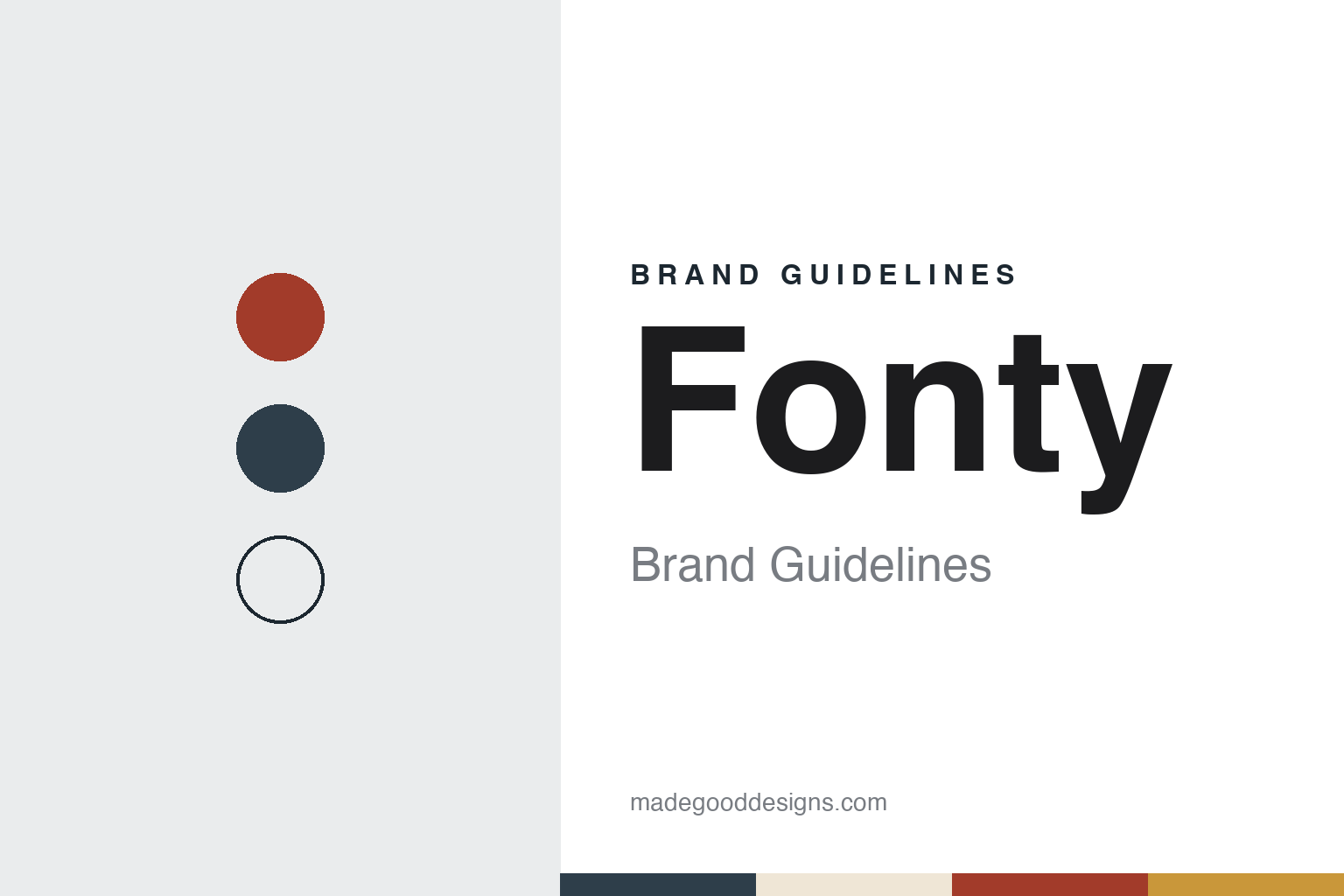
Fonty Brand Guidelines
A riverside wool mill in the Creuse, still spinning and dyeing its own yarn.
Aa
Two constants: a slate, écru and madder red palette and a heritage serif register. Abstract homage — not a Fonty product or mark; no yarn, label or logo is reproduced.
A mill on the Cher
From a riverside flour mill to a family spinner.
Fonty is the brand of a working wool mill: a spinning and dyeing works at Rougnat, a small commune in the east of the Creuse, in France’s Nouvelle-Aquitaine region, close to the border with the Puy-de-Dôme. The company calls itself “la Filature de Rougnat” and dates itself to 1880. On its website it says it was created that year “sur les rives du Cher,” a few kilometres from the river’s source in the Combrailles, and that it is one of the last wool spinning and yarn dyeing manufactures still at work in France.
The fullest public account of the mill’s early history is in French Wikipedia’s article on Rougnat. At the time of the Revolution, it says, the commune had four water mills on the Cher grinding flour or hemp, one of them the Moulin Neuf, run by Jacques Gorsse. In 1880 his son, Pierre Gorsse, turned the mill into a carding and spinning works, and in 1896 Pierre’s son Alexandre took it over. Its trade was simple and local: collecting raw wool from the farmers who raised the sheep and returning it to them as spun yarn.
The name on today’s labels arrived by marriage. According to the same article, Alexandre Gorsse’s daughter married Émile Fonty, a farmer’s son from neighbouring Arfeuille, and the mill later passed to their son, Jean Fonty. He widened its market beyond the farms of the district, selling spun wool to travelling market traders, haberdashers and hosiery makers. When his son Jacques Fonty succeeded him in 1962, the article says, the mill employed only five or six people.
Colour
Growth, a carpet group and a new company.
Under Jacques Fonty the business grew. French Wikipedia says the mill diversified, put up new workshops and, above all, began exporting, to the rest of Europe, the United States and Japan, and that by the end of the 1970s it employed about forty people. The family stayed in charge until 1997, when, the article says, the company was sold to the De Poortere-Balsan group. Balsan is the Châteauroux carpet maker that French Wikipedia’s own article on it describes as owned from 1987 by the Belgian group Louis de Poortere, which filed for bankruptcy in August 2000.
The next decade is visible in France’s official business notices. The BODACC, the bulletin of legal announcements, records collective insolvency proceedings against the old company, SARL Filatures Fonty, before the commercial court at Châteauroux, with a statement of creditors’ claims filed in November 2007. On 10 September 2014 the court closed the company’s judicial liquidation for insufficient assets. By then the mill had a new owner. The French business register lists the present operating company, Filature de Rougnat, as created in December 2006, and French Wikipedia says that in 2006, with 24 staff, the mill was taken over by four French textile shareholders, who refocused it on hand-knitting yarn.
The mill changed hands again in spring 2017, when it was bought by Benoît de Larouzière, a former strategy consultant, according to French Wikipedia, which cites a 2025 report in L’Humanité Magazine; the article puts the workforce at about twenty. The register gives Filature de Rougnat a headcount in the 20-to-49 band and shows it as active, filing accounts as recently as 2025. The company says it was first awarded the state’s Entreprise du Patrimoine Vivant label, for firms with rare craft skills, in 2017; the government’s list of current holders records its label as running from November 2023 to November 2028.
Typography
Seven countries, seven ways to make yarn.
The seven brands in this group all sell yarn for hand knitting and crochet, and they come from seven countries: Purl Soho from the United States, Dale Garn from Norway, Schoppel from Germany, Puppy from Japan, King Cole from the United Kingdom, Mirasol from Peru and Fonty from France. What links them is less a fibre or a price point than the question of who actually stands behind the label on the ball.
Some yarn brands begin as shops, where a retailer’s taste in colour and pattern becomes a house range that others then spin to order. Some are spinners first, mills whose brand name is simply the name over the factory door, and whose shade cards grew out of what their machines and dye houses could make. Others are built around a social purpose, using the sale of yarn to fund work, training or schooling in the places where the fibre is grown and the yarn is made. Many sit somewhere between these models, and some have moved from one to another as owners changed.
Each guide separates what independent sources record from what the company says about itself — who founded it, who owns it now and where its yarn is made — and marks plainly what rests only on the company’s own word.
Aa
A bookish, traditional serif — the register of a centenary mill and its printed shade cards. (Specimen set in Libre Caslon Text, a serif STAND-IN; NOT the Fonty logo.)
Fonty
Spun, dyed and labelled under one roof.
What sets Fonty apart in the knitting aisle is that the brand and the factory are the same thing. The company says its collection runs to more than sixty base yarns in natural fibres, each offered in twenty to 120 colours, all “filés et teints par les équipes de la manufacture.” Its list of materials is long, with merino above all, alongside alpaca, mohair, French angora, silk, cashmere, Normandy linen and cotton, and it says that fleeces come from local and regional farms but more often from elsewhere in France, from Europe, Central Asia and the wool-growing countries of the southern hemisphere, before being processed into carded or combed yarn in the Creuse.
The company describes the whole chain on its own site. Raw fibre is washed, sorted, blended and carded on two carding lines, then spun, twisted, skeined, dyed, dried and wound into cones, skeins or balls on machinery it dates to the 1950s to 1980s. Its dyers, it says, have built a library of several hundred thousand recorded shades. The house collection is only one of four businesses it names: it also spins and dyes to order for knitwear makers, weavers and other yarn brands, makes yarn for tapestry, weaving and embroidery workshops, including the tapestry weavers of nearby Aubusson, and turns farmers’ own fleeces into dyed yarn they can sell at the farm. The mill is a member of Lainamac, an association promoting wool from the Massif Central, and opens its doors for guided visits, open days and a factory shop.
For a design guide, Fonty shows how a yarn brand can be built from a place and a process rather than a campaign: a mill name, a river and a shade card stand in for an advertising identity. Compare Plassard, another French yarn house with 19th-century roots, and Bergère de France, a French spinning mill that also survived a change of owners. For this guide we use a Combrailles slate, an undyed écru and a madder red with a serif, an unofficial interpretation; no product or logo is reproduced.
Explore & save
Keep Fonty’s identity on hand — save it to a board in the Made Good inspiration library.
Fonty identity set
Pin the slate, écru and madder red palette and the heritage serif register to your own board.