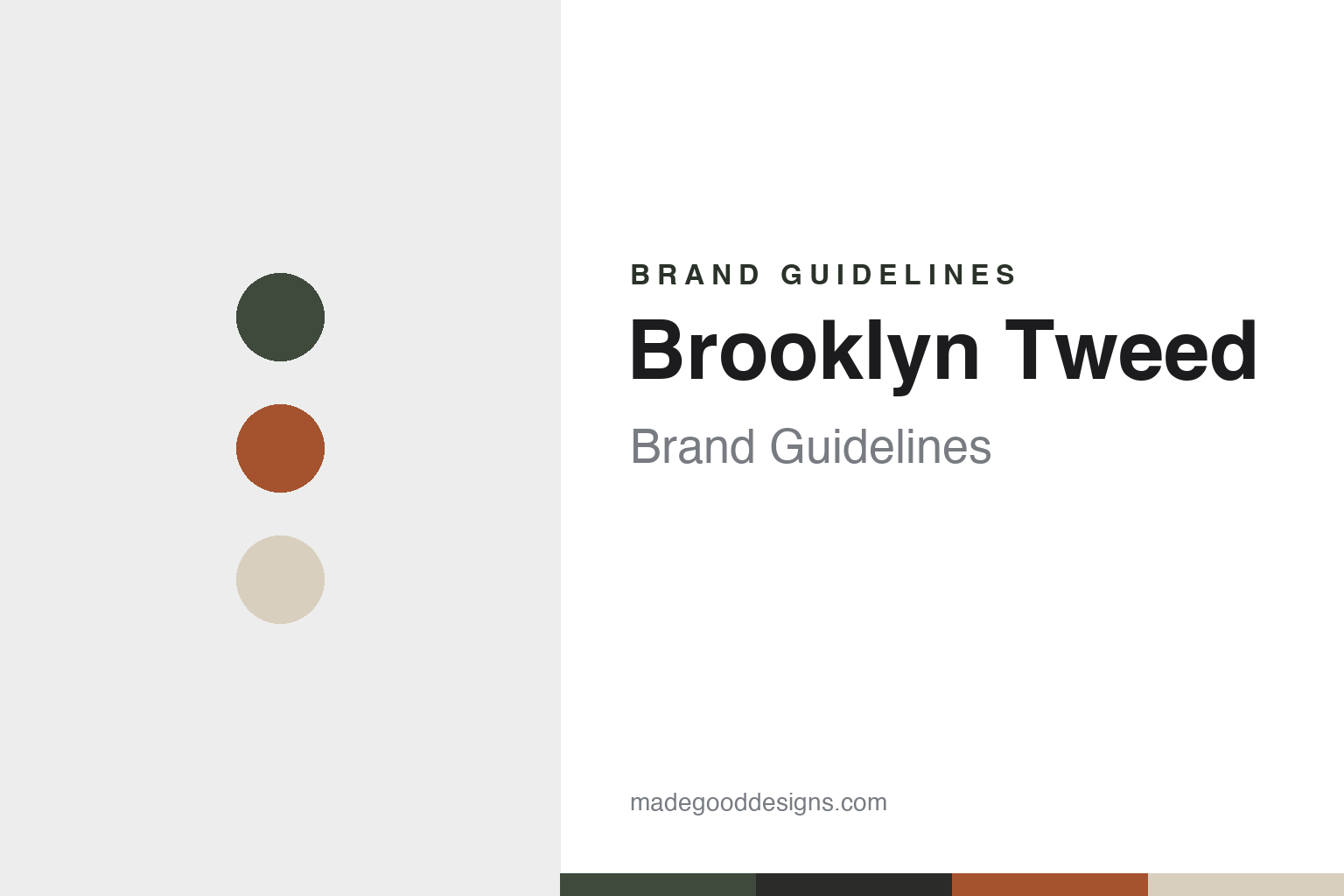
Brooklyn Tweed Brand Guidelines
The American-wool yarn maker that went pattern-only.
Aa
Two constants: a Brooklyn Tweed spruce, charcoal and rust palette and a Clean sans register. Abstract homage — not a Brooklyn Tweed product or mark; no skein, pattern or logo is reproduced.
From blog to yarn
A designer’s blog and a worsted-weight tweed.
Brooklyn Tweed began as a blog. The company says Jared Flood, a knitwear designer and photographer, started it as a knitting blog in 2005, and that five years later, while he was living in New York City, he expanded it into a yarn and pattern company “with the goal of bringing awareness to a rapidly disappearing US textile industry.” It kept the Brooklyn name when it later moved across the country.
Its first yarn, Shelter, came out in 2010. The company’s 2025 brand book says it was released at nine hand-selected shops in the United States; it was a worsted-weight, woolen-spun yarn of Targhee-Columbia wool from Wyoming. Loft, a finer yarn in the same wool, followed in 2011, and the company says it went on to release fifteen more yarns after Shelter, from Quarry in 2015 to Imbue Sport in 2024. By the time of the brand book it counted more than 100 shops worldwide among its stockists.
Flood moved the company from New York to his native Pacific Northwest in 2015, and Brooklyn Tweed now gives its home as Portland, Oregon. Its brand book names him as founder, co-owner and creative director, and Luigi Boccia as co-owner responsible for business development; the two signed the company’s 2025 announcement as its “Founders/Co-Owners.” The book describes Flood as part of a new generation of independent knitwear designers who used their own photography, digital publishing, online distribution and social media to build a direct relationship with knitters.
Colour
Named breeds, named states, named mills.
Brooklyn Tweed’s yarns were built around one promise: that they were designed, sourced, dyed and spun “100% within the USA,” in the company’s words. It chose wool from particular breeds — Columbia, Merino, Rambouillet, Targhee and Targhee-Columbia — which it says suit the ranges of the American West, and named the states its wool came from: Wyoming above all, with Montana, South Dakota, Colorado, Nevada and Utah. Dapple, launched in 2020, blended Merino with organic cotton from a Texas growers’ cooperative.
Unusually, the company published its supply chain. Its brand book says it shares “a map with all the names of our supply chain partners,” treating as a shared resource what most firms consider proprietary. By that account, wool for its woolen-spun yarns was scoured in San Angelo, Texas, then carded and spun in Harrisville, New Hampshire, and Two Rivers, Wisconsin — the map names Harrisville Designs and Crescent Woolen Mills — while wool for its worsted-spun yarns was scoured and combed into top at Jamestown, South Carolina, where the map names Chargeurs, and spun at historic mills in Springvale, Maine, and Nazareth, Pennsylvania. Dye works in Philadelphia and in Saco, Maine, also appear on the map. These are the company’s own statements; we did not confirm each partnership independently.
Harrisville has a long wool history of its own. English Wikipedia says the town has had a woolen mill since 1794, that its Cheshire Mills buildings are protected within a National Historic Landmark district, and that Harrisville Designs was launched in 1971 by John Colony after his family’s Cheshire Mills business closed. Brooklyn Tweed also made limited Ranch yarns from the wool of a single named ranch — Bare Ranch in California, Forbes Ranch in Wyoming and Campbell-Hansmire Ranch in Colorado — and later sold undyed yarn bases to independent dyers, noting that it had “seen manufacturing pressures rise and long-time production partners close.”
Typography
Design and documentation.
The seven brands in this group all sell yarn for hand knitting and crochet, and they come from seven countries: Sirdar from the United Kingdom, Lana Grossa from Germany, Ístex from Iceland, Manos del Uruguay from Uruguay, Brooklyn Tweed from the United States, Filatura di Crosa from Italy and Hjertegarn from Denmark. What sets them apart is less the colour card than the question behind every ball: where the wool comes from, and who spins it.
The answers differ widely. Some yarn is washed and spun by a national wool processor that takes in a country’s own fleece; some is made by artisan cooperatives, where the people who dye and twist the fibre share in the business; some comes out of an old spinning district, where generations of mills grew up beside the same rivers; and some is sold by brands that design the yarn and its colours but commission mills to make it. Each route leaves its mark on a brand’s name, its labels and the way it talks about wool.
Each guide also separates what independent sources record from what the company says about itself — who founded it, who owns it now and where its yarn is made — and marks plainly what rests only on the company’s own word.
Aa
A clean sans — patterns for knitters by knitters. (Specimen set in Jost, a sans STAND-IN; NOT the Brooklyn Tweed logo.)
Brooklyn Tweed
Fifteen years of yarn, then patterns.
The yarn chapter has closed. On 18 April 2025 Flood announced on the company blog that, beginning in June 2025, Brooklyn Tweed would “return to its roots as a pattern-only design company, transitioning out of yarn manufacturing.” The decision, he wrote, was not “driven by any lack of viability” but by the founders’ wish to follow their own creative paths. The company’s yarn page now sums up the period as “2010–2025: 15 years of great American wool” and says the yarns are no longer available.
What remains is the pattern library. Brooklyn Tweed says it has published more than 800 patterns with more than 140 designers, and its website is now a pattern store, with Flood’s own designs — the Timberline cardigan among them — and a beginners’ line called BT by Brooklyn Tweed. It has also published books: Woolens (2016), Capsule collections by Olga Buraya-Kefelian (2015) and Michele Wang (2017), and Brooklyn Tweed’s Knit & Crochet Blankets (2024), published by Abrams. Much of its reputation rests on photography: the company says Flood’s images are often credited for their “painterly sensibility,” and its site signs off with the line “Precision in Every Pattern. Beauty in Every Detail.”
For a design guide, Brooklyn Tweed shows how a brand can be built on provenance — named breeds, named states, named mills — and then outlive the product that carried that story. Compare Cascade Yarns, another Pacific Northwest yarn company, and Jamieson’s of Shetland, which spins native Shetland wool at its own mill. For this guide we use a spruce green, a charcoal and a rust with a sans, an unofficial interpretation; no product or logo is reproduced.
Explore & save
Keep Brooklyn Tweed’s identity on hand — save it to a board in the Made Good inspiration library.
Brooklyn Tweed identity set
Pin the Brooklyn Tweed spruce, charcoal and rust palette and the Clean sans register to your own board.