Opal Brand Guidelines
The Swabian sock yarn that prints its patterns onto the running thread.
Aa
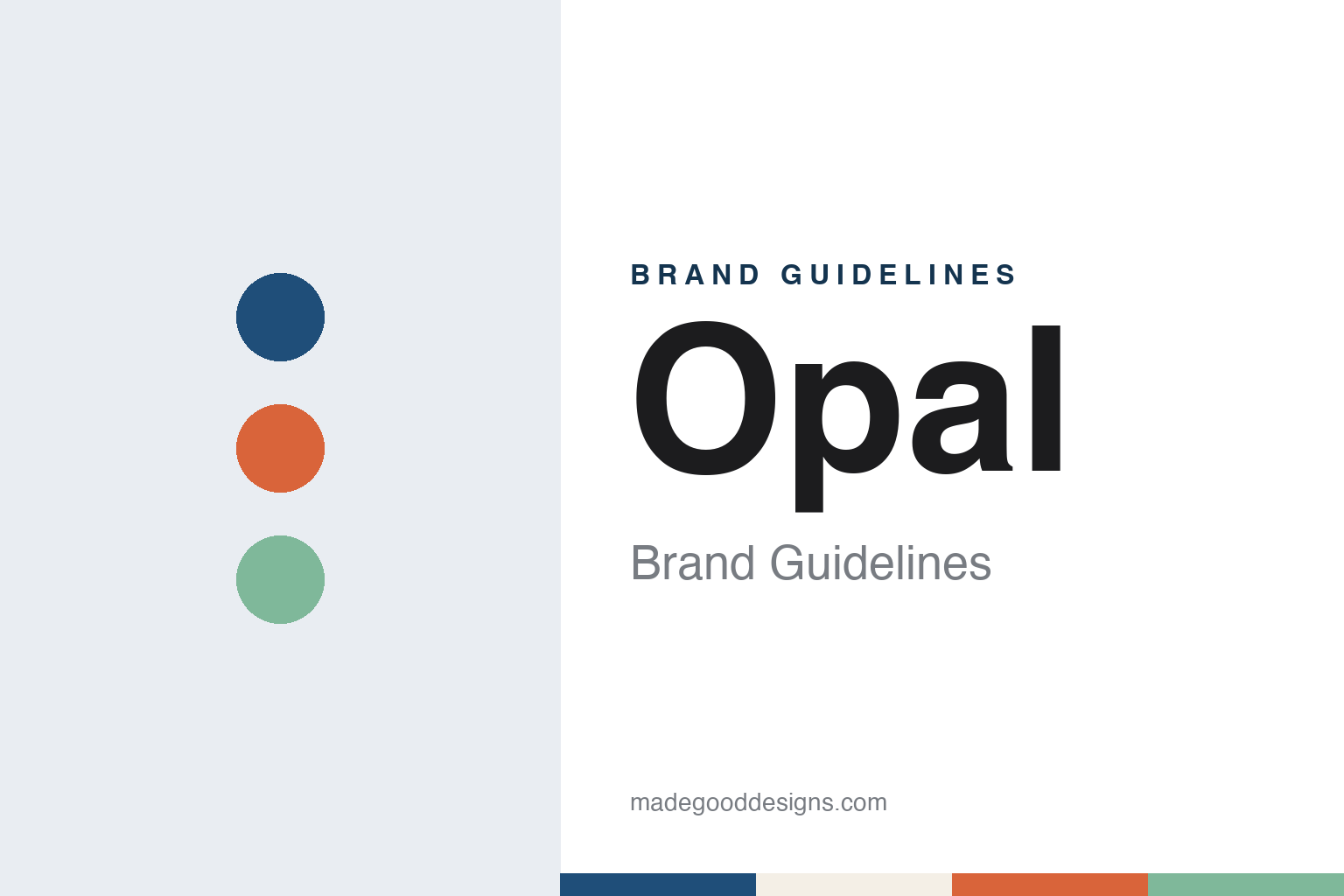
Two constants: an Opal blue, fire orange and green palette and a Rounded sans register. Abstract homage — not an Opal product or mark; no ball band, logo or label is reproduced.
TUTTO Wolfgang Zwerger
A family dye works at the foot of Burg Hohenzollern.
Opal is a sock and pullover yarn made by TUTTO Wolfgang Zwerger GmbH, a family company in Hechingen, in the Zollernalb district of Baden-Württemberg. The company describes the town as a small knitting-industry town “at the foot of Burg Hohenzollern,” the hilltop castle that overlooks it, and its official website, sockenwolle.de — literally “sock wool” — was carrying the brand by 2005.
The company’s own timeline traces the business back further than the brand. It says its roots lie in Berlin in 1978, in the sale of natural wool and a workshop making beechwood knitting needles. Between 1981 and 1984, it says, Wolfgang Zwerger and Beate Göhring-Zwerger ran a part-time business called “Wolle und Seide” — wool and silk — and built a plant-dye works in Altshausen, in Upper Swabia. From 1984 to 1988 they worked full-time in Bodelshausen under the name “ZwergerGarn,” and in 1994 a limited company, Tutto Beate Göhring-Zwerger GmbH, was founded in Hechingen.
The brand followed two years later. The company says it launched Opal Pullover- und Sockenwolle in 1996 and sold it worldwide; in 2002 the company took its current name, TUTTO Wolfgang Zwerger GmbH. An archived version of the firm’s older website, captured in January 2005, names TUTTO Wolfgang Zwerger GmbH of Hechingen as its operator and points visitors to sockenwolle.de with the strapline “Opal-Sockenwolle mit tollen Mustereffekten” — Opal sock wool with great pattern effects. A capture from 2002 lists general agents for Baden-Württemberg, Bavaria and Thuringia, Austria and South Tyrol, Italy and Switzerland, and representatives in the United States and Canada.
The name, the company says, comes from the Latin opalus, the precious stone whose play of colour suits a yarn sold on its patterning.
Colour
Printing on the running thread.
Opal’s look comes from how it is coloured. On its production page the company says it dyes, washes, finishes and packs its yarns in Hechingen, and that it prints yarn on special machines. Its “Ambiente Color” process, it says, prints the running thread rather than a skein, which is how the yarn knits up into confetti dots, flames, stripes and Nordic-style patterns as a sock grows. An explainer on the company’s site describes the sequence: one colour drum per colour applied in turn, the colour fixed with steam, the yarn washed, dried, steamed again, then wound and fitted with its band. The company also says it prints yarn for other firms’ own labels.
The classic Opal quality, according to the company, is 75 percent wool and 25 percent polyamide 6.6, the nylon content that makes sock yarn hard-wearing. It also lists cotton and bamboo blends and sport yarns with polypropylene, in 4-, 6- and 8-ply weights, with a 3-ply added in February 2017. On wool origin the company says it has used wool only from Germany and South America since the brand began, uses no Australian or New Zealand wool, and that its wool is mulesing-free; we give those as its claims.
Two long-running projects sit next to the yarn. The company says its first Opal Regenwald collection, in 2004, was made with the German charity Rettet den Regenwald e.V. (Rainforest Rescue), and that by 2024, twenty years on, the series had raised more than €300,000 in donations. In 2008, it says, it started a Schafpate — sheep-sponsor — project supporting itinerant shepherding in Germany, with yarns made only from German wool; it reports more than €100,000 raised by 2018. We have not seen independent figures for either total.
The company also says its 2006 collection after works by the painter Friedensreich Hundertwasser, initiated by Frederic Zwerger with his father, ran to four special collections of eight shades each, and that it took first place in a Craft & Fashion Award in April 2007 given by the organiser of the h+h handicrafts fair. It says the children’s programme Die Sendung mit der Maus filmed a segment in its factory. We have not verified either independently and report them as the company’s account.
Typography
Design and documentation.
The seven brands in this group all sell yarn for hand knitting and crochet, and they come from seven countries: Plassard from France, Opal from Germany, Holst Garn from Denmark, Rauma from Norway, Daruma from Japan, Lana Gatto from Italy and Red Heart from the United States. They sit at very different points on the map of the yarn trade, from small regional names to brands sold by the million.
At one end are regional spinners and family firms, whose names are tied to a town, a valley or a national wool tradition, and whose colour cards often grew out of what local mills could make. At the other end are mass-market brands, built for craft chains and online shops, where a yarn name can pass from one corporate owner to another while the label on the ball stays the same. Between them sit companies that design yarn and its colours but rely on others to spin it.
Each guide separates what independent sources record from what the company says about itself — who founded it, who owns it now and where its yarn is made — and marks plainly what rests only on the company’s own word.
Aa
A rounded sans — printed stripes on a running thread. (Specimen set in Rubik, a sans STAND-IN; NOT the Opal logo.)
Opal
Made in Germany, by the company’s account.
The firm presents itself as an owner-managed, mid-sized family company. Its company page says it currently has 28 employees and is run by managing director Frederic Zwerger, together with his siblings Henrike and Felix; its timeline says Frederic joined the management in 2012 and that Henrike and Felix were given Prokura, the German form of commercial power of attorney, in 2014. The brand marked 30 years in 2026.
On where the yarn is made, the company makes a broad claim and a narrower one. Its company page says the entire production, including sales and marketing, takes place at one site, and that “all work steps needed for the production of our wool are carried out at our headquarters in Hechingen” — “Made in Germany.” Its production page lists dyeing, washing, finishing and packing in Hechingen but does not itemise spinning. We give both statements and do not assert where the fibre is spun.
Watch the domains. The official site is sockenwolle.de; opal-wolle.de and opalwolle.de have been parked or used for unrelated pages and are not the company’s.
We found no published brand guidelines, logo history or official colours. The palette here — a deep blue, a fire orange and a soft green on raw wool — is our own interpretation of a brand known for multicoloured printed yarn.
For a design guide, Opal shows how a yarn brand can build its identity on a production technique, letting the printed pattern do the talking. Compare Schachenmayr, the spinning name from Salach in the same state, and Lana Grossa, the Bavarian yarn house that spins in Italy. For this guide we use blue, orange and green with a sans, an unofficial interpretation; no product or logo is reproduced.
Explore & save
Keep Opal’s identity on hand — save it to a board in the Made Good inspiration library.
Opal identity set
Pin the Opal blue, fire orange and green palette and the Rounded sans register to your own board.