Alize Brand Guidelines
The Istanbul hand-knitting yarn brand with a factory in Isparta.
Aa
Two constants: an unofficial berry-and-pink palette and a rounded geometric sans register. Abstract homage — not an Alize product or mark; no ball band, logo or label is reproduced.
Yünteks and Alize
An Istanbul office, a showroom and a factory in Isparta.
Alize is a Turkish brand of hand-knitting yarn. Its contact details are published on a statutory company-information page run under the name of Yünteks, which lists Alize’s head office in the Merter area of Istanbul, a shop and showroom in Yenibosna, also in Istanbul, and a factory in the Süleyman Demirel Organised Industrial Zone in Isparta, a city in south-western Türkiye’s lakes region. That makes Alize a brand of a Turkish company rather than an importer’s label, and the company presents the factory as part of the business.
The company’s own site, alize.gen.tr, carries the line “Örmeye Değer,” which translates roughly as “worth knitting,” and describes its goods as hand-knitting, knitwear and weaving yarns. The site is published in Turkish, English and Russian, and the brand’s social accounts run under the name “alizeyarns,” which suggests where it looks for customers beyond Türkiye. We could not confirm a founding date or the names of the founders from the company’s pages, so we do not give them here.
The pages we read do not describe any change of ownership, and there is no sign in them that Alize has been sold to a foreign group. Everything we could document points to a privately run Turkish company with its management in Istanbul and its production in Isparta.
Colour
A long range built mostly on acrylic and wool blends.
Alize’s catalogue is large. A 2024 copy of its hand-knitting collection page, saved by the Internet Archive, lists dozens of yarn families, many of them in several versions: plain, “batik” (multicolour), ombré, fine and metallic. Each entry gives the fibre content, the weight and length of a ball, and the number of colours, and that information is the most useful guide to how the brand works.
The fibre lists show a brand built mostly on acrylic, alone or mixed with wool, cotton, bamboo, alpaca or mohair. Angora Gold, one of the best-known names, is listed as 20% wool and 80% acrylic; despite its name, the listing does not include angora fibre. Baby Best is given as 90% acrylic and 10% bamboo, with the acrylic described as anti-pilling. Bella is listed as 100% cotton, and the Superlana family runs from a classic weight to “Maxi” and “Megafil” versions. Colour counts on the page run from about a dozen to more than fifty shades per yarn.
The best-known family abroad is Puffy. The site gives Puffy More its own page with patterns and templates, and the family runs to several versions, including Puffy Fine, Puffy Fur and Puffy More Plus. The site also has a video section, “Alize TV,” with knitting and crochet videos, and a downloadable brochure for each new season.
Read together, the collection page describes a mass-market brand: many affordable synthetic blends, big colour cards and constant new versions of proven names, rather than a small range of rare fibres.
That approach shapes how the range reads. Long colour cards, baby yarns and multicolour “batik” and ombré versions suit blankets, baby clothes and shawls as much as fitted garments, and several of the larger put-ups, such as a 250-gram cotton ombré, look aimed at one-ball projects. The Russian-language version of the site suggests that buyers to the north and east matter to the company, while the English version serves buyers elsewhere.
Typography
Design and documentation.
The seven brands in this group all sell yarn for hand knitting and crochet, and they come from seven countries: Novita from Finland, Järbo from Sweden, Alize from Turkey, Hamanaka from Japan, Adriafil from Italy, Wool and the Gang from the United Kingdom and Knit Picks from the United States. Set side by side, they show two quite different ways of putting a ball of yarn in front of a knitter.
One is the national yarn maker: a name that grew up in a single country, sold through that country’s department stores, craft shops and yarn shops, and often found in homes for generations. The other is the brand built around the buyer rather than the shop — one that sells online or by catalogue, or packs yarn, needles and a pattern together as a kit, and talks to knitters directly. The first kind tends to lean on heritage and place; the second on convenience, price or a sense of belonging to a community. Each route shapes a brand’s name, its labels and the voice it uses.
Each guide also separates what independent sources record from what the company says about itself — who founded it, who owns it now and where its yarn is made — and marks plainly what rests only on the company’s own word.
Aa
A rounded geometric sans for a colourful mass-market range. (Specimen set in Poppins, a sans STAND-IN; NOT the Alize logo.)
Alize
A big colour card, named with care.
Alize’s look is built around colour and volume. A range with dozens of yarns and as many as fifty shades in one of them depends on clear colour cards, consistent ball bands and a naming system that lets a knitter tell Angora Gold from Angora Gold Batik at a glance. The brand handles this with a simple pattern: a family name, then a short descriptive word such as “Batik,” “Ombre,” “Fine” or “Simli” (Turkish for “with glitter”).
The other lesson is reach. A site in three languages, a video channel and a social presence under one handle show a Turkish maker selling far beyond its home market, and the identity has to read the same in an Istanbul shop and on a foreign web store. Publishing composition, ball weight and length for every yarn also gives buyers in any country the same basic facts.
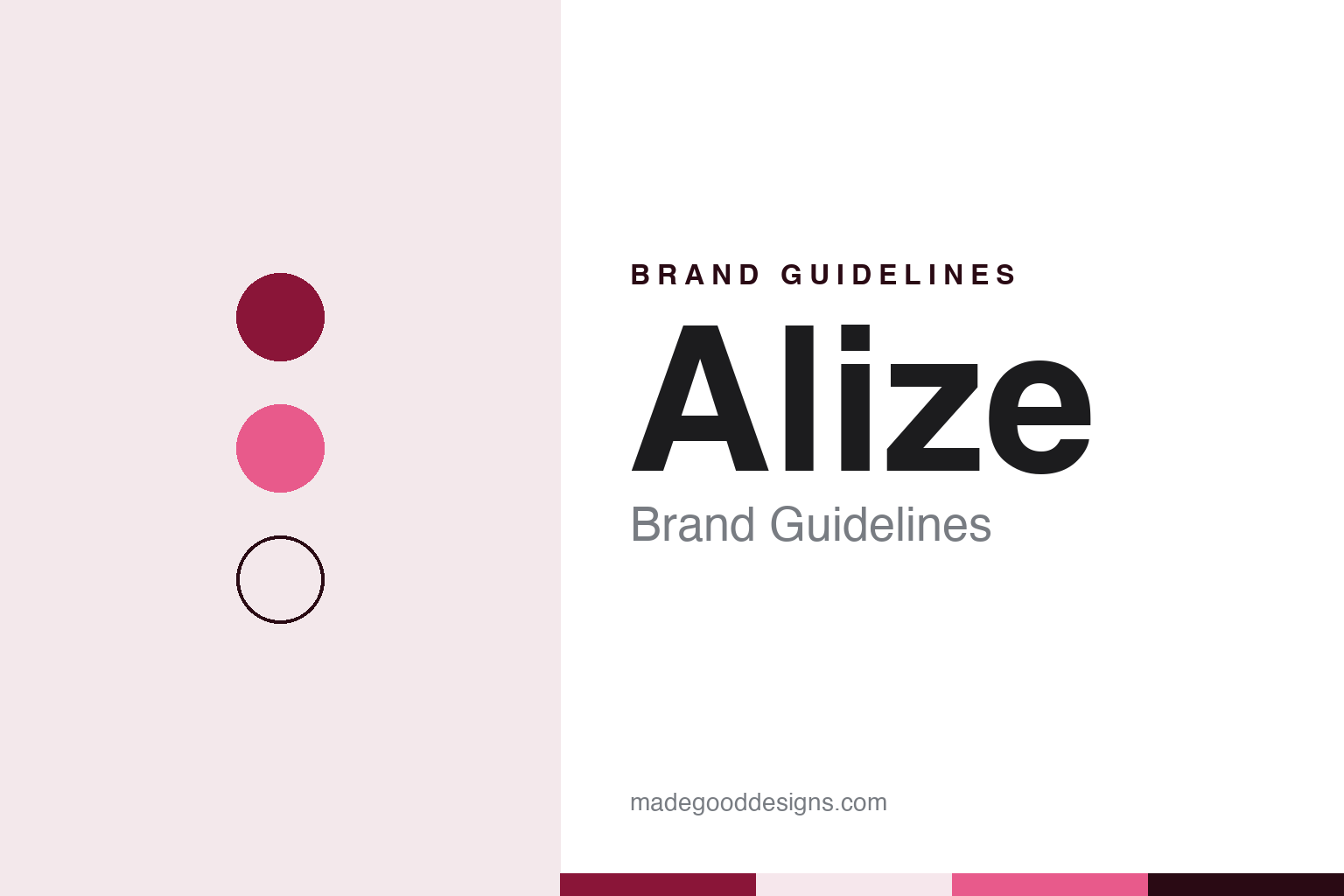
No official brand colour, typeface or style guide is published, so our palette is an interpretation: a deep berry for headings and small text, a lighter pink for accents and a pale blush for backgrounds, chosen to suggest the bright colour cards rather than copy any label.
For a design guide, Alize shows how a large mass-market yarn range can stay legible through a strict naming system and full product information. Compare Lion Brand, another large brand built on affordable yarns, and Katia, a Mediterranean brand known for novelty yarns. For this guide we use berry, pink and blush with a rounded sans, an unofficial interpretation; no product or logo is reproduced.
Explore & save
Keep Alize’s identity on hand — save it to a board in the Made Good inspiration library.
Alize identity set
Pin the Alize berry, pink and blush palette and the rounded geometric sans register to your own board.