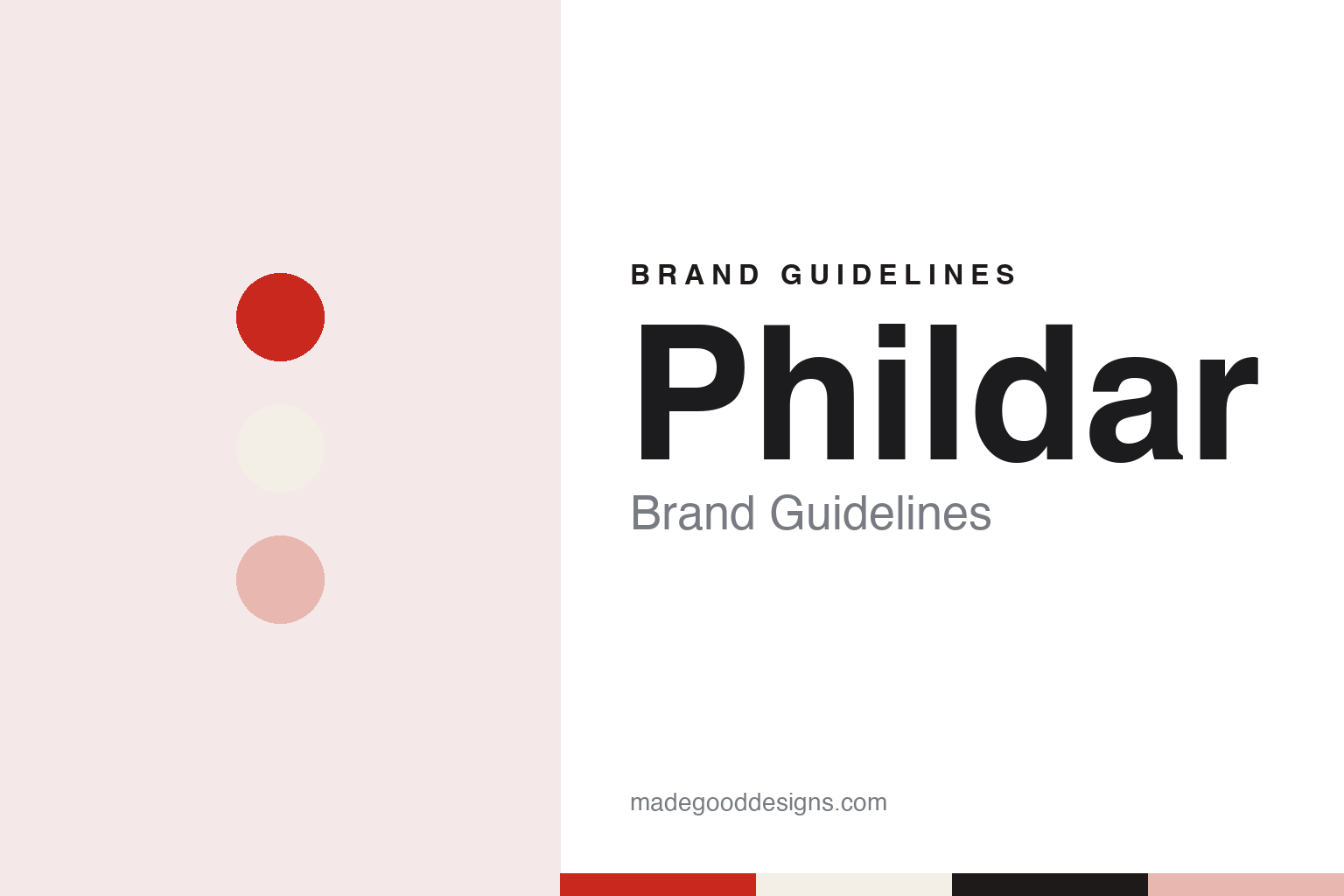
Phildar Brand Guidelines
The Mulliez family’s knitting-yarn name from Roubaix.
Aa
Two constants: a Phildar red, cream and ink palette and a geometric sans register. Abstract homage — not a Phildar product or mark; no yarn, label or logo is reproduced.
Au fil d’art
A wool shop, a mill family and a name that sounds like “fil d’art.”
Phildar began with a shop. In 1943, French Wikipedia says, citing Valérie Sauvage’s 2012 history of the brand in La Saga des marques, Gérard Mulliez (1906–1989) opened a shop in Poitiers called Les textiles d’art, which he soon renamed Au fil d’art — a name that, spoken aloud, sounds like the brand it became. FashionNetwork, reporting in 2020, gave the founding as 1946 “within the Mulliez group,” so the date depends on the source. Mulliez came from a textile family of the Nord; he was the father of the Gérard Mulliez who later founded Auchan.
The business grew quickly after the war by doing two things at once: it made yarn and it sold it. French Wikipedia, again citing Sauvage, gives 1,400 employees by 1950 and the first franchised Phildar shop, in the Nord, in 1956. That shop network became the brand’s signature. By 1973 Phildar employed 3,000 people, and in the 1970s it counted up to 2,000 franchised shops, FashionNetwork reported. A former group manager, Gérard Deman, is quoted by Sauvage as remembering that “next to every church, there was a Phildar shop.”
Phildar’s mills also shaped French retail beyond knitting. When Auchan opened its first store in Roubaix in 1961, it did so in a former Phildar yarn-twisting factory, French Wikipedia says, and in its difficult early years the yarn business helped balance the books. In 1971 Phildar opened a women’s clothing shop in Lille under the name Pimkie, which became independent three years later.
Colour
From mill to kit to catalogue.
As fewer people knitted at home, Phildar spread out. Sauvage, cited by French Wikipedia, lists socks, tights and lingerie among its products in the 1970s, along with clothing banners including Pimkie and Grain de Malice. The Roubaix factory closed in the 1990s, according to the same source, ending Phildar’s life as a large-scale yarn manufacturer in the town.
What remained was a brand built around shops, patterns and catalogues. In the 2000s, French Wikipedia says, Phildar promoted “prêt-à-tricoter” — complete kits with pattern, balls of yarn, needles and accessories — to bring a younger generation to knitting. In 2018 it went back into ready-to-wear clothing, Les Echos reported, a move that did not last.
The modern brand speaks through its yarn names and its pattern books. Many of its yarns carry names beginning with “Phil,” such as Phil Partner, a habit that keeps the brand in front of the customer on every ball band. Its website in February 2026 described itself as a “Maison de Tricot,” offered knitting and crochet courses through a “Wool School,” and listed partner knitting cafés.
On manufacturing, the company makes specific claims. Its website, as archived in February 2026, says “90% made in Europe, of which 66% made in Italy” and “100% designed in Roubaix,” adds that 55% of its yarn qualities contain at least half noble or natural fibres such as mohair, alpaca or cotton, and says its catalogues are printed on recycled paper with water-based inks. We give these as the company’s claims; we did not find an independent audit of them. French Wikipedia illustrates the brand with a logo it dates to 2023; we did not find documentation of its typeface or official colours.
Typography
The seven brands in this group all sell yarn for hand knitting and crochet, but they work at very different scales and come from seven countries. Between them they cover most of the ways a ball or skein of yarn reaches a maker: from a mill on an island, from a small hand-dyeing studio, from a family distributor, and from names sold widely on the high street and in craft chains.
Four come from continental Europe. Phildar is French, Scheepjes is Dutch, Katia is Spanish and Isager is Danish, and each guide sets out who founded the brand, who owns it now and what it says about where its yarn is spun. Two are smaller and rooted in place: Jamieson’s of Shetland, from the islands north of mainland Scotland, and Hedgehog Fibres, an Irish hand-dyer. The last, Cascade Yarns, is an American family firm in Seattle that sources its yarn from partner mills abroad.
Each guide separates what independent sources record from what the company says about itself, and marks plainly what rests only on the company’s own word.
Aa
A geometric sans for a shop-front brand. (Specimen set in Jost, a sans STAND-IN; NOT the Phildar logo.)
Phildar
Insolvency in 2020, a buyout, and Happywool.
The company that had carried the name since the war did not survive 2020. On 1 July 2020 the commercial court of Lille Métropole opened safeguard proceedings, a French court-protection procedure; Franceinfo reported the news the next day, in the middle of the coronavirus crisis. According to notices in the official French gazette of company announcements, the BODACC, the court converted the case into redressement judiciaire (receivership) on 21 July 2020. Four bids arrived by the end of July, Le Monde reported, including offers from the fabric retailer Mondial Tissus and from Kindy.
On 22 September 2020 the court chose the bid led by Phildar’s own management through a new company, PP Yarns, backed by members of the Mulliez family. FashionNetwork named the buyer as Phildar’s chief executive, Eric Vandendriessche, and reported that the plan kept 8 company-run shops and 7 affiliated ones out of 115 points of sale, and 86 of 211 employees; Les Echos reported 125 job cuts. The same day, the BODACC notices show, the court adopted the sale plan and placed the old Phildar company in liquidation, so the brand, rather than the company, carried on. The new owners said they would refocus on knitting yarn and leave clothing behind, BFM Business reported.
In 2022 the owners created Happywool, a name grouping the Phildar and Pingouin yarn brands, FashionNetwork reported, and in January 2023 the company, PP Yarns & Co, adopted the status of an “entreprise à mission,” a French company with a stated purpose. Its shops also sell Anny Blatt, Les Echos reported in 2022. Constance de Polignac became Happywool’s chief executive in early 2025, Le Journal des Entreprises reported. Company accounts cited by French Wikipedia show revenue of about €21 million in 2025, against more than €40 million in 2016, and continuing losses. The BODACC notices we checked, up to July 2026, list accounts filings and shop purchases for PP Yarns & Co, but no new insolvency proceedings.
For a design guide, Phildar shows how a retail name can outlast the factories that made it. Compare Katia, a Spanish family yarn brand, and Scheepjes. For this guide we use a red, a cream and an ink with a sans, an unofficial interpretation; no product or logo is reproduced.
Explore & save
Keep Phildar’s identity on hand — save it to a board in the Made Good inspiration library.
Phildar identity set
Pin the Phildar red, cream and ink palette and the geometric sans register to your own board.