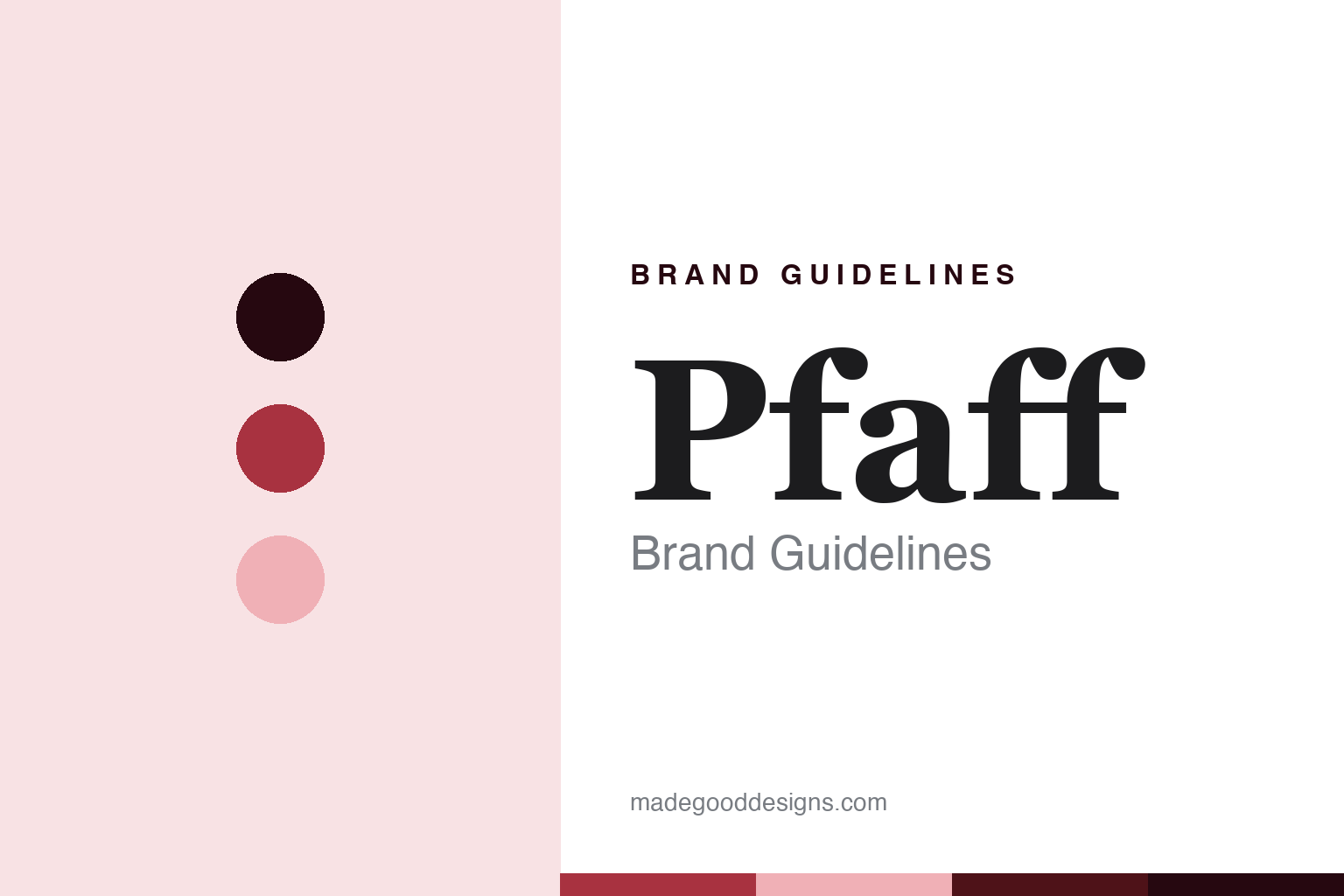
Pfaff Brand Guidelines
German engineering, dual-feed since 1968.
Aa
Two constants: a Pfaff-red palette and a heritage-serif register. Abstract homage — not a Pfaff product or mark; no machine, needle or logo is reproduced.
German engineering, dual-feed since 1968
Pfaff is the 1862 German home-sewing brand defined by its IDT dual-feed — now a brand of SVP Worldwide under Platinum Equity, made mainly in China.
Pfaff follows Juki as the round’s German-heritage node — a home-sewing name founded in a Kaiserslautern workshop in 1862, defined for over half a century by a single feed innovation, and now owned by an American private-equity house rather than a German maker. Its answer to a round about who owns the machines and where they are made is a heritage-then-globalised one, told carefully: an old German brand whose consumer arm belongs to a US group and whose machines are built mainly in China.
Its identity is German engineering, dual-feed since 1968. The 1862 founding, the IDT dual-feed and the SVP-under-Platinum-Equity ownership are the story here. Fed evenly, top and bottom. German engineering, dual-feed since 1968.
(Honest notes, so the brand, the ownership and the making are framed accurately, and one important split named. There are two separate Pfaffs, and this article is about the consumer, home-sewing Pfaff — the IDT machines — not the separate industrial Pfaff company, which has been owned by China’s ShangGong group since 2013; we do not conflate them. Consumer Pfaff sells home sewing and embroidery machines as its heroes — the creative embroidery line and performance and quilt machines — all built around its hallmark feed system; we report its language as the brand’s own. On origin: Pfaff was founded in 1862 in Kaiserslautern, Germany, by Georg Michael Pfaff, an instrument maker. On the signature technology: its Original IDT, Integrated Dual Feed, an even-feed-from-top-and-bottom system, first launched on the PFAFF 1222 in 1968 and remains the brand’s hallmark. On ownership: consumer Pfaff is a brand of SVP Worldwide, the group that also holds Singer and Husqvarna Viking, and SVP passed from Kohlberg to Ares in 2018 and to Platinum Equity in August 2021, which still owns it, with no verified onward sale. On a sensitive point, attributed and bounded: SVP has been reported by S&P and trade press to be under financial distress — a deep-junk credit rating and a $50 million injection via payment-in-kind notes — which we attribute rather than assert, and we do not claim any bankruptcy or layoffs that are not verified. On where it is made: consumer Pfaff machines are made mainly in China today, with premium tiers historically produced in Europe, and because there is no official per-model origin statement we frame it as reported. Its designs and the Pfaff name are IP we describe but do not reproduce; there is no official brand hex; these tones are an unofficial interpretation.)
Colour
Pfaff lives in a Pfaff red. Click a swatch to copy the hex.
Pfaff’s identity is heritage, engineered and globalised — a Pfaff red, an ink, a pale red, a deep red, and a paper. The palette leans Pfaff red and pale red: a warm, heritage register that nods to a long German engineering history rather than a loud logo colour. It signals German engineering, dual-feed since 1968 — heritage, engineered and globalised. The honest caveat: with no official brand hex, and the wordmark associated with red, these values are a heritage, unofficial interpretation, not first-party colours.
The lesson is a warm red signals a heritage, engineered identity. Pfaff’s world is the precise German machine, defined by one feed system. For designers, it is a reminder that a warm red and a soft pale can carry a heritage, engineering brand — a considered tone held as an accent, not a product shot. Because a mid hue can fail as small text, keep type dark and let the colour live in the accents, palette and band. The takeaways: credit the 1862 founding and Georg Michael Pfaff; credit the 1968 IDT dual-feed; name the SVP-under-Platinum-Equity ownership; attribute the distress to S&P rather than assert it; and separate consumer Pfaff from the Chinese-owned industrial Pfaff.
Typography
The register is a heritage serif — heritage, engineered, globalised.
Pfaff’s identity carries a heritage, engineered, globalised spirit — an old German name now inside an American group. A heritage serif captures the mood: warm, classic and precise, the register of a long-lived engineering brand. Set in a Pfaff-red palette, the heritage serif feels storied and engineered — exactly the personality Pfaff carries. It behaves like a made, considered thing rather than a loud logo, mirroring a feed-grid and a seam-gradient. (Pfaff’s real products and the name are things we describe but do not reproduce, and the exact typeface is not ours to use.) Because it is not ours to use, the honest description is “a heritage-serif brand,” shown here in a stand-in. The type behaves like the brand: heritage, engineered and globalised.
Aa
A heritage-serif brand — storied and engineered. (Specimen set in Playfair Display, a heritage-serif STAND-IN; NOT the Pfaff logo or products.)
The sewing node
Pfaff stands for German engineering, dual-feed since 1968.
Pfaff sits second in the round as its German-heritage node. A Pfaff-red palette, a heritage serif and an 1862 founding make one thing — German engineering, dual-feed since 1968 — the whole identity: heritage, engineered and globalised. The 1862 founding is the pitch, the IDT dual-feed is the hallmark, and the SVP-under-Platinum-Equity ownership is the frame. The point is an old German name now inside an American group, in a round about who owns the machines and where they are made.
Put to work, the identity is the brand told straight, the split named, the ownership updated and the distress attributed. A brand in this spirit would credit the 1862 founding and Georg Michael Pfaff, credit the 1968 IDT dual-feed, name the SVP-under-Platinum-Equity ownership, attribute the distress to S&P, and separate consumer Pfaff from the Chinese-owned industrial Pfaff. A reader in this spirit would keep the facts right: consumer Pfaff sells home sewing and embroidery machines built around IDT as its heroes; it was founded in 1862 in Kaiserslautern by Georg Michael Pfaff; its IDT dual-feed launched on the 1222 in 1968; its consumer arm is a brand of SVP Worldwide, owned by Platinum Equity since August 2021, with SVP reported by S&P to be financially distressed; and its machines are made mainly in China today, premium tiers historically European. Pfaff sits after Juki and before Bernette. The honest editorial moves are to name the split, to credit the founding and the IDT, to update the ownership, and to attribute the distress.
For designers and brand-builders, Pfaff carries the sewing node: separate two same-named companies — and attribute a distress claim, don’t assert it. The lessons: a brand can be defined by one durable innovation, here the IDT dual-feed since 1968; a founding is credited to Georg Michael Pfaff in 1862; an ownership is named at its current state, SVP Worldwide under Platinum Equity, and kept separate from the Chinese-owned industrial Pfaff; and a financial-distress claim is attributed to S&P and trade press, bounded, without asserting an unverified bankruptcy or layoffs. It is also a reminder to stay precise: consumer Pfaff is the IDT home-sewing brand, US-PE-owned and made mainly in China — with the palette here an unofficial interpretation. The hook is that division: born in a Kaiserslautern workshop in 1862, Pfaff’s engineering now lives on two divorced paths — its factory machines Chinese-owned, its home sewers, still defined by the 1968 dual-feed, belonging to an American private-equity house. Read that way, Pfaff is less a single machine than German engineering, dual-feed since 1968: heritage, engineered, globalised. The lesson for a brand is that naming the split and attributing the distress reinforce each other, and crediting the IDT keeps the story earned. Pfaff made German-engineering-dual-feed-since-1968 the identity — proof that a carefully separated, honestly framed account can anchor a node.
Explore & save
Keep Pfaff’s identity on hand — save it to a board in the Made Good inspiration library.
Pfaff identity set
Pin the Pfaff-red palette and the heritage-serif register to your own board.


