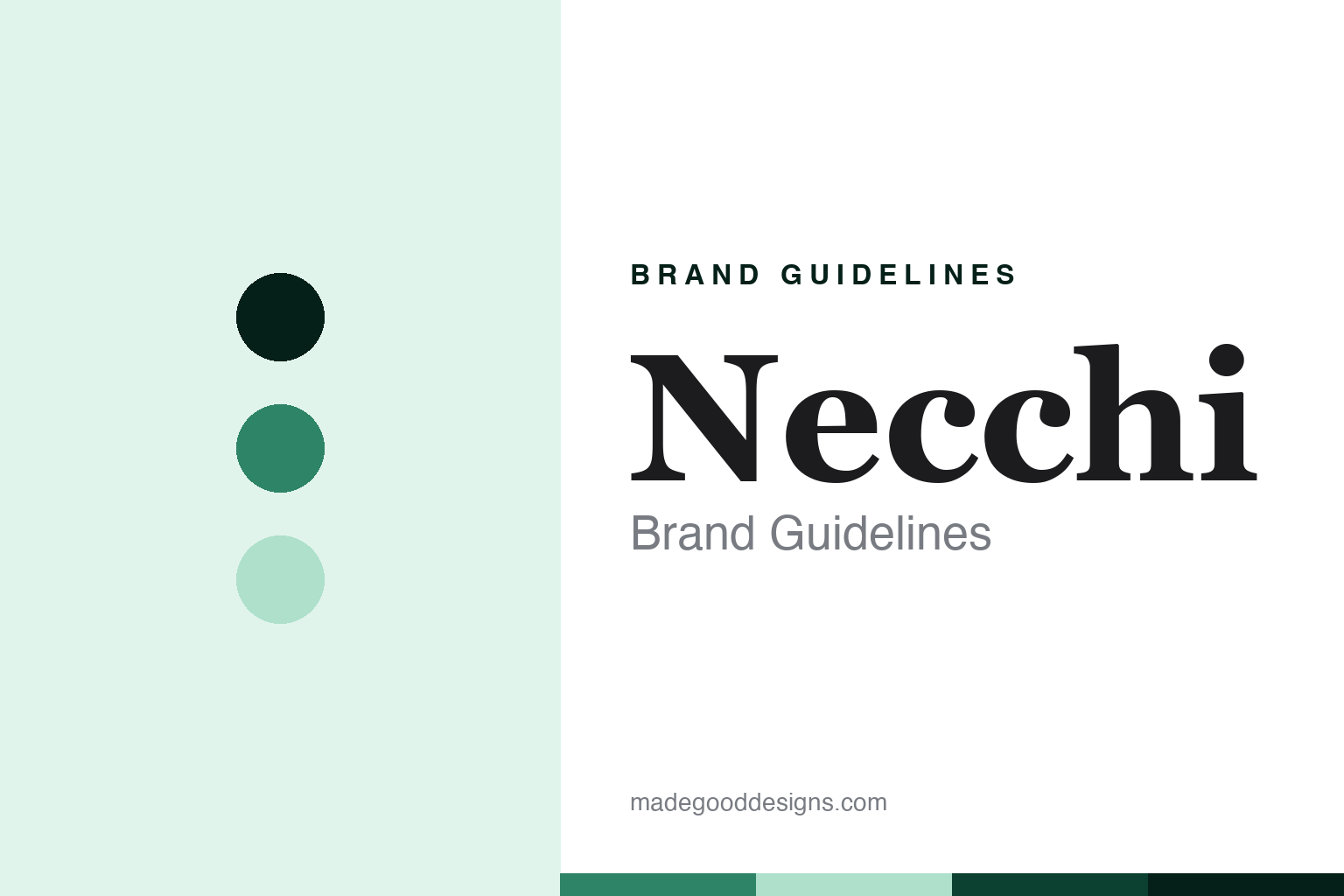
Necchi Brand Guidelines
A design legend, now a licensed name.
Aa
Two constants: a Necchi-green palette and a design-serif register. Abstract homage — not a Necchi product or mark; no machine, needle or logo is reproduced.
A design legend, now a licensed name
Necchi is the Italian heritage brand of the MoMA-honoured Mirella, whose original company dissolved; the name is now a licensed trademark held in Singapore.
Necchi follows bernette as the round’s heritage-and-licensing node — an Italian name that made one of the most celebrated machines in design history, whose original company no longer exists, and whose trademark has travelled from Pavia to Singapore to a distributor in Texas. Its answer to a round about who owns the machines and where they are made is a rare and honest one: a design legend that outlived its maker, now a licensed name on outsourced machines.
Its identity is a design legend, now a licensed name. The Mirella design heritage, the dissolution of the original company and the licensed-trademark present are the story here. A legend that outlived its maker. A design legend, now a licensed name.
(Honest notes, so the heritage and the present are framed accurately and clearly separated. Necchi machines are still sold in 2026 — recent models such as the NE210 and C700 — but Necchi is now a licensed, badged trademark rather than an operating Italian manufacturer, so we frame it clearly as a heritage brand whose name is now licensed. On origin: the family firm traces to a cast-iron and copper foundry founded in Pavia, Italy, in 1865 under Ambrogio Necchi; his son Vittorio Necchi turned it to sewing machines around 1919, with the first model, the Necchi BD, in 1924, and by 1946 it was making around a thousand machines a day. On the design heritage: the 1956 Mirella, designed by Marcello Nizzoli, won the 1957 Compasso d’Oro and sits in the Museum of Modern Art collection, and the 1950s Supernova pioneered automatic zig-zag machines in Italy — this is the strongest, and the true, part of the story. On the end of the original company, framed carefully: the original Necchi S.p.A. declined and was wound down in the late twentieth century, with contributing factors cited as market saturation and debt from diversifying into refrigerator-compressor manufacturing, and Vittorio Necchi died without heirs so his sisters sold the rights to the name; we describe this as a decline and sale of the name rather than asserting a specific dated bankruptcy, which is not cleanly documented. On the ownership chain: the name passed through Allyn International in Colorado in the 1980s and the Yugoslav maker Bagat, then Janome held the rights and sold Janome-built machines under the Necchi badge until early 2024 — and we note that Janome is an independent Japanese company, not a subsidiary of Brother, correcting a common web claim; the current trademark holder is Necchi International Pte. Ltd., a Singapore company incorporated in 2017, and US rights passed to ABM International of Texas in April 2024. On where it is made: current machines are built by Asian OEMs and the present manufacturing country is not officially disclosed, while earlier Janome-era machines came from Thailand and Taiwan, so we frame current production as undisclosed. Its designs and the Necchi name are IP we describe but do not reproduce; there is no official brand hex; these tones are an unofficial interpretation.)
Colour
Necchi lives in a Necchi green. Click a swatch to copy the hex.
Necchi’s identity is heritage, design-led and licensed — a Necchi green, an ink, a pale green, a deep green, and a paper. The palette leans Necchi green and pale green: an elegant, mid-century register that nods to Italian design history rather than a loud logo colour. It signals a design legend, now a licensed name — heritage, design-led and licensed. The honest caveat: with no official brand hex, these values are an elegant, unofficial interpretation, not first-party colours.
The lesson is a mid-century green signals a heritage, design-led identity. Necchi’s world is a design legend that outlived its maker. For designers, it is a reminder that a refined green and a soft pale can carry a heritage, design brand — an elegant tone held as an accent, not a product shot. Because a mid hue can fail as small text, keep type dark and let the colour live in the accents, palette and band. The takeaways: credit the Mirella, Nizzoli, the Compasso d’Oro and MoMA; frame the original company’s end as a decline and sale of the name, not a dated bankruptcy; name the current licensed chain, Singapore holder and Texas distributor; and say current making is Asian-OEM and undisclosed.
Typography
The register is a design serif — heritage, design-led, licensed.
Necchi’s identity carries a heritage, design-led, licensed spirit — a name whose fame rests on a single celebrated object. A design serif captures the mood: elegant, refined and Italian, the register of a mid-century design legend. Set in a Necchi-green palette, the design serif feels considered and historical — exactly the personality Necchi carries. It behaves like a made, museum-worthy thing rather than a loud logo, mirroring a seam-gradient and a spool-arc. (Necchi’s real products and the name are things we describe but do not reproduce, and the exact typeface is not ours to use.) Because it is not ours to use, the honest description is “a design-serif brand,” shown here in a stand-in. The type behaves like the brand: heritage, design-led and licensed.
Aa
A design-serif brand — elegant and historical. (Specimen set in Cormorant Garamond, a design-serif STAND-IN; NOT the Necchi logo or products.)
The sewing node
Necchi stands for a design legend, now a licensed name.
Necchi sits fourth in the round as its heritage-and-licensing node. A Necchi-green palette, a design serif and the Mirella heritage make one thing — a design legend, now a licensed name — the whole identity: heritage, design-led and licensed. The Mirella heritage is the pitch, the dissolution of the original company is the turn, and the licensed-trademark present is the honest frame. The point is a design legend that outlived its maker, in a round about who owns the machines and where they are made.
Put to work, the identity is the brand told straight, the heritage credited, the end framed carefully and the licensing named. A brand in this spirit would credit the Mirella, Nizzoli, the Compasso d’Oro and MoMA, frame the original company’s end as a decline and sale of the name, name the current Singapore-holder and Texas-distributor chain, and say current making is Asian-OEM and undisclosed. A reader in this spirit would keep the facts right: Necchi’s hero is the design heritage — the 1956 Mirella by Nizzoli, in MoMA, and the 1950s Supernova — with current NE210 and C700 machines badged and OEM-built; it traces to an 1865 Pavia foundry, with Vittorio Necchi turning it to sewing machines around 1919, first model 1924; the original Necchi S.p.A. declined and was wound down and the name sold; the name passed through Allyn, Bagat and Janome, with Janome an independent Japanese company, not a Brother subsidiary, and is now held by Necchi International Pte. Ltd. of Singapore with US rights to ABM International of Texas since 2024; and current machines are Asian-OEM built, country undisclosed. Necchi sits after bernette and before Jack. The honest editorial moves are to credit the design heritage, to frame the end carefully, to name the licensing chain, and to leave current making undisclosed.
For designers and brand-builders, Necchi carries the sewing node: separate a design legend from a licensed present — and frame a company’s end without inventing a date. The lessons: a brand can rest its fame on one celebrated object, here the Mirella; a heritage is credited precisely with Nizzoli, the Compasso d’Oro and MoMA; a company’s end is framed as a decline and sale of the name rather than a dated bankruptcy the sources do not confirm; and a licensing chain is named at its current state, a Singapore trademark holder and a Texas distributor, with current making left undisclosed. It is also a reminder to stay precise: Necchi is an Italian design legend whose name is now a licensed trademark on Asian-OEM machines — with the palette here an unofficial interpretation. The hook is that survival: Necchi’s 1956 Mirella, designed by Marcello Nizzoli, won the 1957 Compasso d’Oro and sits in New York’s Museum of Modern Art — the brand became a design legend even as the Italian company behind it dissolved, leaving a much-travelled trademark now held in Singapore and sold from Texas. Read that way, Necchi is less a single machine than a design legend, now a licensed name: heritage, design-led, licensed. The lesson for a brand is that separating the legend from the licence and framing the end carefully reinforce each other, and crediting the Mirella keeps the story earned. Necchi made a-design-legend-now-a-licensed-name the identity — proof that an honestly-framed heritage can anchor a node.
Explore & save
Keep Necchi’s identity on hand — save it to a board in the Made Good inspiration library.
Necchi identity set
Pin the Necchi-green palette and the design-serif register to your own board.


