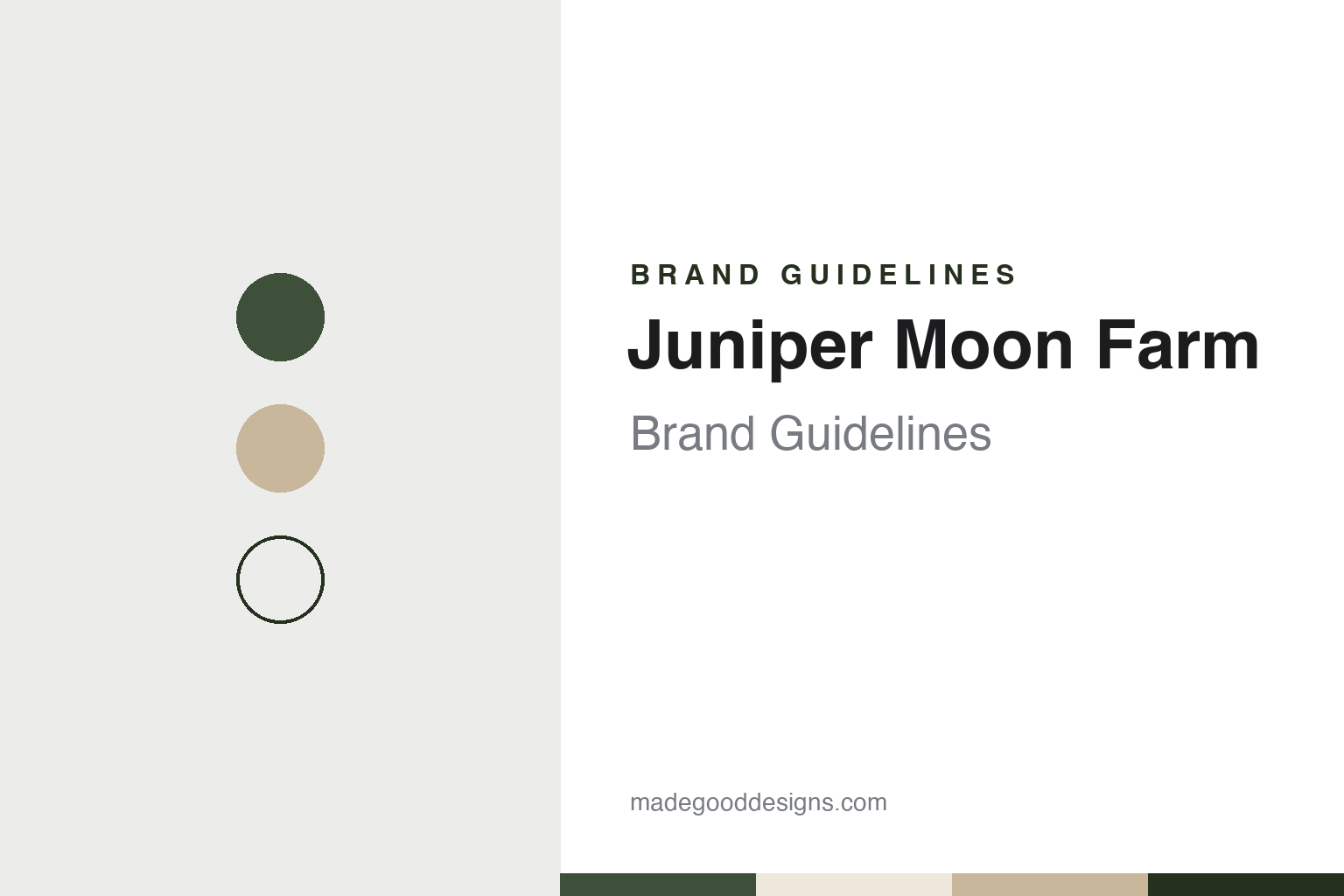
Juniper Moon Farm Brand Guidelines
The Virginia sheep farm that became a yarn line.
Aa
Two constants: a pasture green and fleece palette and a farmhouse serif register. Abstract homage — not a Juniper Moon Farm product or mark; no skein, label or logo is reproduced.
Four sheep
A fibre farm run on the shareholder model.
Juniper Moon Farm began as a farm before it was a yarn brand. The brand’s own website says it started in 2007 on a 139-acre farm in Virginia as “a small community-supported cooperative with just four sheep,” and Knitting Fever, which sells the yarn today, repeats the same founding story on its brand page. Retailers’ brand descriptions consistently name the founder as Susan Gibbs, and in 2011 she wrote about lambing season at the farm in a series of posts for HuffPost.
The model was borrowed from food. Community-supported agriculture lets subscribers buy a share of a farm’s harvest in advance; at Juniper Moon Farm, according to retailers’ brand texts, the harvest was wool and mohair from the flock, returned to shareholders as yarn and spinning fibre. Several of those texts describe it as the first farm to apply the CSA model to yarn and fibre, which we give as the brand’s own description rather than a checked fact.
The farm also gave the brand its voice. The pastoral register of those early years — pasture, flock, seasons, “sheep to skein” — still runs through the company’s marketing today, and the brand site describes it as “a story of harmony” between nature, animals and human hands, even though, as the company’s own sourcing list makes clear, the yarns are now made from fibre grown in South America rather than on the Virginia farm.
Colour
From a flock to a wholesale yarn line.
The farm and the yarn line ran side by side for several years before the line took over. In a 2021 brand spotlight published by the Michigan retailer Michigan Fine Yarns, Gibbs is described as having operated the CSA for nearly a decade before the flock was retired and she shifted the business to the commercial line of yarns she had begun curating, “working with Knitting Fever, Inc (KFI).” Another retailer’s description dates the end of the CSA and the flock’s retirement to the end of the 2015 season.
Knitting Fever is the key to the brand as it exists now. The company says it began in 1974, when Sion Elalouf opened a needlepoint and knitting shop in Great Neck, New York, and that in the early 1980s it gave up retail to import European and Japanese yarns for American shops; it now describes itself as an international distributor. Its catalogue places Juniper Moon Farm alongside imported lines such as Noro, Lana Gatto and Laines du Nord. The Juniper Moon Farm website says the farm’s story inspired Knitting Fever “to transform that vision into the beloved brand of hand knitting yarns,” and that Knitting Fever “continues to nurture” it. We found no public record of who owns the trademark, so we describe the brand as developed and distributed with KFI rather than owned by it.
The company says the range now runs to more than 40 yarns and nearly 1,000 patterns, and that by 2017 it was sold in hundreds of independent yarn shops outside the US as well as at home. Knitting Fever’s own history explains that reach: the company says it expanded from the US into Canada first and then into other countries, and its website now carries separate contacts for European buyers. Retail listings for the brand in the US often sum the arrangement up in a line, describing Juniper Moon Farm as a premium yarn “distributed by Knitting Fever Inc.” and dating it to 2007.
Typography
Craft, provenance and documentation.
The seven brands in this group all sell yarn for hand knitting and crochet, and they are linked to six countries: Paintbox Yarns and Erika Knight from the United Kingdom, Juniper Moon Farm from the United States, Lamana from Germany, Laines du Nord from Italy, De Rerum Natura from France, and ITO, a label run from Germany whose yarns, it says, come from Japan. What they share is less a place than a question: who actually makes the yarn that carries the name on the label?
Some yarn brands are, in effect, designer or retailer labels. The company chooses the fibres, sets the colour card, writes the patterns and builds the brand, but the spinning and dyeing are done by mills elsewhere, sometimes in another country, and the name on the ball tells you who designed it rather than who made it. Others are fibre-led, built around a particular wool, a flock or a mill, where the story of the yarn starts with the raw material and the place it was grown or spun.
Many brands sit somewhere between the two, and their own descriptions do not always make the line clear. Each guide therefore separates what independent sources record from what the company says about itself — who founded it, who owns it now and where its yarn is made — and marks plainly what rests only on the company’s own word.
Aa
A soft, old-style serif — the farmhouse register of the brand’s pastoral story. (Specimen set in Fraunces, a serif STAND-IN; NOT the Juniper Moon Farm logo.)
Juniper Moon Farm
A farm name on yarns spun from bought-in fibre.
Where the yarn is made is the part of the story the brand says least about. Its website names where the fibres come from — wool from Argentina and Uruguay, and baby alpaca and organic cotton from the Peruvian highlands — but neither the brand site nor Knitting Fever’s product pages that we checked state where the yarns are spun or dyed. The Virginia farm, in other words, is the brand’s origin, not its factory.
What the product pages do document is certification. Knitting Fever’s listing for Herriot, a 100 percent baby alpaca yarn, carries OEKO-TEX Standard 100, a Fair Trade Peru alpaca origin mark and a mulesing-free label; Patagonia Organic Merino is listed as 100 percent organic wool. The brand site names GOTS, OEKO-TEX, mulesing-free and American wool certifications across the range; we give those as the company’s statements, and each applies to particular yarns rather than to the whole line.
The current range, as listed by Knitting Fever, spans everyday garment yarns as well as softer luxury blends, among them Moonshine, the alpaca Herriot family, the organic merino lines and Zooey, each supported by its own patterns. That pairing of yarn and pattern collection is the standard model of the wholesale yarn trade, and it is how Knitting Fever presents its other brands too.
For a design guide, Juniper Moon Farm shows how a farm story can carry a brand long after the farm stops supplying the fibre. Compare Noro, the Japanese yarn maker Knitting Fever also distributes in the US, and Laines du Nord, another brand in the same catalogue. For this guide we use pasture green, oat and fleece white with a serif, an unofficial interpretation; no product or logo is reproduced.
Explore & save
Keep Juniper Moon Farm’s identity on hand — save it to a board in the Made Good inspiration library.
Juniper Moon Farm identity set
Pin the Juniper Moon Farm pasture green and fleece palette and the farmhouse serif register to your own board.