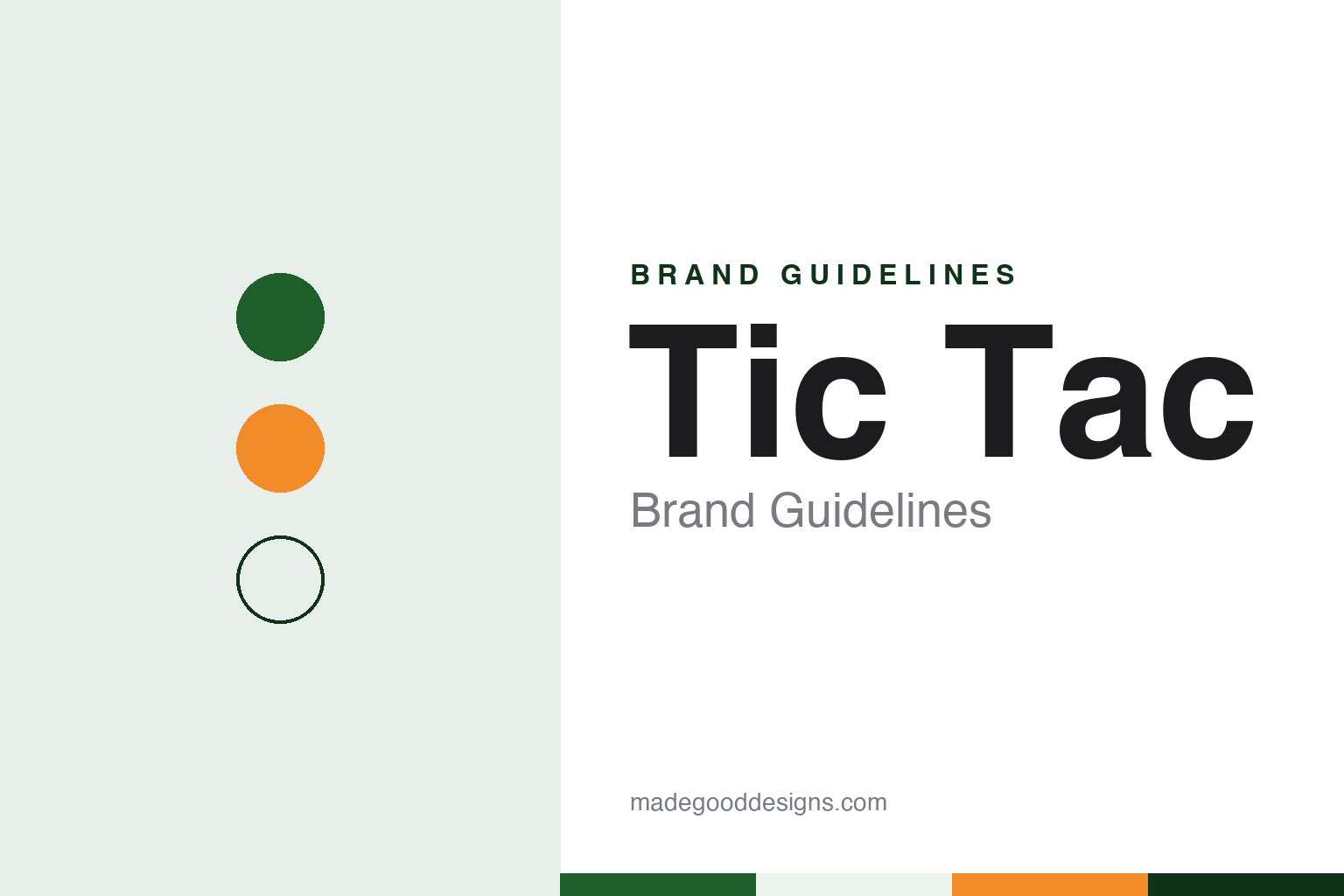
Tic Tac Brand Guidelines
Ferrero’s 1969 “Refreshing Mints,” named for the click of the box.
Aa
Two constants: a Tic Tac green, orange and clear white palette and a geometric sans register. Abstract homage — not a Tic Tac product or mark; no box, logo or mint is reproduced.
Refreshing Mints
An Alba company, a mint and a name taken from a sound.
Tic Tac is a Ferrero brand, and Ferrero is a company from Alba, in Piedmont. English Wikipedia says the group grew from the business of Pietro Ferrero, a pastry-maker who in 1946 made a cream of hazelnuts and cocoa in the town; the International Directory of Company Histories says he had moved his pastry shop to Alba in 1942. The company is still privately owned by the Ferrero family and has its headquarters in Alba, English Wikipedia says, with Giovanni Ferrero as executive chairman; in 2017 Lapo Civiletti became its first chief executive from outside the family. Wikipedia counts 36 Ferrero plants as of 2025.
The mint came at the end of the 1960s. English Wikipedia says Ferrero introduced it in 1969 under the name “Refreshing Mints,” and in 1970 renamed it Tic Tac, after the clicking sound the pack makes as it is opened and closed. The design consultancy Pemberton & Whitefoord, which says it has worked with Ferrero on Tic Tac branding and packaging for more than a decade, gives the same dates in its own history of the brand. It says mint came first, orange followed a year later, and lemon arrived in 1972.
America followed at once. The Directory says Ferrero opened a sales office in New York City in 1969 to introduce Tic Tac to North America, and Ferrero’s own American press material says the brand was launched in the United States in 1969 and has been a leading mint brand there for more than 50 years. English Wikipedia says that since 1980 the brand’s American slogan has been “The 1½ Calorie Breath Mint.”
Colour
A clear box, a new material and a redrawn identity.
The pack is the best-known part of the brand, and the name comes from it. English Wikipedia describes Tic Tacs as sold in small transparent plastic boxes with a flip-action living-hinge lid. Pemberton & Whitefoord calls the clear flip-top box the brand’s trademark and credits it with dispensing the mints one at a time.
The material has changed. In June 2009 Confectionery News reported that Ferrero was switching Tic Tac boxes in the United States from polystyrene to polypropylene, while keeping their clear, familiar look. Ferrero said the change would cut greenhouse-gas emissions by 44 per cent and energy use by 34 per cent, and use 296 tonnes less packaging a year. The new boxes carried a printed call to recycle; the brand manager at the time, Jim Morris, told the magazine the company wanted to encourage consumers to “reduce, reuse, and recycle.”
The identity has been redrawn as well. The branding agency Team Créatif says it created a new global identity for Tic Tac covering 40 countries: it defined the brand’s strategic platform, simplified the logo “for greater impact and immediacy,” built a graphic system meant to stand on its own for what it calls “TicTacness,” and applied it to new packaging. Its case study does not give a year. English Wikipedia shows the 1969 and 1970 logos alongside the current one, which is written in lower case.
Typography
Design and documentation.
The seven brands in this group all make mints, pastilles, throat sweets or chews, and they come from the Netherlands, Italy, Britain and Switzerland: Mentos, Tic Tac, Altoids, Polo, Fisherman’s Friend, Ricola and Fruittella. Sugar confectionery brands in general sit at many different points in the trade, from family firms that still carry a founder’s surname to names that now belong to much larger confectionery groups, and a single brand can be sold everywhere from a station kiosk to a supermarket checkout.
A sweet brand’s identity is usually carried less by a single sweet than by a pack, a name and the moment it promises, because the company behind the name may have changed hands, moved its factory or grown far beyond the town where it started. That makes the questions behind each name worth asking plainly: who started it, who owns it now, and where its sweets are actually made and packed.
Each guide separates what independent sources record from what the company says about itself — its founding story, its owners over time, where its sweets are made and how its packaging has changed — and marks plainly what rests only on the company’s own word.
Aa
A clean geometric sans for a clear plastic box. (Specimen set in Poppins, a sans STAND-IN; NOT the Tic Tac logo.)
Tic Tac
Made in Cork, Brantford, Lithgow and beyond.
Tic Tac is made on several continents. English Wikipedia names plants in Cork, Ireland, and in Australia, Canada, India and Ecuador, and says the brand is sold in more than 100 countries. In June 2025 The Irish Times reported that Ferrero Ireland’s Cork plant makes more than a third of the world’s supply of Tic Tacs, as well as their plastic packaging, and employed 317 people; Wikipedia puts Cork’s share at 35 per cent.
In North America, Confectionery News reported in 2016 that Ferrero’s plant in Brantford, Ontario, established in 2006, makes Tic Tac alongside Nutella, Kinder Surprise, Ferrero Rocher and Raffaello. In Australia, Ferrero’s food-service website says Tic Tac is manufactured in Lithgow, about three hours west of Sydney. English Wikipedia lists flavours from the original mint and orange to spearmint and lime.
Ferrero also uses campaigns to add flavours. Ferrero says its “Choose Your Match” campaign, run in more than 25 countries in the autumn of 2024, asked fans to vote for a limited-edition flavour from five contenders, and that dragon fruit won; its global junior brand manager, Louis Kevin Gambut, said fans were “at the heart of our brand.” In February 2026 Ferrero launched Tic Tac Dr Pepper mints in the United States, a limited-time collaboration with the soft drink sold in the usual pocket-sized box. In both announcements Ferrero presents Tic Tac as one of the world’s leading brands of pocket confectionery, recognisable by its flip-top pack; we give that as the company’s description.
For a design guide, Tic Tac shows a brand whose name was taken from its own pack. Compare Kinder and Ferrero Rocher, two other Ferrero brands. For this guide we use a leaf green, an orange and a clear white with a geometric sans, an unofficial interpretation; no product or logo is reproduced.
Explore & save
Keep Tic Tac’s identity on hand — save it to a board in the Made Good inspiration library.
Tic Tac identity set
Pin the Tic Tac green, orange and clear white palette and the geometric sans register to your own board.