Koko Black Brand Guidelines
The Royal Arcade chocolatier that survived administration.
Aa
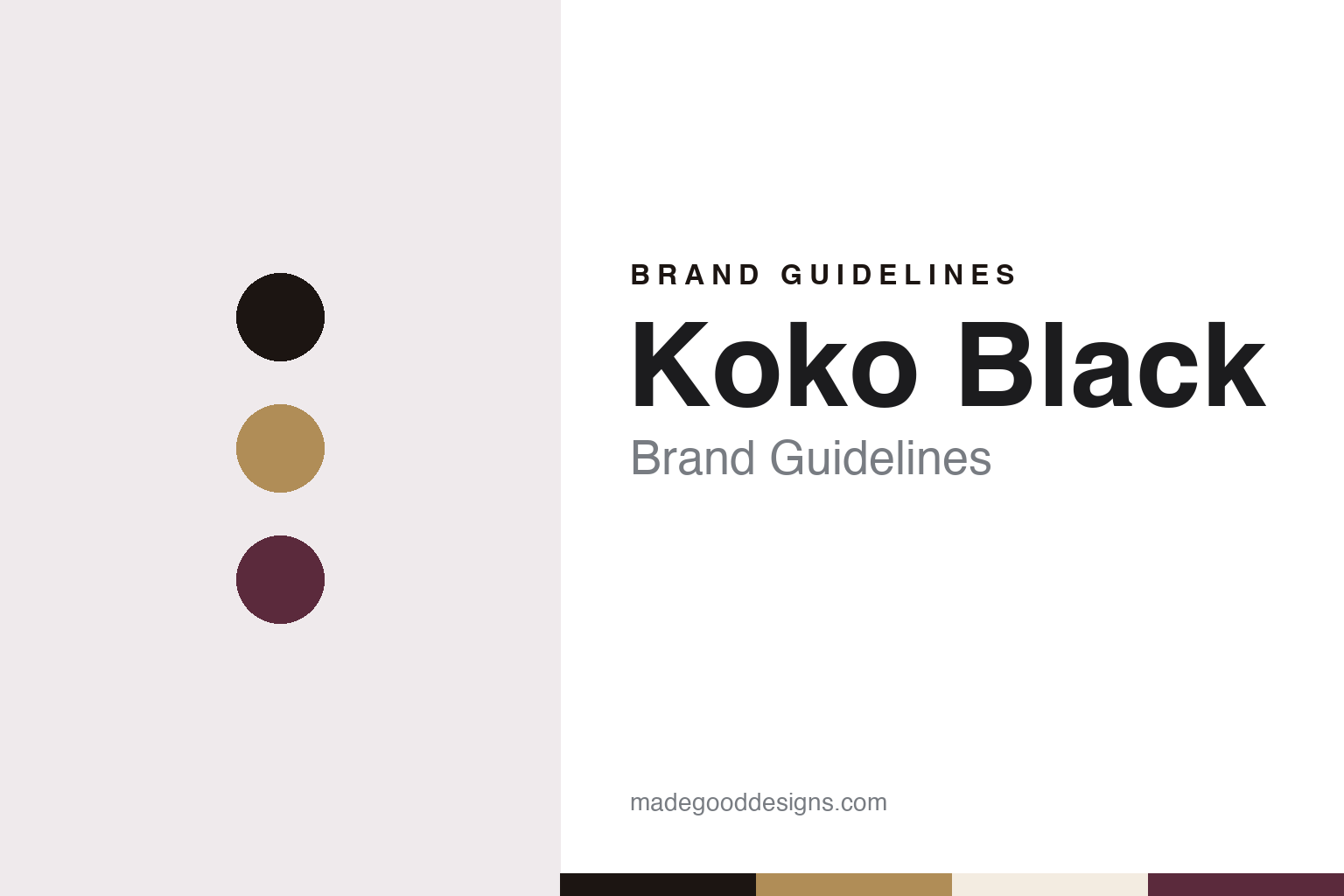
Two constants: a black, plum and gilt palette and a salon serif register. Abstract homage — not a Koko Black product or mark; no box, logo or wrapper is reproduced.
The Royal Arcade
A chocolate salon under Victorian arches.
Koko Black opened its first shop in Melbourne in 2003, inside the Royal Arcade, the shopping arcade between Bourke Street Mall and Little Collins Street that Wikipedia describes as the oldest surviving arcade in Australia, opened in 1870. The trade magazine Baking Business gave the same founding place and year in November 2025, and SmartCompany dated the first outlet to 2003 when it reported on the business in 2015.
The company tells its own origin story in a few lines. In the early 2000s, it says, its founders decided that Australia lacked “premium, world-class, distinctively Australian chocolate,” travelled to Belgium “with a hunger to learn and a hankering for ganache,” and came back with the Belgian chocolatier Dries Cnockaert, with whom they opened the Royal Arcade store. Its website names the founder only by his first name, Shane, and we have not found a full name in the sources checked, so we leave it there.
Koko Black is a chocolatier, not a bean-to-bar maker; it says it works with couverture, the high-cocoa-butter chocolate that confectioners buy in to temper, mould and enrobe, and no source we checked says it roasts cocoa beans itself.
The company says one store became fifteen and that its first small collection of pralines grew into a range of about 260 truffles, marbles, blocks, boxes and hot-chocolate blends. By 2015, SmartCompany reported, it had outlets in Melbourne, Perth, Canberra, Brisbane, Adelaide and Sydney, and one in Queenstown, New Zealand, with about 300 staff across retail and wholesale.
Colour
Administration, then a burger founder.
Growth outran the business. In April 2014, SmartCompany reported, Koko Black received a $3 million grant from the Victorian Government’s Melbourne’s North Innovation and Investment Fund towards a $10.9 million new headquarters in Melbourne’s northern suburbs, which it called “The Alchemy Hall Project.” Its central manufacturing facility was then in Coburg, in the city’s inner north.
On 9 November 2015 Deloitte’s Salvatore Algeri and Glen Kanevsky were appointed voluntary administrators of Koko Black Group and several related companies, according to notices reported by SmartCompany. The shops kept trading through Christmas. “The business expanded very rapidly and undertook a series of major projects over the past 18 months,” Algeri said; “in combination, the level of activity was beyond the resources of the business.” The New Zealand store was not part of the administration, and within a week the administrators were advertising the business for recapitalisation or sale.
In January 2016 a company owned by Simon Crowe, founder of the Grill’d burger chain, bought Koko Black out of administration, Deloitte confirmed to SmartCompany. Most of the 14 stores were expected to transfer, with two or three salons left out. In a letter to staff Crowe said the brand’s culture was “founded on product quality, creativity and design,” and that what it needed was better systems, processes, reporting and analytics.
Under Crowe the business rebuilt online. Chief executive Nicolas Georges told SmartCompany in March 2021 that online sales rose 250% in 2020, the first pandemic year, and that the company then had 14 stores and about 300 staff, roughly 100 of them at its Melbourne site. It sold gift boxes with Australian distilleries such as Four Pillars and Starward.
Typography
Design and documentation.
The seven brands in this group all sell chocolate, and they come from three countries: Haigh’s, Darrell Lea and Koko Black from Australia, Whittaker’s from New Zealand, and Laura Secord, Purdys and Rogers’ Chocolates from Canada. They are grouped here because they share a market position more than a style: each is a home-grown name in a country whose chocolate shelves are also stocked by international groups.
They reach shoppers in different ways. Some are known mainly through their own shops, where the window, the counter and the box do much of the work of a brand; others are known mainly through supermarket shelves, where a wrapper has a few seconds to be recognised. Many sit between the two, and the line between a chocolatier, a confectioner and a chocolate maker is not always drawn the same way from one company to the next.
Each guide separates what independent sources record from what the company says about itself — who founded it, who owns it now, where its cocoa comes from and where its chocolate is made — and marks plainly what rests only on the company’s own word.
Aa
A high-contrast salon serif for a chocolate house. (Specimen set in Playfair Display, a serif STAND-IN; NOT the Koko Black logo.)
Koko Black
Native flavours and a second factory.
The brand now leans on Australian ingredients. The company says that although it learned from European chocolatiers it is “loudly and proudly Australian,” and lists flavours including lemon myrtle, whipstick wattle, Davidson plum and green ants. Its website describes its chocolate as “handcrafted using premium, natural ingredients, free from artificial colours and flavours”; we give that as its claim.
Expansion resumed in 2025. On 27 March a flagship opened in The Market Pavilion at Chadstone, Melbourne, which Baking Business reported as the brand’s 20th store in Australia, with a hot-chocolate bar and the largest praline counter it had built. In early April Koko Black bought Chocolatier Australia, a Melbourne chocolate maker, and its production facility at Heidelberg West, which includes a 4,000-square-metre climate-controlled warehouse, Baking Business reported, citing Food & Drink Business; production would continue at its Coburg North site for the immediate future. Crowe, named as owner, called the purchase “a testament to our confidence in the brand’s strength,” and the company said it planned seven to ten new stores in the 2026 financial year.
On 5 December 2025 it reopened in Queensland with a store in Brisbane’s Queen Street Mall, its 22nd, chief executive Rory Gration said; the state’s first Koko Black, opened in 2014, had closed after the administration. Baking Business, citing Linium Intelligence, reported that Koko Black held more than a tenth of Australia’s direct-to-consumer chocolate market, on a par with Lindt and behind Haigh’s.
For a design guide, Koko Black shows how a chocolatier can sell a place — an arcade salon — as much as a product, and keep that story through a change of owner. Compare Haigh’s, the older Australian chocolate retailer it trails, and Neuhaus, the Brussels praline house of the tradition it learned from. For this guide we use black, plum and gilt with a serif, an unofficial interpretation; no product or logo is reproduced.
Explore & save
Keep Koko Black’s identity on hand — save it to a board in the Made Good inspiration library.
Koko Black identity set
Pin the Koko Black black, plum and gilt palette and the salon serif register to your own board.