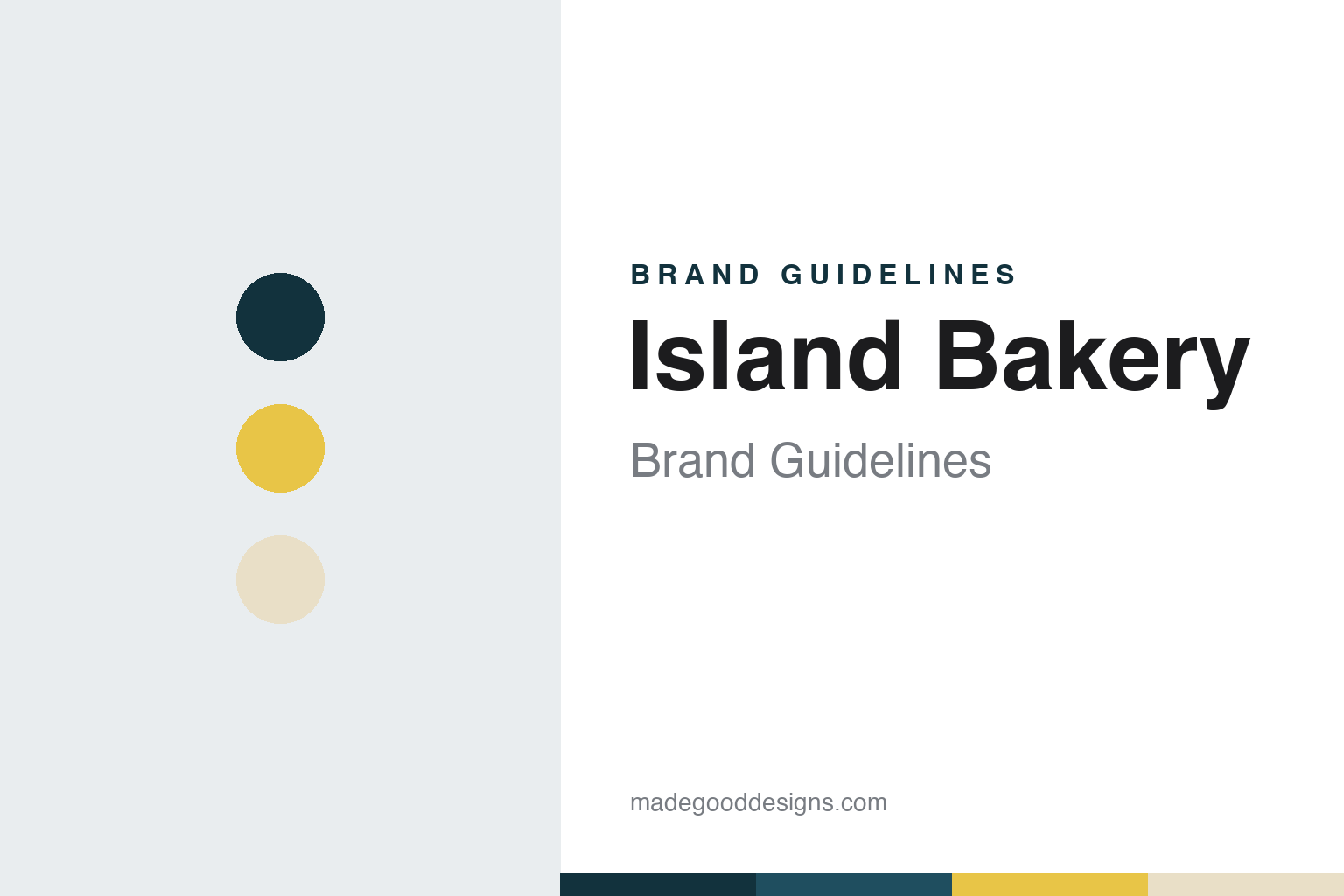
Island Bakery Brand Guidelines
The Tobermory bakery making organic biscuits on the Isle of Mull.
Aa
Two constants: an Island Bakery sea blue and lemon palette and a bookish serif register. Abstract homage — not an Island Bakery product or mark; no carton, logo or biscuit is reproduced.
A garage in Tobermory
Bread first, biscuits later.
Island Bakery is an organic biscuit maker in Tobermory, the main town on the Isle of Mull in the Inner Hebrides. Its own history says the business was started by Joe and Dawn Reade, two graduates of the University of Edinburgh, who began baking bread in a converted garage in Tobermory in 1994, when the town’s baker was retiring. The bakery’s first trade was bread for the island, not biscuits.
The company says the couple bought a shop on Tobermory’s Main Street in 1996 and ran it as the Island Bakery Delicatessen. In 2001 they launched Island Bakery Organics, a range of organic biscuits that started, the company says, with four varieties. Among its first customers were the London department stores Harvey Nichols and Selfridges, and the company says the range picked up several Great Taste awards and an organic food award in its first year. In 2007, it says, the Reades sold the delicatessen to concentrate on biscuits.
A larger bakery followed. The company says its new bakery was completed in June 2012 and is powered by local renewable energy: a hydro turbine on the river in Tobermory, a wind turbine, and ovens heated by wood chip. Those details are the company’s own account. Today it describes itself as a team of about 40 people, and its website still presents Joe and Dawn Reade at the head of the business, with no outside owner named. Companies House lists the trading company, Island Bakery Organics Limited, as active.
Colour
Lemon Melts and a Dragons’ Den pitch.
The bakery’s best-known biscuit is the Lemon Melt. In July 2017 the company said Lemon Melts had been voted the Nation’s Favourite Organic Product at the BOOM (Best of Organic Market) Awards, after a public nomination, and in September 2021 it said they had received a two-star Great Taste award, one of four Great Taste awards it reported for its products that year. Its Apple Crumbles, which the company calls Joe Reade’s favourite, won two stars at the Great Taste awards in 2020 and the sweet organic bakery category at the BOOM awards in 2021; its Organic Three Seed Oatcakes won a vegan category at the same awards a few months after launch. The bakery also makes shortbreads, Chocolate Gingers and what it calls “savoury nibbles.”
Its biscuits reached supermarket shelves gradually. In January 2016 the company announced that its biscuits were on sale in Booths, and in March 2017 it said three lines — Lemon Melts, Chocolate Gingers and Shortbread — would go into 260 Waitrose stores. In January 2021 it reported that it had been placed in the top five sweet and savoury biscuit brands in Fine Food Digest’s Best Brands 2020/21, a survey of independent delicatessens, farm shops and food halls, alongside Border Biscuits and Peter’s Yard. In March 2019, it says, it won the Artisan Food category at the Scottish Rural Awards in Edinburgh.
Beyond its own online shop, the company sells to the trade. Its website has a trade shop, a list of distributors and a set of point-of-sale materials for resellers.
Island Bakery has also had a brush with television. English Wikipedia’s list of offers made on the BBC programme Dragons’ Den records that Joe Reade pitched Island Bakery in an episode broadcast on 2 September 2009, asking for £150,000; no deal was made.
Typography
Biscuits, wrappers and ownership.
The seven brands in this group all make biscuits, and they come from three parts of Britain: Border Biscuits, Paterson’s, Island Bakery and Crawford’s from Scotland, Duchy Originals and Fudges from England, and Burton’s from Britain more widely. Biscuit brands in general sit at many different points in the trade, from everyday packets on a supermarket shelf to small-batch boxes sold through delicatessens, and a single company can work at both ends at once.
A biscuit brand’s identity is usually carried less by a single mark than by a recipe, a wrapper and the familiar shape of the biscuit inside, and the name on the front may have outlived the bakery, the family or the town that first made it. That makes the questions behind each name worth asking plainly: who started it, who owns it now, which larger groups it has passed through, and where its biscuits are actually baked today.
Each guide separates what independent sources record from what the company says about itself — its founding story, its owners over time, its recipes and where its biscuits are made — and marks plainly what rests only on the company’s own word.
Aa
A bookish serif — a small island bakery’s register. (Specimen set in Lora, a serif STAND-IN; NOT the Island Bakery logo.)
Island Bakery
Card cartons and paper boats.
Packaging is one part of the brand the company explains in detail. On its website, Island Bakery says that Dawn Reade looks after its social media, its marketing and its packaging design. The company calls its range “Organic Indulgence from the Hebrides” and describes itself as a maker of “Scotland’s finest organic biscuits” — both its own phrases.
The company says most of its biscuits are sold in card cartons, and that the card is carbon-balanced through the World Land Trust. Gift packs come in tins, and two-biscuit packs in foiled flow-wrap film are made for hotels, trains and coffee shops. It says it tested compostable films and decided against them, and that it replaced the acetate trays inside its cartons with paper “boats.” It also says that the film inside its cartons is not yet recyclable and that it is trialling a recyclable alternative. The company says its organic ingredients are traceable, and that its biscuits contain no genetically modified ingredients, no preservatives and no artificial colours or flavours. We found no published brand guidelines and no official colour values.
For a design guide, Island Bakery shows how a small producer can build a brand on one place — a harbour town on a Hebridean island — and on a clear account of what goes into its biscuits and packs. Compare Walker’s Shortbread, another Scottish family bakery that tells its story through where it bakes, and Nairn’s, a Scottish oatcake maker. For this guide we use a sea blue, a deep water blue, a lemon yellow and an oat cream with a serif, an unofficial interpretation; no product or logo is reproduced.
Explore & save
Keep Island Bakery’s identity on hand — save it to a board in the Made Good inspiration library.
Island Bakery identity set
Pin the Island Bakery sea blue and lemon palette and the bookish serif register to your own board.