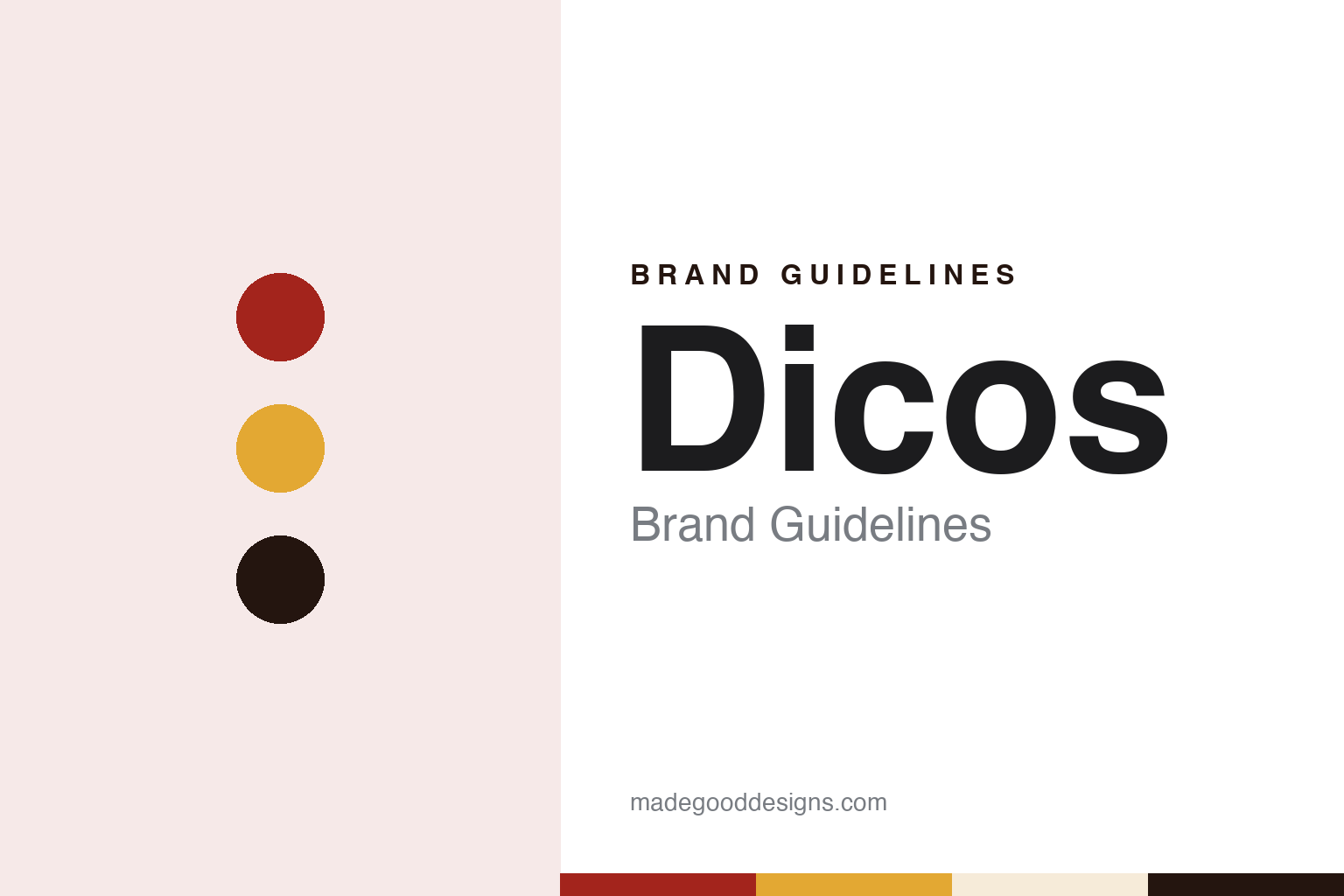
Dicos Brand Guidelines
A Chengdu fried-chicken chain grown through franchising.
Aa
Two constants: a chilli red, fryer gold and dark roast palette and a heavy sans register. Abstract homage — not a Dicos product or mark; no logo, packaging or menu item is reproduced.
Chengdu, 1994
A Sichuan start and a Taiwanese owner.
Dicos began in Chengdu, the capital of Sichuan province, in 1994, according to English Wikipedia and Inside Retail Asia, which described it in October 2013 as a fast-food chain with a Western-style menu. In Chinese the name is written 德克士, Dékèshì in pinyin, and English Wikipedia says the company styles its wordmark in lower case as “dico’s”. Chinese Wikipedia, drawing on the company’s own account, says the chain presents its fried-chicken flavour as coming from Texas in the American South.
The chain changed hands early. In 1996 it was bought by the Ting Hsin group, the Taiwanese food company behind the Master Kong noodle and drinks brand, Chinese Wikipedia says; the new owner rebuilt the chain’s corporate identity system and set Dicos up as a sister brand to Master Kong. The Shanghai business site Jiemian gave 1996 as the year Dicos was established in Chengdu when it reported on the company in April 2019, while English Wikipedia and Inside Retail Asia both give 1994 as the founding year.
Today the chain sits inside a restaurant company that English Wikipedia names as Tianjin Ding Qiao Food Service and that Chinese business press call the Ting-Qiao (顶巧) catering group. Inside Retail Asia described the owner in 2013 as the Taiwanese food manufacturer Ting Hsin International Group. In April 2019 Jiemian reported that Dicos had moved its head office from Tianjin to Shanghai, which the company presented as a way of staying close to the big-city market and learning from it. English Wikipedia lists further company offices in Chongqing, Guiyang, Wuhan and Changsha.
Colour
Crispy chicken, rye buns and a 24 April ritual.
Fried chicken is the centre of the menu. Jiemian wrote in September 2026 that customers know Dicos mainly for its crispy fried chicken and its crispy “pistol leg”. Chinese Wikipedia lists the pistol leg in flavours including a Xi’an-style chilli-oil version and a black-gold rattan-pepper version, alongside crispy chicken pieces, drumsticks and Japanese-style karaage. Burgers come in two named bread styles, rye buns and a soft French-style bread, and wraps and sides such as spicy wings and golden fish fingers make up the rest of the list. Chinese Wikipedia groups the whole menu into burgers, fried chicken, rice dishes, drinks and sides, and names fried chicken as the main product.
The chain has also built rituals for its staff. Chinese Wikipedia says that since 2014 restaurants across the country have closed for four hours on the morning of 24 April each year for “Crispy Day”, when employees train together on frying technique. It is one of the few brand events that the encyclopaedia records in detail.
Technology and tie-ins have been part of the image too. In November 2017 Yicai Global, citing the Beijing News, reported that Dicos had opened its first unstaffed restaurant in Shanghai, where customers chose food, placed orders and paid on touch screens; at that point the chain ran about 2,300 outlets. Jiemian noted in 2019 that the brand had earlier run promotions with the World of Warcraft game and the Justice League films, using licensed characters to reach younger customers.
The visual identity is now being reworked. In April 2026, Jiemian reported in September, the general manager of the Ting-Qiao restaurant group said Dicos was updating its brand visuals, store interiors and product packaging, and that newer restaurants were adding family-friendly areas while also catering for solo diners and groups of friends. The company has not published a typeface or colour specification, so the tones in this guide are an unofficial interpretation.
Typography
How the category presents itself.
China’s tea-drink, coffee, burger and restaurant chains present themselves first at street level. A shopfront, a cup and a paper bag are often the first things a customer sees of the brand, and many chains add a mascot, a theme song or a recurring character that appears on signs, packaging and social media at the same time. Some keep their shops small and built for takeaway; others put the same care into seating, lighting and a bakery counter as into the drinks.
Menus are usually organised by named drinks and dishes rather than by codes. Fruit teas, cheese-topped teas, lemon drinks, soft-serve ice cream, fried chicken and hotpot appear under house names, and chains that move abroad often add local flavours while keeping the core list the same. The names, the cups and the colours of the shop carry the brand from one city to the next.
The size of a network is something these companies publish themselves, in annual reports, listing documents and on their own sites, and the press repeats those counts with a date attached. Some chains run every shop directly; others rely mainly on franchisees, and several have moved from one model to the other. Store networks now reach Southeast Asia, Australia, Europe and North America as well as the home market.
Ownership is usually set out plainly on corporate pages: who founded the business and where, which group owns it now, and whether its shares trade in Hong Kong, on a mainland exchange or in New York. This guide follows those published facts, attributes counts to dated sources, and treats each chain’s visual identity as a design subject rather than a claim about its food or drinks.
Aa
A heavy sans for a lower-case fried-chicken wordmark. (Specimen set in Archivo Black, a sans STAND-IN; NOT the Dicos logo.)
Dicos
A franchise network across smaller cities.
Franchising carried Dicos across China. Jiemian reported in April 2019 that the chain had taken franchisees since 1999 and that about 85 per cent of its restaurants were franchised; of roughly 2,500 stores at that time, about 200 were in first- and second-tier cities, with the rest in smaller cities and county towns. In the same report the company said it relied mainly on restaurants run by its own head office in the hardest big-city markets, such as Beijing, Shanghai and Guangzhou, and its chief executive contrasted smaller-city diners, drawn by seasoning, with big-city diners, drawn by the choice of ingredients.
The network has grown since then. Chinese Wikipedia gives more than 3,000 restaurants as of 2024, and in September 2026 Jiemian cited the company’s website as listing more than 3,000 stores nationwide, about 85 per cent of them franchised. Outside mainland China, Chinese Wikipedia records a Taiwan branch in Taipei 101 from May 2013, a Hong Kong branch in North Point from the first quarter of 2023, a second Hong Kong shop in Wan Chai from November 2023 that had changed hands by February 2024, and a Mong Kok site in 2025 that opened alongside a Lanzhou beef-noodle brand.
For a design guide, Dicos shows how a fried-chicken chain from Chengdu built recognition around a short list of signature products, a lower-case wordmark and a large franchise estate, and how it is now refreshing its visuals, interiors and packaging. Compare it with KFC, the American fried-chicken chain it competes with in China, and with Tastien, a Fujian burger chain that also grew through franchising. For this guide we use a chilli red, a fryer gold and a dark roast brown with a heavy sans, an unofficial interpretation; no product or logo is reproduced.
Explore & save
Keep Dicos’s identity on hand — save it to a board in the Made Good inspiration library.
Dicos identity set
Pin the Dicos chilli red, fryer gold and dark roast palette and the heavy sans register to your own board.
Source & notes
Frequently Asked Questions
What font can I use to match the Dicos look?
This guide describes Dicos’ type as “A heavy sans for a lower-case fried-chicken wordmark”. Its type specimen is set in Archivo Black from Google Fonts as a stand-in; Archivo Black is not Dicos’ own lettering.
What colours are in the Dicos palette?
This guide’s Dicos palette is Chilli red #A3241C, Fryer gold #E3A833, Dark roast #24150F, Batter cream #F6EBD9 and Paper #FAF7F2. The tones are the guide’s own unofficial interpretation, not official Dicos hex codes.
When was Dicos founded?
Dicos was founded in 1994, in Chengdu, Sichuan. Dicos is known for Crispy fried chicken, crispy pistol leg.