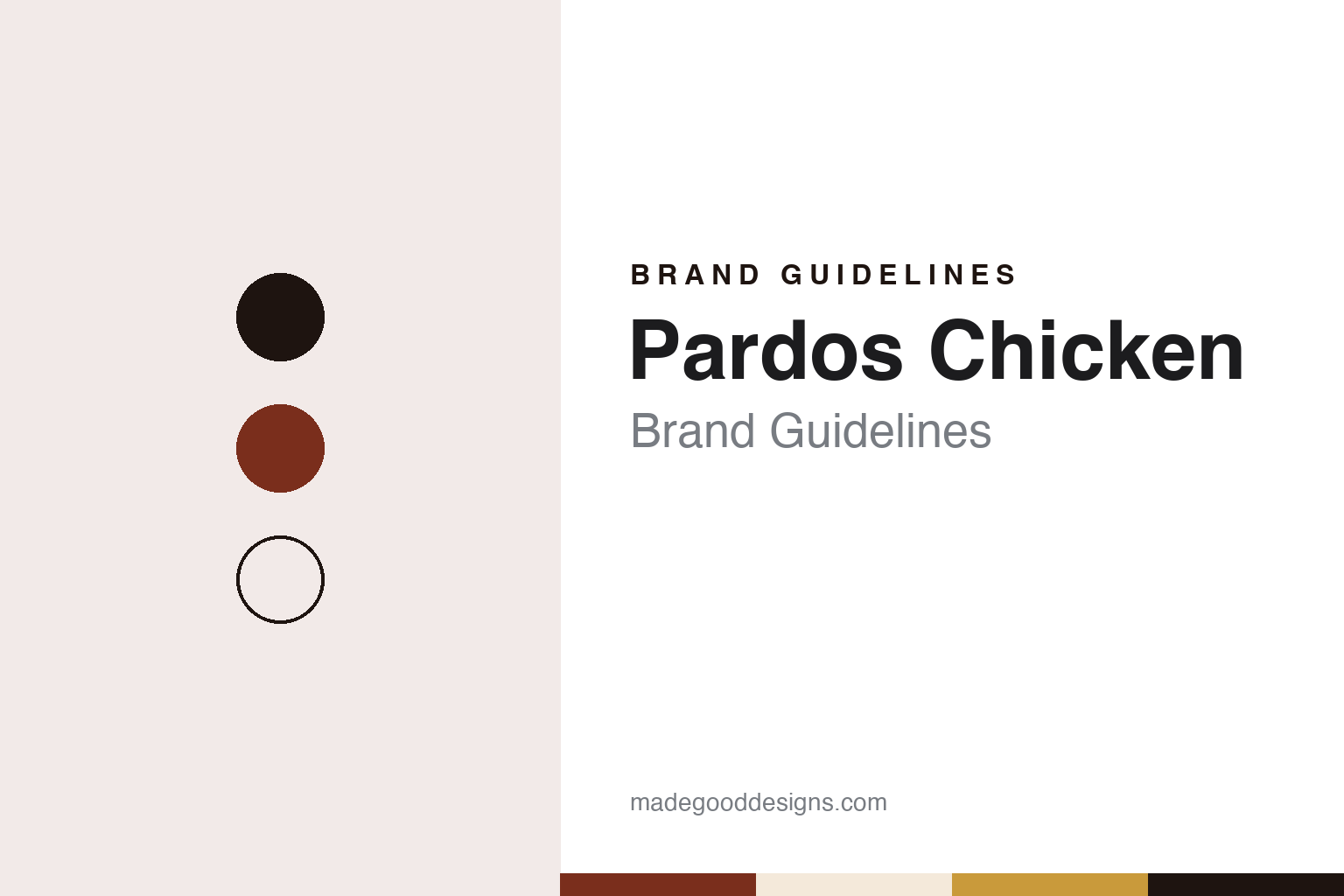
Pardos Chicken Brand Guidelines
The Miraflores pollería named after Avenida Pardo.
Aa
Two constants: a Pardos Chicken ember brown, cream and gold palette and a Warm serif register. Abstract homage — not a Pardos Chicken product or mark; no dish, logo or sign is reproduced.
Avenida Pardo
A pollería named after the street it stood on.
Pardos Chicken began in the Lima district of Miraflores. It opened on 6 December 1986, according to a history of the chain published by the Peruvian business site Infomercado in March 2024, and its founders were Willy Wong and his business partner Antonio Ortiz. Gestión, the Lima business daily, wrote in July 2024 that the first restaurant stood on Avenida José Pardo, and that the avenue gave the chain its name. The paper spells the brand both as Pardos Chicken and as Pardo’s Chicken.
Wong came to the chicken trade by way of office lunches. Gestión reported that before 1986 he had already opened two restaurants, Orlys and Chicken’s Hut, and before them a small place called El Ruiseñor in San Isidro, Lima’s financial district, which served home-style set lunches to office workers under the name “menú ejecutivo.” Infomercado adds that Chicken’s Hut, on Avenida Alfredo Benavides in Santiago de Surco, was a three-table pollería run with Ortiz, and that a third partner, Raúl Núñez, later found a plot for rent on the fifth block of Avenida José Pardo. The first idea for that plot was a drive-in; Ortiz argued for what the partners already knew, pollo a la brasa, and the new restaurant took the avenue’s name.
The recipe belongs to the early kitchen staff. Gestión names the first chefs as Manuel, a cook, and Irineo, a grill man: Irineo created the house recipe, and Manuel refined it and fixed the quantities of each ingredient. The paper reports that the chickens are still seasoned by hand twenty-four hours before cooking.
The original restaurant did not stay on Avenida Pardo. In 1995, Gestión reported, it moved from the fifth to the seventh block of Avenida Alfredo Benavides, into a building designed like a Miraflores house in the style of a hacienda. Infomercado says the founders bought that site so that they no longer depended on rented premises. Laura Wong, the founder’s eldest daughter, manages that restaurant, according to Gestión.
Colour
From a founders’ restaurant to Wu Restaurantes.
The chain changed hands in the second half of the 1990s. Infomercado says Wong and Ortiz began franchising the brand in 1996, and that two young entrepreneurs, the brothers Edwin and Arnold Wu, bought a franchise to open a Pardos Chicken in San Isidro. Running a franchise network was a different job from running one restaurant, and the founders sold the majority of the business to the Wu brothers. Gestión dates the purchase of the brand to 1997 and says the brothers then set up a company called Servicios de Franquicia Pardo’s, which still exists; in an interview published by EY Peru, the Wu side dated the first purchase to 1998 and said it had bought the brand alone, at first with a 70% stake and later the whole of it.
The Wu brothers built a restaurant group around the brand. Gestión describes Wu Restaurantes as a holding company with Arnold Wu as executive president and Edwin Wu as general manager of Pardos Chicken. In April 2024 the paper listed its brands as Pardos Chicken, the chifa chain Mr. Shao and Tampa Chicken; in November 2023 it also named Planet Chicken, which pairs pollo a la brasa with Peruvian criollo dishes and is aimed at districts in the north, centre and east of Lima. In the EY interview the company said it had stopped granting franchises in Peru in 2003.
Growth was concentrated in the capital. In November 2023 Gestión reported that the chain had six restaurants outside Lima, in Piura, Trujillo and Chiclayo, and was building its first restaurant in the south, at the Mall Aventura Porongoche in Arequipa. By April 2024 the paper reported that the Arequipa restaurant had opened, put the chain at more than 30 restaurants in Lima, Trujillo, Chiclayo, Piura and Arequipa, and reported a new line of sandwiches alongside the chicken. In Lima the group returned in late 2023 to the Larcomar centre in Miraflores, a site it had previously franchised, reopening it with the same operator, Gestión reported.
Abroad the record is mixed. Perú Retail reported in January 2026 that the chain’s first foreign market had been Chile, in 2003, where it later closed its operations; Gestión still listed a presence in Chile in July 2024. In the EY interview the company also described an earlier restaurant in Miami that ran for about nine years.
Typography
Peru’s pollería chains.
Latin American restaurant, burger, chicken and café chains tend to present themselves first through the street. A shop front carries the name, a short line of colour and often a counter or an ice-cream window that can be read from the pavement, and many chains run more than one format under the same name: a quick-service counter, a table-service restaurant, a kiosk in a shopping centre or a separate ice-cream shop. Drive-through lanes, delivery apps and self-service ordering screens have since joined the shop front as places where the name has to work.
Menus do much of the brand work. Chains in the region usually give their signature dishes their own names, from a house burger to a named roast chicken or a crêpe, and repeat those names across menu boards, packaging and campaigns. Mascots and characters appear in some of these identities, and seasonal campaigns are often built around a new named dish or a limited line rather than around the company itself.
Ownership is often a group matter. Several of the larger chains belong to food or restaurant groups that run a number of brands side by side, sometimes including franchises of international names, and the parent usually describes each brand as a separate business with its own identity. Others have stayed in the hands of their founding families for decades and present that continuity as part of the story.
Corporate pages and the business press fill in the rest: who founded the chain, in which city and year, who owns it now, and where it has opened abroad, usually through franchising in neighbouring countries, Spain or the United States. For a design reader, the useful evidence is what each company itself publishes, and how consistently its name, colours and dishes carry from one format to the next.
Aa
A warm serif for a pollería named after a Miraflores avenue. (Specimen set in Fraunces, a serif STAND-IN; NOT the Pardos Chicken logo.)
Pardos Chicken
A Lima chain that crossed to the Caribbean.
The newest step is in the Caribbean. On 15 December 2025, Perú Retail reported, Pardos Chicken opened its first restaurant in the region, on the fourth floor of the Ágora Santiago Center in Santiago de los Caballeros, the second city of the Dominican Republic; the trade site said the company had announced the opening on its social media channels. At home, the same January 2026 report counted about 30 restaurants in Lima plus locations in Arequipa, Chiclayo and Trujillo.
The dish at the centre of the brand has its own history in Lima. Gestión wrote in November 2025 that pollo a la brasa dates from around 1950 in Santa Clara, in the Ate district, when the Swiss immigrant Roger Schuler began roasting whole chickens over charcoal; another Swiss, Franz Ulrich, designed the rotating oven, and in 2004 Peru declared the dish part of the nation’s cultural heritage. By the time Pardos Chicken opened in 1986, Gestión notes, Norky’s (1976) and Roky’s (1985) were already in business. Peru marks a Día del Pollo a la Brasa in July, and Gestión reported in 2024 that the Pardos management team worked in the group’s restaurants the day after it.
Much of the brand’s story is told through the founders’ habits. Gestión recounts Wong’s “ley de la mesa,” a saying from his father that only good news is shared at the table, which the paper says remains in use in the restaurants Edwin Wu manages, and reports that managers spend a working day in each restaurant several times a year.
For a design guide, Pardos Chicken shows how a restaurant brand can carry the name of a street long after it has left it, and how a founders’ pollería became the core of a wider restaurant group. Compare Norky’s, the older Lima pollo a la brasa chain, and Bembos, another Lima-born restaurant chain. For this guide we use an ember brown, a cream and a toasted gold with a warm serif, an unofficial interpretation; no product or logo is reproduced.
Explore & save
Keep Pardos Chicken’s identity on hand — save it to a board in the Made Good inspiration library.
Pardos Chicken identity set
Pin the Pardos Chicken ember brown, cream and gold palette and the Warm serif register to your own board.
Source & notes
Frequently Asked Questions
What font can I use to match the Pardos Chicken look?
This guide describes Pardos Chicken’s type as “A warm serif for a pollería named after a Miraflores avenue”. Its type specimen is set in Fraunces from Google Fonts as a stand-in; Fraunces is not Pardos Chicken’s own lettering.
What colours are in the Pardos Chicken palette?
This guide’s Pardos Chicken palette is Ember brown #7A2E1C, Charcoal #1E1410, Adobe cream #F4E9DA, Toasted gold #C99A3B and Paper #FBF7F1. The tones are the guide’s own unofficial interpretation, not official Pardos Chicken hex codes.
When was Pardos Chicken founded?
Pardos Chicken was founded on 6 December 1986, in Miraflores, Lima, Peru.
Who founded Pardos Chicken?
Pardos Chicken was founded by Willy Wong and Antonio Ortiz on 6 December 1986.
Who owns Pardos Chicken?
Pardos Chicken is owned by Wu Restaurantes (Edwin and Arnold Wu).