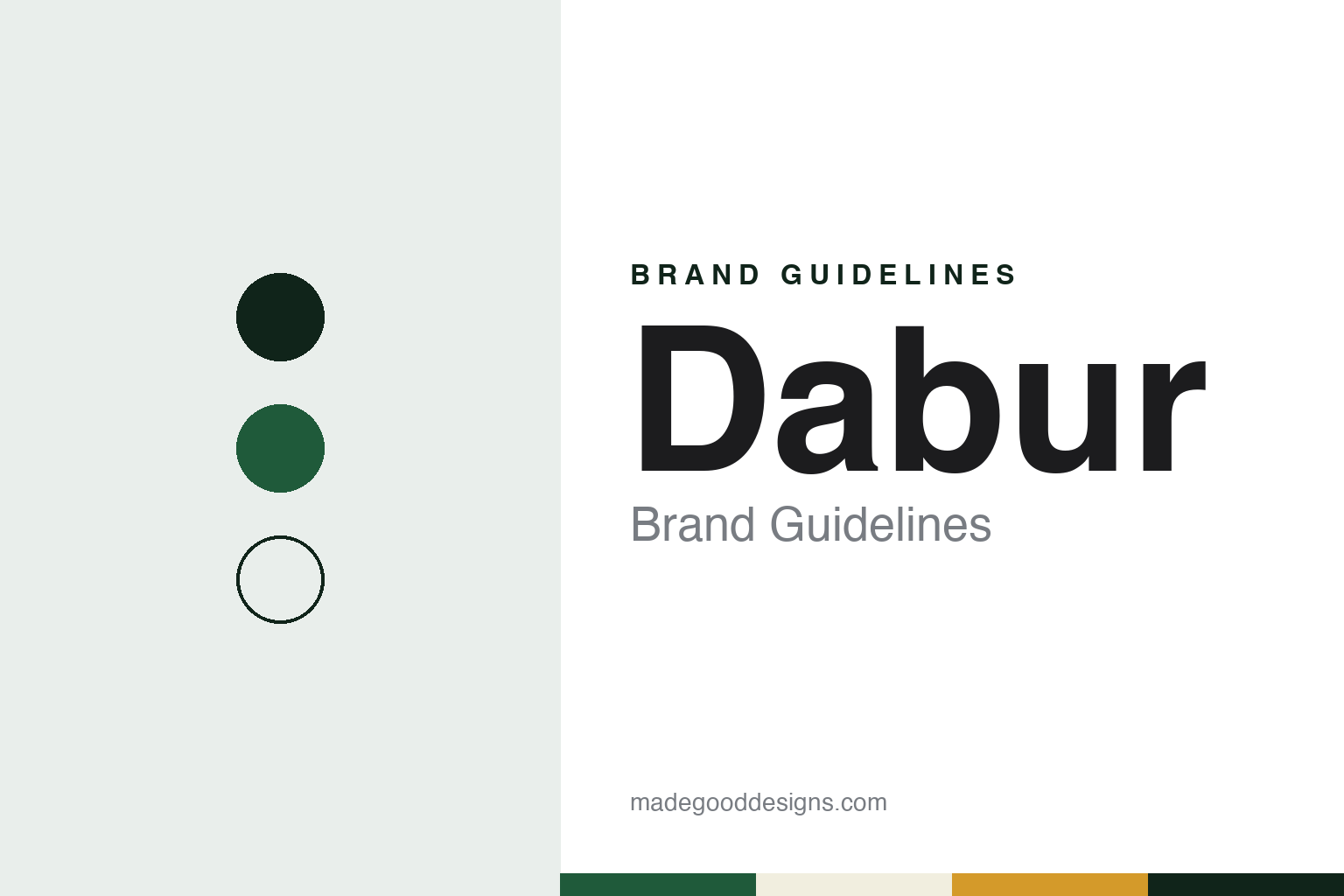
Dabur Brand Guidelines
S. K. Burman’s 1884 Calcutta Ayurvedic firm, now a Ghaziabad consumer-goods group.
Aa
Two constants: a Dabur green, cream and turmeric gold palette and a Warm humanist sans register. Abstract homage — not a Dabur product or mark; no pack, logo or label is reproduced.
Daktar Burman
A Calcutta practitioner’s name becomes a company.
Dabur began in Calcutta in 1884. English Wikipedia says the founder, the Ayurvedic practitioner S. K. Burman, made and sold his own Ayurvedic formulations in Bengal, and that the name Dabur joins two words his customers used for him: daktar, doctor, and Burman. Profit, the Pakistani business magazine, told the same founding story in January 2021, adding that Burman set out to mass-produce, package and market his formulations rather than make them one patient at a time.
The company’s own timeline fills in the early decades. It says Burman set up a manufacturing plant in 1896, that research laboratories followed in 1919, that new units at Narendrapur and Daburgram opened in 1920 as distribution spread to Bihar and the North-East, and that the business became a private limited company, Dabur India (Dr. S. K. Burman) Pvt. Ltd., in 1936. English Wikipedia adds that a grandson moved the factory from Calcutta to Delhi after labour unrest; Dabur dates the shift of its operations to Delhi to 1972, with a plant in temporary premises at Faridabad, and the opening of its Sahibabad factory and a research centre to 1979.
Dabur became a public limited company in 1986 and made its first public share issue in 1994, according to its timeline. English Wikipedia gives its present headquarters as Ghaziabad, in Uttar Pradesh, on the eastern edge of Delhi; the company still lists a registered office in New Delhi. The Burman family remains the promoter, but Dabur says that in 1998 the family handed day-to-day management to professionals and, for the first time in its history, a chief executive from outside the family took charge. Profit reported in 2021 that the family had drawn up a family constitution and a family council and agreed not to hold executive posts in the company.
Colour
Real, Balsara and a portfolio of names.
Much of what shoppers see of Dabur today arrived in the past three decades. The company created a foods division in February 1997, and its Real fruit-juice brand grew out of it; in March 2007 the Economic Times reported that Dabur Foods was marking the tenth year of Real with a new look for the juices and a new fruit-drink line, Real Twist. Dabur’s own timeline records the same 2007 repackaging and the later merger of Dabur Foods into the parent company.
In 2003 Dabur separated its pharmaceuticals business into a new company, Dabur Pharma. In April 2008 the Economic Times reported that the German healthcare group Fresenius Kabi had agreed to take about 73 per cent of Dabur Pharma, with the Burman family leaving the pharmaceuticals business; English Wikipedia records the sale as completed that year.
Acquisitions widened the consumer range. In 2005 Dabur bought the hygiene and home-products businesses of the Balsara group, which, English Wikipedia says, brought brands including Babool, Meswak, Odonil and Odomos. The company dates its purchase of Fem Care Pharma, the maker of the Fem skin-care range, to 2008, and says that in 2010 it made its first acquisitions outside India, buying the Turkish personal-care group Hobi Kozmetik and Namaste Laboratories of the United States. In 2022 Dabur bought a 51 per cent stake in Badshah Masala, a spice maker with two factories at Umargam in Gujarat, the Times of India reported in October 2022; Mint confirmed the purchase in 2024.
In October 2024 Mint reported that Dabur had agreed to buy a majority stake in Sesa Care, maker of Sesa hair oil, from the private-equity fund True North, and to merge the business into Dabur. That merger was agreed in October 2024; not completed at the time of writing. Mint noted that Dabur already sold hair oils under the Dabur Amla, Vatika and Dabur Almond names.
Typography
Ayurvedic brands in Indian retail.
India’s beauty and personal-care brands range from names that began inside old industrial groups to labels that started on their own websites. Lakmé was incorporated in December 1952 as a Tata company, according to Trent, the retailer that the original company became, and its brands passed to Hindustan Lever, now Hindustan Unilever, in 1998, Business Today reported. Dabur says on its corporate site that it started operations in Calcutta in 1884.
Some newer brands describe themselves as digital-first. Honasa Consumer, the owner of Mamaearth, calls itself a “digital-first house of brands” on its corporate website, and says Mamaearth began in 2016. Sugar Cosmetics sold only through its own website and a marketplace partner until 2017, Inc42 reported in 2020, before moving into general trade, large-format stores in malls and its own shops.
Shops and counters remain part of the picture. Sugar’s chief executive told the trade magazine Retail4Growth in 2023 that the brand used exclusive outlets, shop-in-shop counters and multi-brand stores, and that it changes its visual merchandising every year. Lakmé has tied its name to a runway since 2000, when the Fashion Design Council of India and IMG brought it in as title sponsor of a new fashion week, The Tribune reported in 2025.
This guide sets out what can be checked about each brand: when and where it began, who founded and owns it, which named product lines and campaigns it publishes, and how it presents itself in packs, logos and stores. Where a fact rests only on a company’s own pages, the text says so, and the palettes and typefaces shown are an unofficial interpretation rather than any brand’s own.
Aa
A warm humanist sans — for a company whose 2004 logo is built around a tree. (Specimen set in Mukta, a sans STAND-IN; NOT the Dabur logo.)
Dabur
A new logo in 2004, and a name across borders.
Dabur’s present identity dates from the end of 2004. In its issue of 24–30 December 2004, the Nepali Times reported that Dabur had unveiled a new brand identity, with a new logo and the positioning line “Celebrate Life!”, and had grouped its range under five main brands: Dabur, Vatika, Anmol, Real and Hajmola. The Himalayan Times of Kathmandu, reporting the company’s announcement on 31 December, described the new logo as built around a tree, with lettering that kept the character of the old one while moving towards a more contemporary look.
The Hajmola name has its own history outside India. Profit reported in January 2021 that Dabur says it registered Hajmola as a trademark in India in 1958, while the Karachi company Hilal Foods had held a Pakistani trademark on the word since 1982. When Dabur’s Pakistani business began making Hajmola there, Hilal took it to court; a case filed in the Sindh High Court in 1995 ended about four years later with a decision allowing both companies to use the word on their packaging and advertising, and neither side challenged it.
The company’s website now groups its products into hair care, oral care, skin care, home care and foods, among other ranges, with names such as Dabur Red Paste, Dabur Chyawanprash, Odomos and Réal side by side under the one corporate mark.
For a design guide, Dabur shows how a family company’s name, built from a nickname, can carry a wide portfolio of separately named brands, held together by a single mark. Compare Himalaya Wellness, another Indian herbal-products maker, and Biotique. For this guide we use a deep green, cream and a turmeric gold with a sans, an unofficial interpretation; no product or logo is reproduced.
Explore & save
Keep Dabur’s identity on hand — save it to a board in the Made Good inspiration library.
Dabur identity set
Pin the Dabur green, cream and turmeric gold palette and the Warm humanist sans register to your own board.
Source & notes
Frequently Asked Questions
What font can I use to match the Dabur look?
This guide describes Dabur’s type as “A warm humanist sans — for a company whose 2004 logo is built around a tree”. Its type specimen is set in Mukta from Google Fonts as a stand-in; Mukta is not Dabur’s own lettering.
What colours are in the Dabur palette?
This guide’s Dabur palette is Banyan green #1F5A3A, Forest ink #10241A, Ghee cream #F1EEDF, Turmeric gold #D49A2A and Paper #FAF8F1. The tones are the guide’s own unofficial interpretation, not official Dabur hex codes.
When was Dabur founded?
Dabur was founded in 1884, in Calcutta (Kolkata), India. Dabur is known for Dabur Chyawanprash, Vatika, Real, Hajmola.
Who founded Dabur?
Dabur was founded by S. K. Burman in 1884. Dabur is known for Dabur Chyawanprash, Vatika, Real, Hajmola.