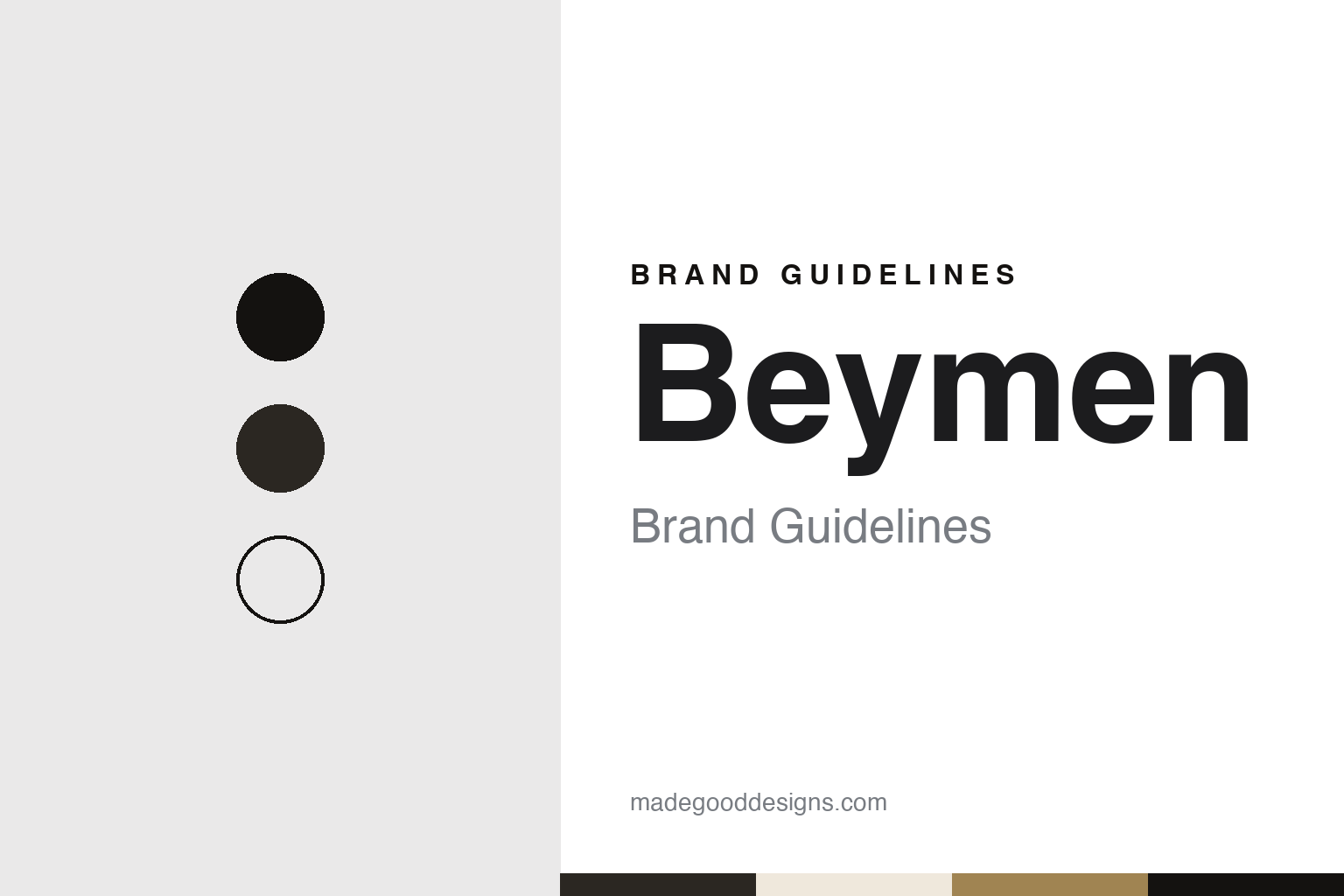
Beymen Brand Guidelines
The 1971 Istanbul department store that became Mayhoola’s Beymen Group.
Aa
Two constants: an ink black, ivory and muted gold palette and a high-contrast serif register. Abstract homage — not a Beymen product or mark; no logo, label or store design is reproduced.
Şişli, 1971
A textile family opens a department store.
Beymen opened its original store in 1971 in Şişli, Istanbul, selling its own private-label clothes, English Wikipedia says. It grew out of the Boyner family’s textile business. The same source says Ali Osman Boyner co-founded the Altınyıldız fabric company in 1952, that the firm began exporting in 1956, and that at the end of the 1960s it moved into ready-to-wear clothing. It credits the idea of an upscale department store to Osman Boyner working with the fashion designer Kerim Kerimol and the Italian fashion-house owner Silvano Corsini.
The chain then spread through Istanbul’s shopping districts. English Wikipedia dates a seven-storey flagship on Abdi İpekçi Avenue in Nişantaşı to 2003, and the store at Zorlu Center, designed by the German-Swiss architects Michelgroup, to 2013; that store opened at about 9,600 square metres and was extended in 2022. The same practice also designed a 2,000-square-metre store at the Akasya mall in Üsküdar, on the Asian side of the city. In 2020 a store at Vadistanbul opened under the Beymen Seasons name, combining current and earlier seasons in one place, and in 2022 a three-storey store opened at the Galataport waterfront development in Karaköy. Outside Istanbul the same source lists stores in Ankara, İzmir, Antalya, Bursa, Adana, Gaziantep, Mersin and the Bodrum peninsula, as well as outlet stores.
Beymen Group’s own pages date the online shop, beymen.com, to 2010. The group says it now runs Beymen alongside Beymen Club, Beymen Collection, Academia, Network and Divarese-George Hogg, with more than 250 stores and more than 4,000 employees. Vogue Business gave a dated count in November 2026: 290 stores in various formats across Türkiye and a small operation in Egypt, including 25 multi-brand stores, around 60 franchise stores for designer labels and stores for three of its own brands.
Colour
From the Boyner group to Mayhoola.
For most of its history Beymen sat inside the Boyner family’s group. That changed in two steps. In May 2015 the Qatari investment fund Mayhoola for Investments became a partner in Boyner Perakende ve Tekstil Yatırımları, the company that held the group’s retail and textile businesses, with Mayhoola holding 54 per cent and Boyner Holding 42.8 per cent, CNN Türk reported.
On 10 May 2019 CNN Türk reported that the two partners had agreed to split. Under the agreement Boyner Holding would take full control of the Boyner department-store business and the Altınyıldız textile company, while 97 per cent of Beymen Mağazacılık and AY Marka Mağazacılık would pass to Mayhoola. Beymen Group’s own history says the acquisition by Mayhoola took place in 2019, and Vogue Business reported in November 2026 that Mayhoola’s chief executive, Rachid Mohamed Rachid, acquired Beymen in 2019. Mayhoola also owns Valentino and Balmain, the same report says, and DHA, the Turkish news agency, named him as chairman of Beymen in November 2026.
One name can confuse. English Wikipedia notes that Beymen Business, a chain of men’s clothing shops, is not part of Beymen Group: it is run by BR Mağazacılık within Boyner Group, alongside Altınyıldız Classics. The department stores and the Beymen Club, Beymen Collection and Network labels sit in Mayhoola’s Beymen Group; Beymen Business sits with Boyner.
The group has also widened its list of partner brands. In July 2026 Patronlar Dünyası reported that Beymen had agreed to buy Disita Giyim, the company behind Dilasima Group, which has represented Max Mara, Vetrina, Boggi Milano and Furla in Türkiye; the paper said Beymen would run those operations once the deal was completed. Beymen Group’s site now lists those names among brands it says joined its portfolio in 2026.
Typography
Department-store and menswear identity in Türkiye.
Turkish fashion and menswear brands tend to present themselves through the things they make and the places they sell them. Tailored suits, shirts, knitwear, leather goods and womenswear lead the product pages, and many labels describe made-to-measure or ceremonial ranges, such as tuxedos for weddings, alongside everyday clothes. Product names and fabrics are usually given plainly, with the collection season as the main organising idea.
Retail format carries much of the identity. Some names began as department stores and now run several store formats under one roof, from full-line stores and single-brand boutiques to outlets and online shops. Others began as menswear makers and grew into chains of their own stores in shopping malls and on high streets. Flagship stores in Istanbul districts such as Nişantaşı and along the Bosphorus are often named in company histories, and the international shops, franchise partners and showrooms that companies publish give a sense of how far a label has travelled.
Group ownership is part of the picture and needs dated sources. Several labels sit inside holding companies: Boyner Group, built on the Altınyıldız textile business, runs department stores and menswear labels, while Orka Holding owns a family of menswear names. Ownership has changed over time through partnerships with foreign investors and later splits or buybacks, so the date of any ownership statement matters as much as the statement itself.
Corporate pages are the usual starting point for founders, owners and store counts. Company “about” and history pages give founding years, founders’ names and milestones in the company’s own words; national newspapers, news agencies and business press add dated reports on openings, partnerships and changes of control. For a designer, that mix explains why these identities often rest on a group name, a flagship address and a type of garment rather than on a single logo.
Aa
A high-contrast serif for a luxury department store. (Specimen set in Bodoni Moda, a serif STAND-IN; NOT the Beymen logo.)
Beymen
Exhibitions, architecture and a new flagship.
Beymen’s public identity leans on cultural programming. To mark its 50th anniversary, Vogue reported in November 2023, the company staged “Golden Opulence” at Tophane-i Amire, a 15th-century Ottoman workshop that now serves as an arts centre in Istanbul. More than 50 designers and brands made a piece for it. The show was curated by the fashion historian Laurence Benaïm, produced by Bureau Betak and accompanied by a book from Assouline. Harper’s Bazaar reported that it ran until 15 December 2023 and named Valentino, Balmain, Stella McCartney and Victoria Beckham among the contributors.
In November 2026 Beymen followed it with “Timeless Treasures – The Eternal Journey of the Bag,” opened with a gala at Tersane Istanbul, DHA reported. Vogue Business said the show gathered 55 global brands’ readings of the Anatolian envelope-shaped bag, along with work by selected student designers, and was timed to the first anniversary of Beymen’s Tersane flagship on the Golden Horn, a 12,000-square-metre store designed with the Office for Metropolitan Architecture (OMA). The same report said 85 per cent of its shoppers are domestic.
Press comparisons show how the store is placed. Vogue Business called Beymen “Türkiye’s answer to Harrods,” Harper’s Bazaar likened it to Bergdorf Goodman, and an Evening Standard travel piece of 2010, cited by English Wikipedia, compared it to Selfridges. Vogue Business named Vakko and Communité among the few specialist luxury retailers it competes with in Türkiye.
For a design guide, Beymen shows how a department store builds a luxury name through architecture and exhibitions rather than a single product. Compare Network, a label inside the same group, and Vakko, the Istanbul retailer Vogue Business names as a competitor. For this guide we use ink black, warm ivory and a muted gold with a high-contrast serif, an unofficial interpretation; no product or logo is reproduced.
Explore & save
Keep Beymen’s identity on hand — save it to a board in the Made Good inspiration library.
Beymen identity set
Pin the Beymen ink black, ivory and muted gold palette and the high-contrast serif register to your own board.
Source & notes
Frequently Asked Questions
What font can I use to match the Beymen look?
This guide describes Beymen’s type as “A high-contrast serif for a luxury department store”. Its type specimen is set in Bodoni Moda from Google Fonts as a stand-in; Bodoni Moda is not Beymen’s own lettering.
What colours are in the Beymen palette?
This guide’s Beymen palette is Ink black #141210, Espresso #2B2722, Warm ivory #EFE8DC, Muted gold #A08452 and Paper #F8F5EF. The tones are the guide’s own unofficial interpretation, not official Beymen hex codes.
When was Beymen founded?
Beymen was founded in 1971, in Şişli, Istanbul. Beymen is known for Department stores, Beymen Club, Network.
Who founded Beymen?
Beymen was founded by Osman Boyner in 1971. Beymen is known for Department stores, Beymen Club, Network.
Who owns Beymen?
Beymen today: Beymen Group, owned by Mayhoola. Beymen is known for Department stores, Beymen Club, Network.


