Ramsey Brand Guidelines
A 1972 London workshop, Gürmen Group and Turkish tailoring.
Aa
Two constants: a suiting ink, stone and claret palette and a high-contrast serif register. Abstract homage — not a Ramsey product or mark; no garment, label or logo is reproduced.
From London to Istanbul
A workshop in London, then factories in Turkey.
Ramsey is a Turkish menswear brand, and its story, as the company tells it, begins outside Turkey. On its corporate pages the company says the Ramsey journey started in London in 1972, with tailoring as its base, and English Wikipedia, citing the company’s own history page, says the first Ramsey clothes were designed in a London workshop that year. English Wikipedia names Remzi Gür as the founder.
The move home came next. According to the same English Wikipedia account, the founders moved production to Turkey in 1985. The first Ramsey shop in England opened in 2001, and the first Ramsey concept store in Turkey opened in 2005 at Istanbul Cevahir, the large shopping centre in the Şişli district. That sequence, a London name built on Turkish production, still shapes how the brand describes itself: the company’s own text speaks of joining a design start in London with Turkey’s manufacturing strength and tailoring tradition.
Ramsey does not stand alone. Its website is run by Gürmen Giyim Sanayi ve Ticaret A.Ş., which the site’s own legal notice groups with Ramsey and the younger menswear label KİP under the name Gürmen Group. English Wikipedia also describes Ramsey as owned by Gürmen Group, which operates KİP as well. In a 2019 interview with Hürriyet, the group’s board member in charge of brands, Zeynep Doğan, named Remzi Gür as chairman and said the family company had investments outside clothing, in energy, agriculture, livestock and technology. She described the management as a mix of the first and second generations of the family.
Colour
Suits, jackets and a factory side.
Tailoring sits at the centre of the range. Ramsey’s online shop opens with suits, and its suit menu lists lines such as Sartoria, Zero Weight and the Powerflex OnBoard Suit, alongside tuxedos, linen suits and wool suits. Jackets, shirts, knitwear, trousers and outerwear follow, from blazers and overshirts to coats, trench coats and leather jackets, with shoes and accessories such as ties, cufflinks, belts and bags, and the accessories menu also takes in pocket squares, sunglasses, gloves and scarves, and perfume. The company also lists a free in-store alteration service on its customer pages.
The brand has tried to widen that formal image. Speaking to Hürriyet in September 2019, Doğan said Ramsey and KİP had long been seen as clothes for work and special occasions. Suits, she said, were still selling, but the group had begun to give more weight to casual collections, with more variety, capsule collections and what she called functional pieces, and had refreshed its shops. She also said the group drew on its design and pattern-development work in suits and jackets.
Ramsey is also a manufacturer for others. In the same interview, Doğan said 40 per cent of the group’s production was for foreign brands, which she could not name under its agreements; English Wikipedia repeats the figure. In August 2022 the business magazine Ekonomist reported that Gürmen Group made men’s ready-to-wear in two factories in the Kastamonu and Karabük area of northern Turkey, producing collections both for its own brands and for international labels, and that it exported to about 30 countries. The magazine linked the group’s investment in production capacity to European brands moving orders from China to Turkey, as demand recovered and shipping costs rose.
One sponsorship gave the brand a stage abroad. In 2012 Ramsey signed a two-year deal as the official formal-wear supplier to Liverpool FC, English Wikipedia says, citing the club’s announcement of 30 April 2012. Under that arrangement Ramsey supplied tailored clothing to the first team.
Typography
Design and documentation.
Turkish fashion and menswear brands tend to present themselves through the things they make and the places they sell them. Tailored suits, shirts, knitwear, leather goods and womenswear lead the product pages, and many labels describe made-to-measure or ceremonial ranges, such as tuxedos for weddings, alongside everyday clothes. Product names and fabrics are usually given plainly, with the collection season as the main organising idea.
Retail format carries much of the identity. Some names began as department stores and now run several store formats under one roof, from full-line stores and single-brand boutiques to outlets and online shops. Others began as menswear makers and grew into chains of their own stores in shopping malls and on high streets. Flagship stores in Istanbul districts such as Nişantaşı and along the Bosphorus are often named in company histories, and the international shops, franchise partners and showrooms that companies publish give a sense of how far a label has travelled.
Group ownership is part of the picture and needs dated sources. Several labels sit inside holding companies: Boyner Group, built on the Altınyıldız textile business, runs department stores and menswear labels, while Orka Holding owns a family of menswear names. Ownership has changed over time through partnerships with foreign investors and later splits or buybacks, so the date of any ownership statement matters as much as the statement itself.
Corporate pages are the usual starting point for founders, owners and store counts. Company “about” and history pages give founding years, founders’ names and milestones in the company’s own words; national newspapers, news agencies and business press add dated reports on openings, partnerships and changes of control. For a designer, that mix explains why these identities often rest on a group name, a flagship address and a type of garment rather than on a single logo.
Aa
A high-contrast serif for a tailoring house. (Specimen set in Bodoni Moda, a serif STAND-IN; NOT the Ramsey logo.)
Ramsey
A store network at home and abroad.
Ramsey sells mainly through its own shops. In August 2022, Ekonomist reported that Gürmen Group was trading from 145 points of sale across Ramsey and KİP, 100 in Turkey and 45 abroad. The magazine said Ramsey had opened four new stores in Turkey over the previous year and had recently opened stores in Dubai and Qatar, while the group had raised its marketing spending on Ramsey and had redesigned KİP’s shops, starting with the KİP store at Istanbul Cevahir. Ekonomist said the group had decided to refresh both brands after shopping habits changed in 2020 and 2021, with new work on communication, collections and stores, and that it had also rebuilt the online shops of both labels.
The foreign network has grown in stages. In the 2019 Hürriyet interview, Doğan listed recent openings in Uzbekistan, Tajikistan and Kazakhstan, and said the group was opening stores in Turkey more selectively. As of 2024, English Wikipedia, citing the company’s website, listed 78 Ramsey stores, 58 of them in Turkey, made up of 29 Ramsey concept stores, 15 group stores, seven outlets and seven franchise stores; it named other locations in North Macedonia, Ukraine, Azerbaijan, the United Arab Emirates, Armenia, Qatar, Kazakhstan and Russia. Those counts are dated figures, not a current total.
The brand’s look follows its products. Ramsey presents itself as a tailoring label, with the suit, the shirt and the jacket at the front of its shop, and with a casual line built around them.
For a design guide, Ramsey shows how a Turkish menswear house can carry a London origin story into a store network spread from Istanbul to the Gulf and Central Asia. Compare it with Kiğılı, another Istanbul menswear chain, and with Damat, the tailoring label of Orka Holding. For this guide we use suiting ink, stone and claret with a high-contrast serif, an unofficial interpretation; no product or logo is reproduced.
Explore & save
Keep Ramsey’s identity on hand — save it to a board in the Made Good inspiration library.
Ramsey identity set
Pin the Ramsey suiting ink, stone and claret palette and the high-contrast serif register to your own board.
Source & notes
Frequently Asked Questions
What font can I use to match the Ramsey look?
This guide describes Ramsey’s type as “A high-contrast serif for a tailoring house”. Its type specimen is set in Bodoni Moda from Google Fonts as a stand-in; Bodoni Moda is not Ramsey’s own lettering.
What colours are in the Ramsey palette?
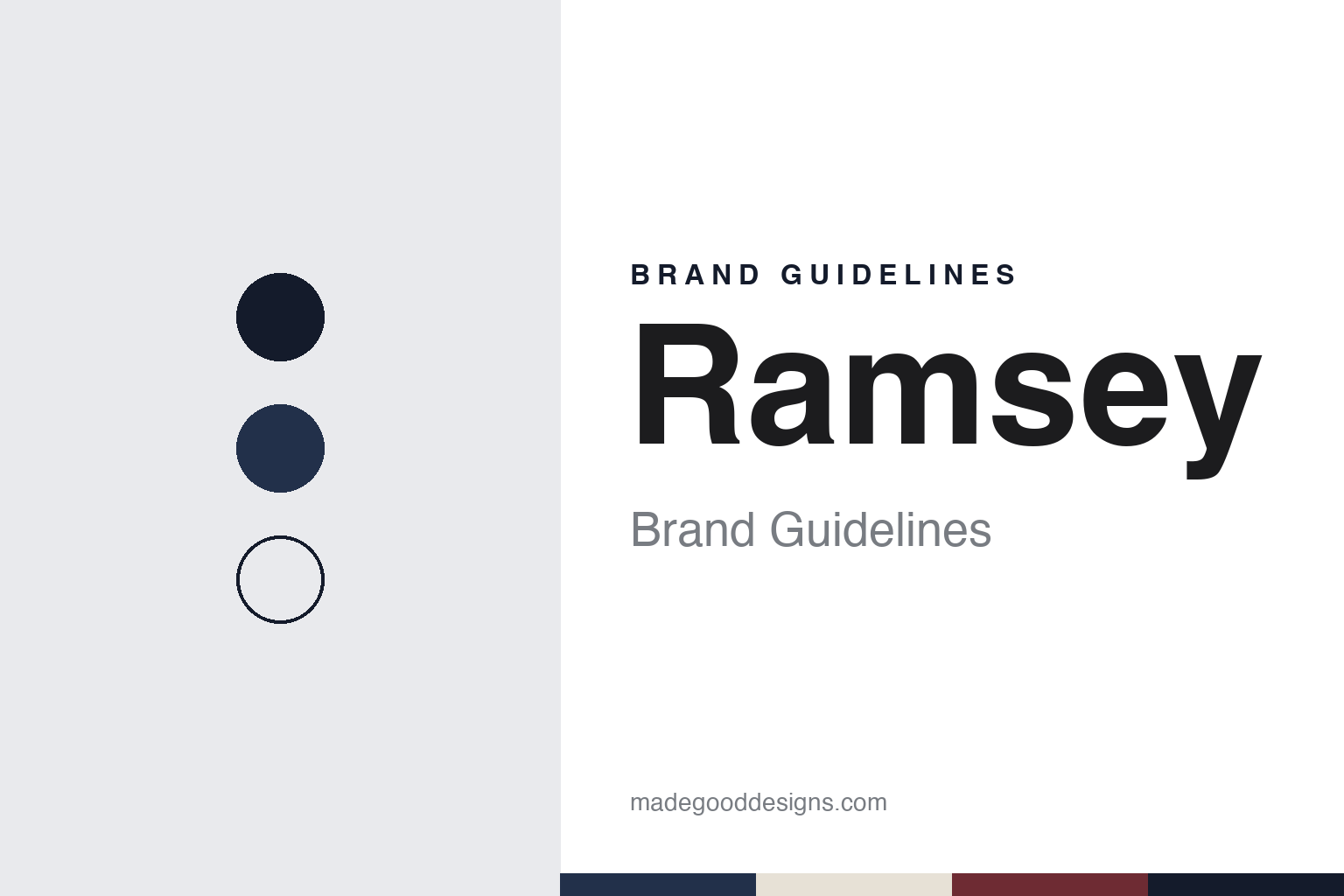
This guide’s Ramsey palette is Suiting ink #22304A, Midnight wool #141B2B, Stone linen #E7E1D6, Claret lining #6E2B33 and Shirt white #F6F4EF. The tones are the guide’s own unofficial interpretation, not official Ramsey hex codes.
When was Ramsey founded?
Ramsey was founded in 1972 (company history), in London workshop.
Who owns Ramsey?
Ramsey is owned by Gürmen Group (Gürmen Giyim). Ramsey is known for Suits, jackets, shirts, tuxedos.