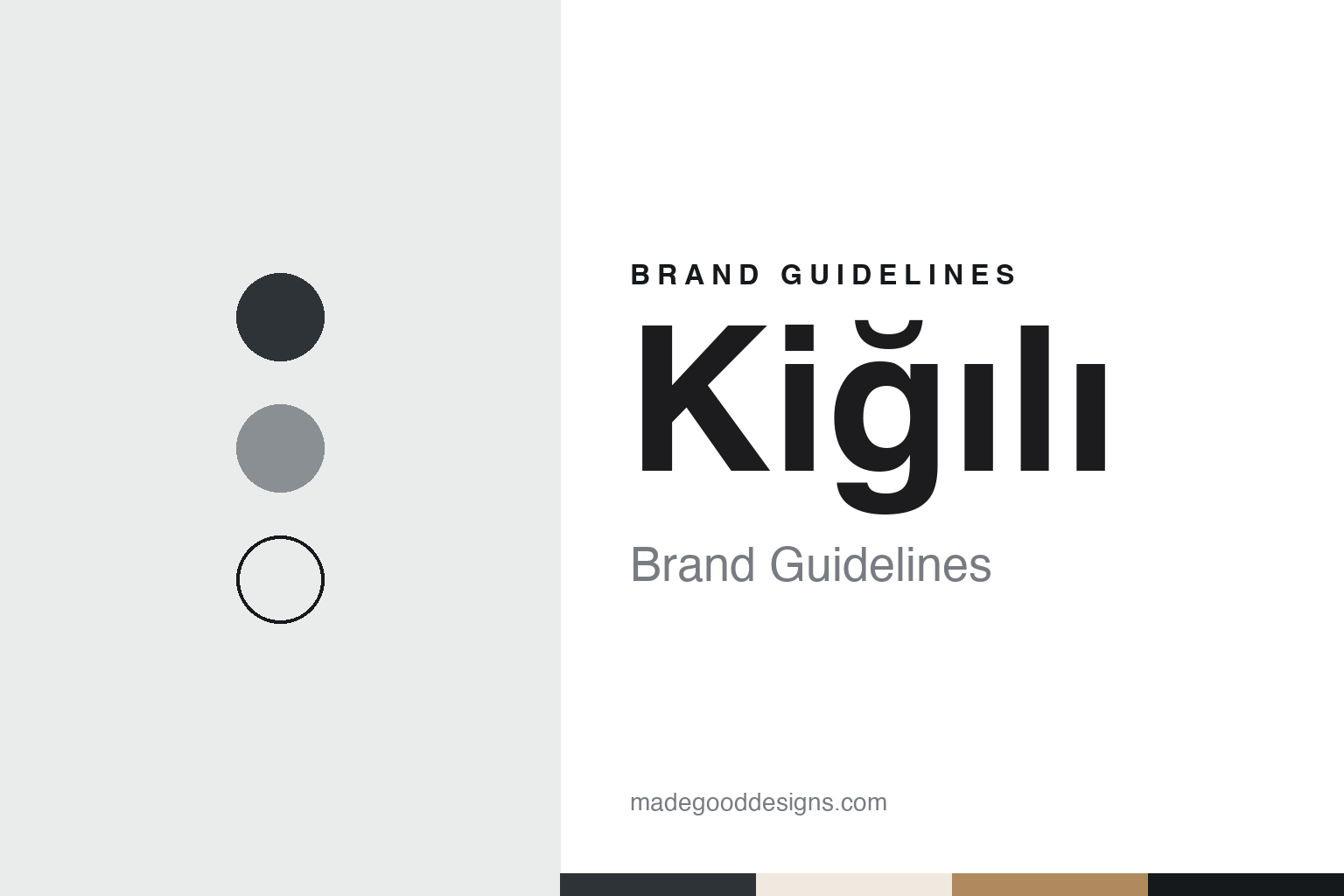
Kiğılı Brand Guidelines
A 1938 fabric shop that became an Istanbul menswear chain.
Aa
Two constants: a charcoal, suit-grey and camel palette and a tailored serif register. Abstract homage — not a Kiğılı product or mark; no garment, logo or label is reproduced.
A fabric shop in Beyoğlu
From suiting cloth to ready-made shirts.
Kiğılı is an Istanbul menswear maker and the chain of men’s clothing stores that carries its name. Its story begins in 1938, when, according to English Wikipedia and the company, the business was set up to sell fabric for men’s clothing. The company describes the cloth trade as the occupation of the family’s grandfather and father, and says that for its first decades Kiğılı was a shop selling suiting fabric, at a time when men in Turkey still bought cloth and took it to a tailor. Daily Sabah, writing in December 2021, dated the brand’s entry into the Turkish fashion market to 83 years earlier, which matches 1938.
The turn to ready-to-wear came under Abdullah Kiğılı, who, the company says, began working in textiles as a child and took charge of the business after finishing his education; he chairs its board, and the corporate site calls him the founder. In 1965 Kiğılı produced its own shirts and began selling them ready-made in the shop, and trousers, suits and coats followed, the company says. English Wikipedia also dates the move into ready-made trousers and shirts to 1965.
In 1969 the company opened its first store devoted only to ready-made clothing, on İstiklal Avenue in Beyoğlu, which English Wikipedia describes as the city’s main upscale shopping street at the time. A garment factory followed: the company dates it to 1980 and places it in Yenibosna, Istanbul, and says that from then on it both sold its own production and made collections under contract for other Turkish menswear brands.
Colour
Logistics, a tailoring line and a training academy.
The chain’s growth in the 2000s rested on back-office investment as much as on shops. In 2005, the company says, it opened a 25,000-square-metre logistics centre at Şekerpınar, in Gebze, east of Istanbul, and it says it now runs five logistics centres. In 2006 it opened the first Abdullah Kiğılı Exclusive Cut stores, a line that uses the chairman’s name for tailored pieces with special fabrics and made-to-measure options. In 2007 it set up the Kiğılı Training Academy for staff, which it describes as a programme for managing and developing its people, and in 2018 it marked its 80th year. The ready-to-wear story is told through labels: the company says the first shirt to carry a Kiğılı label came out of its 1965 workshop.
In 2024, the corporate timeline says, the head office moved out of Gebze so that the central teams could work together in one place; the company’s legal notices give the operating company as Kiğılı Giyim Ticaret A.Ş., based in Pendik, on Istanbul’s Asian side.
Suits, shirts, trousers and coats remain the core of what the company describes. In December 2021 Daily Sabah reported the launch of a separate brand, Oktay Kaynarca designed by Kiğılı, made with the Turkish actor Oktay Kaynarca. The paper said the actor had worked with Kiğılı on earlier collections since 2019, that the company, citing strong customer demand for those collections, had chosen to turn the line into a brand of its own, and that it began with about 3,500 pieces, from caps and gloves to suits and coats. It quoted the chief executive at the time, Hilal Suerdem, and described Kaynarca as an actor who had played starring roles in television series and films for more than 30 years. Kaynarca told the paper that the new brand took its idea from Shakespeare’s line “All the world’s a stage,” arguing that what a man wears reflects his character, and named leather and fur pieces and clothes for weekend wear among the first products. English Wikipedia also records the 2021 launch, and adds that in 2023 Kiğılı opened a virtual store in the metaverse.
Sport is the other public face. The corporate site lists sponsorships including the Fenerbahçe club, İstanbul Başakşehir and the Turkish volleyball and handball federations.
Typography
How Turkish fashion chains present themselves.
Turkish fashion, denim and footwear chains are mostly met in person, in shopping centres. Trade reports on these companies’ expansion abroad tend to describe the same kind of opening: a new unit in a regional mall, the brand name across the fascia, and a launch event at the door. For a design reader, the store front is where the identity is fixed, and the shopping bag is the version of it that leaves the building.
The names are short and usually written as plain lettering. Some of these chains use a word or an abbreviation rather than a symbol, and where a mascot or emblem once existed, published histories describe it being folded into a typographic logo. Campaign imagery, rather than the logo, carries most of the season-to-season change: model-led photography, designer collaborations and named collections are how the companies present each range.
Collection and store naming is generally descriptive. Sub-brands and formats tend to add a plain word to the parent name, such as Home, Outlet or Baby, so the parent name stays visible on every sign. In this guide we describe those ranges by the names the companies publish, without judging one against another.
The corporate side matters too. Some of these businesses began as small family shops or wholesale labels in Istanbul and later became large groups, some of them listed on Borsa Istanbul. Their corporate pages on founders, owners, board members and listings are part of the brand’s public face, and the guides in this series draw on those pages alongside dated independent reporting. The palettes shown are our own unofficial interpretations, not company colour standards.
Aa
A tailored serif for a menswear house built on cloth. (Specimen set in Libre Caslon Text, a serif STAND-IN; NOT the Kiğılı logo.)
Kiğılı
An İstiklal Avenue name in other countries.
Kiğılı has taken its stores beyond Turkey since the 2010s. The company says it opened in China in 2013 and opened its first European store, in North Macedonia, in 2016. English Wikipedia lists subsidiaries in Serbia, Romania and North Macedonia. In November 2023 Milliyet reported that Kiğılı had opened its first store in Croatia, in Split, on the Adriatic coast, quoting the deputy chair, Hilal Suerdem, on the company’s growth in Europe.
Store counts depend on the date and on what is counted. As of November 2026 the corporate site lists 180 stores in Turkey, a presence in 13 countries and more than 38 sales points abroad. The same site invites applications from franchise partners for stores in Turkey and abroad.
The name itself is the brand. Kiğılı trades under the family surname, written with the Turkish dotless ı and soft ğ on its own website, and its second label, Exclusive Cut, carries the chairman’s full name. English Wikipedia gives its pronunciation as roughly “kee-uh-luh.”
For a design guide, Kiğılı shows a fabric shop that became a menswear chain while keeping the family name over the door. Compare Colin’s, an Istanbul clothing group that also grew from its own production, and Network, another Turkish fashion chain. For this guide we use charcoal, a suit grey and a camel with a serif, an unofficial interpretation; no product or logo is reproduced.
Explore & save
Keep Kiğılı’s identity on hand — save it to a board in the Made Good inspiration library.
Kiğılı identity set
Save the Kiğılı charcoal, suit grey and camel palette and the tailored serif register to your own board.
Source & notes
Frequently Asked Questions
What font can I use to match the Kiğılı look?
This guide describes Kiğılı’s type as “A tailored serif for a menswear house built on cloth”. Its type specimen is set in Libre Caslon Text from Google Fonts as a stand-in; Libre Caslon Text is not Kiğılı’s own lettering.
What colours are in the Kiğılı palette?
This guide’s Kiğılı palette is Charcoal #2E3338, Ink #16191C, Suit grey #8A8F94, Camel #B08A5E and Shirting #EFE9DF. The tones are the guide’s own unofficial interpretation, not official Kiğılı hex codes.
When was Kiğılı founded?
Kiğılı was founded in 1938 (fabric trade), in Istanbul, Turkey.