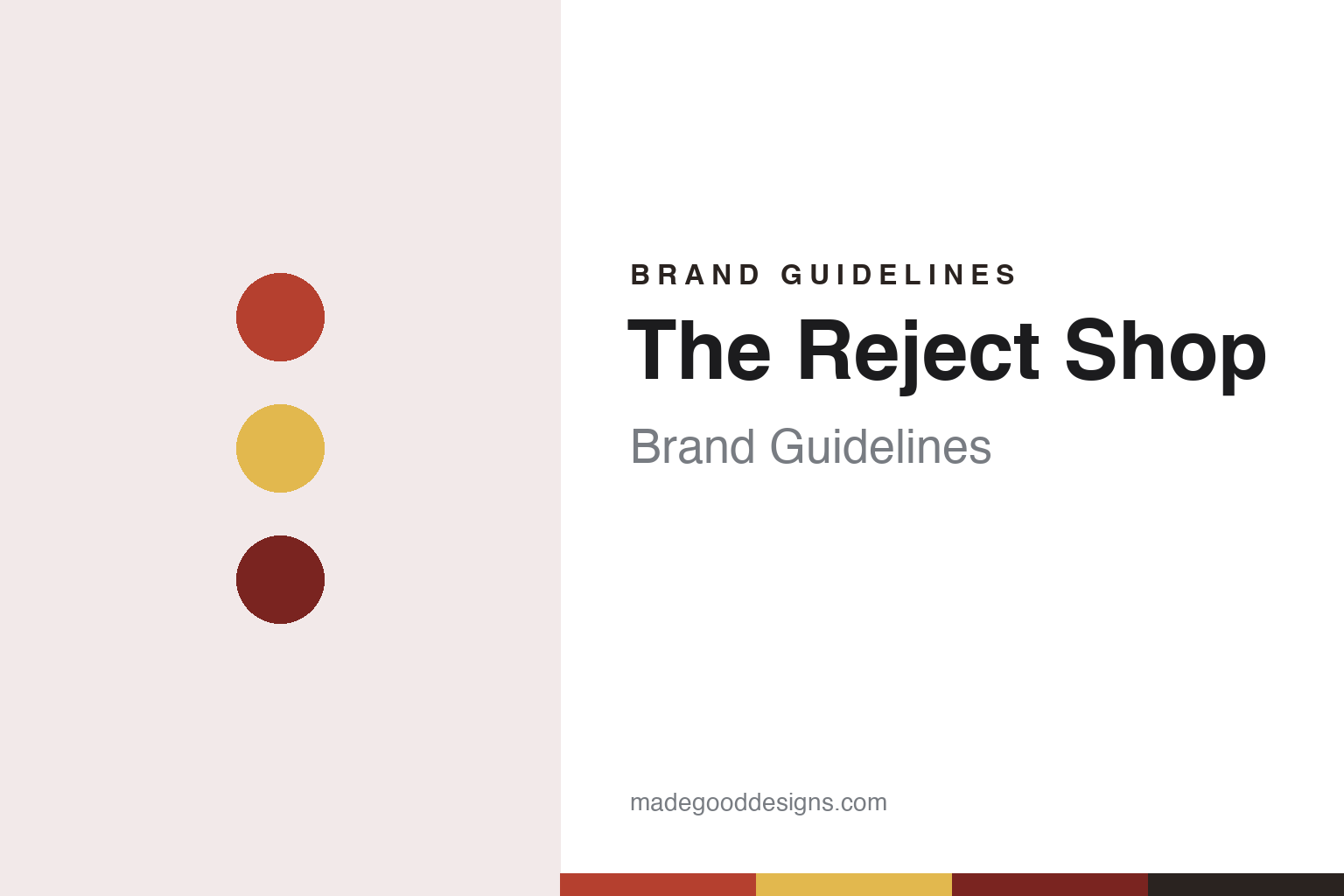
The Reject Shop Brand Guidelines
A Melbourne shop of seconds that became a national discount chain.
Aa
Two constants: a brick red, mustard and oxblood palette and a heavy sans register. Abstract homage — not a Reject Shop product or mark; no sign, logo or packaging is reproduced.
Seconds in South Yarra
A Melbourne shop named for what it sold.
The Reject Shop began in 1981, when Ron Hall and John Shuster opened a store in the Melbourne suburb of South Yarra. The company gives that year, place and pair of founders on its own website, and SmartCompany repeated the founders and the year in a report published in July 2026. English Wikipedia says the first shop sold seconds and discontinued lines, which is where the name came from: a shop of rejects, sold cheaply, with that plain word kept on the sign.
The business stayed relatively small through its early years. English Wikipedia says the chain became majority owned by Macquarie Bank in 1994, and that it floated on the Australian Securities Exchange in June 2004. The same account says the company tripled in size in the two years after it went public, and that it passed 300 stores in October 2013, after taking on sites left by the closure of Retail Adventures, the group behind several older Australian discount chains; some of those sites were former Chickenfeed stores in Tasmania.
For most of its listed life The Reject Shop operated as a variety store rather than a department store. English Wikipedia describes its range as household and consumer goods, including food and snacks, party supplies, cleaning products, kitchenware and seasonal items, and gives its head office as Kensington, in Victoria. The company’s own description is similar: homewares, everyday essentials and goods for special events, alongside products from large grocery and household brands, and it names Dove, Cadbury and Finish among them.
The chain also tried new ways of reaching shoppers. In September 2020, English Wikipedia says, The Reject Shop announced a partnership with the British supermarket group Tesco, and in November 2020 it began a partnership with the delivery service DoorDash. The same account says that in October 2020 it introduced a lowest-price guarantee.
Colour
A Canadian owner from July 2025.
Ownership changed in 2025. English Wikipedia says the board accepted a takeover offer from Dollarama, the Montreal-based discount retailer, in March 2025. Inside Retail reported on 22 July 2025 that the acquisition had been completed by way of a scheme of arrangement, that trading in the shares had been suspended at the start of the month, and that the company would ask to be removed from the ASX by the close of trade on 23 July. The deal marked Dollarama’s entry into the Australian market, Inside Retail wrote, and Dollarama’s chief executive spoke at the time of more than 5,000 employees joining the group.
Canadian Grocer, reporting the completion the same day, gave The Reject Shop’s network as 390 locations and noted that Dollarama also has a growing presence in Latin America through Dollarcity. With the takeover, an Australian chain that had been listed for about two decades became one part of a Canadian group.
The new owner soon made clear that the name would change. English Wikipedia says it was confirmed in August 2025 that The Reject Shop stores would be rebadged as Dollarama. In October 2025 RealCommercial quoted a Dollarama spokesperson, speaking to News Corp, who described a multi-year process with no imminent banner conversions: a store would move to the Dollarama banner only once it held a critical mass of Dollarama products, phased in gradually. The same report gave the network as 395 stores.
The corporate name changed first. English Wikipedia says the company’s entity name changed from The Reject Shop Limited to Dollarama Australia Pty Ltd in January 2026. By July 2026, SmartCompany reported, Dollarama was steadily converting all 395 Reject Shop stores to the Dollarama name and format, with supermarket-like shelving running lengthways through the stores, and the Australian business was being reshaped as a low-priced general merchandise supermarket rather than a discounter. As of that July 2026 report, the conversion was still in progress.
Typography
Discount, home and hobby retail.
Discount, home and hobby retailers in Europe, Britain, Australia and Malaysia tend to present themselves first through the store itself. The sign over the door, the logo on the bags and the layout of the aisles carry most of the identity, and many of these chains repeat one standard format from town to town, so a shopper meets the same look in a high street, a retail park or a shopping centre.
Own-label ranges are a second layer. Many of these retailers sell established consumer brands alongside goods under their own names, and they publish those range names on their websites, packaging and shelf cards. For a design guide, the useful facts are the ones the companies state themselves: what each range is called, what it covers and how it sits beside branded stock, rather than any claim about quality or price.
Store networks are the third. Chains in this group publish their store counts, the countries they trade in and the mix of company-run and franchise branches, and those figures move quickly as new sites open and others close. Any count is only as good as its date, so the guides in this series give each figure with the year of the source that reports it.
Ownership is the fourth. Some of these businesses began as a single shop run by a founder or a family, and later passed to private-equity firms, listed parent groups or stock-market investors. Their corporate pages usually tell that story, from the first store to the current owner, and the guides here describe family and group ownership plainly, with dates, as the sources set it out.
Aa
A heavy, plain sans for a name that describes the shop. (Specimen set in Archivo Black, a sans STAND-IN; NOT The Reject Shop logo.)
The Reject Shop
A plain name that did the work of a logo.
The Reject Shop’s identity rests on its name more than on any symbol. The phrase describes what the first South Yarra shop sold, seconds and discontinued lines, and it stayed on the sign as the chain grew from one Melbourne store to a national network of 390 to 395 locations in the counts reported in 2025 and 2026. SmartCompany described the chain’s logo as red and yellow in July 2026, and placed The Reject Shop on its list of Australian retail brands disappearing from shopping centres that year.
The converted stores are described in more detail than the old sign. SmartCompany wrote that the new-look stores follow the format of Dollarama’s Canadian shops, with supermarket-like shelving running the length of the store. The spokesperson quoted by RealCommercial in October 2025 tied the change of sign to the change of stock, so that the banner over the door follows the range on the shelves rather than leading it.
The story also shows how a retail name can outlast several owners. The Reject Shop was founded by two people, majority owned by Macquarie Bank from 1994, listed on the ASX from 2004 and owned by Dollarama from July 2025, according to English Wikipedia and Inside Retail; the name stayed the same through each of those changes until the new owner chose to replace it with its own.
For a design guide, The Reject Shop shows how a plain descriptive name can carry a discount chain for four decades, and how a new owner can retire it store by store. Compare it with Big W, another Australian discount chain, and Daiso, a variety-store chain from Japan. For this guide we use a brick red, a mustard yellow, an oxblood, a warm ink and a paper white with a heavy sans, an unofficial interpretation; no product or logo is reproduced.
Explore & save
Keep The Reject Shop’s identity on hand — save it to a board in the Made Good inspiration library.
The Reject Shop identity set
Pin the brick red, mustard and oxblood palette and the heavy sans register to your own board.
Source & notes
Frequently Asked Questions
What font can I use to match the The Reject Shop look?
This guide describes The Reject Shop’s type as “A heavy, plain sans for a name that describes the shop”. Its type specimen is set in Archivo Black from Google Fonts as a stand-in; Archivo Black is not The Reject Shop’s own lettering.
What colours are in the The Reject Shop palette?
This guide’s The Reject Shop palette is Brick red #B5402F, Mustard #E2B84E, Oxblood #7A2420, Warm ink #2A2320 and Paper #F7F2E8. The tones are the guide’s own unofficial interpretation, not official The Reject Shop hex codes.
When was The Reject Shop founded?
The Reject Shop was founded in 1981, in South Yarra, Melbourne.
Who founded The Reject Shop?
The Reject Shop was founded by Ron Hall and John Shuster in 1981.
Who owns The Reject Shop?
The Reject Shop has been owned by Dollarama since July 2025.


