Hubo Brand Guidelines
A Belgian DIY chain bought out by its managers in 1992.
Aa
Two constants: an orange, ink blue and plywood palette and a sturdy grotesque register. Abstract homage — not a Hubo asset; no store sign, logo or product is reproduced.
From Utrecht to Wommelgem
A Dutch franchise name, a Belgian branch and a 1992 buyout.
The name Hubo comes from the Netherlands. English Wikipedia says it began as an abbreviation of Houthandel Utrecht Bedrijven Organisatie, the organisation of a Utrecht timber business that, it says, started as a wood shop in the 1930s. The sources used for this guide do not say how Houthandel Utrecht operated during the occupation of 1940–1945. According to the same article, the organisation opened a group of hardware shops under the name Houtribo, began franchising in 1967 and used the Hubo name for its franchise organisation from 1969.
Belgium followed within a few years. A 2003 report in the trade magazine DIY International says Hubo was established in Belgium in 1972, and English Wikipedia also gives 1972 for the Belgian subsidiary. Dutch Wikipedia adds that the first Belgian Hubo store opened in 1976, so the branch and the first shop are dated differently. In the 1980s, English Wikipedia says, the Dutch Hubo business was sold to KBB, the retail group now known as Maxeda, which also owned the Praxis chain.
The decisive change came in October 1992. DIY International reported that the Belgian activities were taken over that month by Max Scheirs, Erwin Van Osta and Carl Liekens, members of the local management, and English Wikipedia describes the deal as Hubo Netherlands selling its Belgian subsidiary to three of the local management team. Dutch Wikipedia puts the number of Belgian stores at the time at 28. From then on, the two chains went separate ways: English and Dutch Wikipedia both say Hubo Belgium and Hubo Netherlands are two separate entities, and the Dutch chain later became part of the franchise group DGN Retail.
The Belgian company now trades as Hubo België NV, with its head office in Wommelgem, near Antwerp, according to its website.
Colour
Franchise stores, Wallonia and the garden trade.
Hubo grew as a franchise organisation. By 2002, DIY International reported, the Belgian business had developed into a franchise network of 62 outlets across the country. Dutch Wikipedia says that about half of today’s stores are run by independent franchisees, and the company’s website invites independent DIY retailers to join its franchise.
Much of the growth came through takeovers. In April 2002 Hubo bought the five Bricomarché stores in the south of Belgium, giving it a footing in the French-speaking part of the market, DIY International reported; the same report says the company bought the five Selfmade stores with effect from 1 January 2003, and that its sixth store in Wallonia, at Gembloux, had opened. Selfmade brought a strong garden range and experience of direct imports, the magazine wrote, and its large store at Schilde was to keep its own format for a time. Dutch Wikipedia lists further purchases: Superbois in Wallonia and Super Do-it in Flanders in 2004, and Aster-X in 2009.
The garden trade became a second line. Made in, the Flemish regional business news site, reported in March 2015 that Hubo had taken over the Walter Van Gastel garden centres in mid-2012 and Florina early in 2013, and that it had agreed to take over three Intratuin garden centres at Olen, Aarschot and Zwijndrecht from January 2016, keeping the Intratuin name and the existing staff. At the time of that report, Walter Van Gastel had eight garden centres and two flower shops, according to Made in, and the garden chains were run as separate commercial organisations from the DIY stores.
On the buying side, Hubo has been a member of Bricoalliance, an international purchasing group, since 2006, according to both the company and English Wikipedia.
Typography
How DIY chains present themselves.
European DIY chains and builders’ merchants present themselves first through the building: a large shed on a retail park or industrial estate, with a fascia sign and on-site parking and loading. In the trade press, store openings are reported branch by branch, with the site, the town and the running total, and that branch count is often the main public measure of how a network has grown.
Ownership shapes the identity more than in most retail sectors. Some chains are owned by listed building-materials groups that run several trading names side by side; others are co-operatives or buying groups whose members are independent family firms. In the co-operative model the shared name may sit above the member’s own name rather than replacing it, and store formats are often run as franchises supplied by a central organisation.
Formats are named and graded with care. A group may run a full-size DIY store with a garden centre, a smaller local format, a trade-only warehouse and a merchant yard for builders, each with its own sign but a shared family resemblance. Own-label ranges, hire counters, kitchen design services and click-and-collect services are named by the companies themselves and appear in their store descriptions and opening announcements.
Corporate pages fill in the rest: founders, founding dates, acquisitions and the parent company. The guides in this series set out what dated, independent sources say about each chain — when it began, who owns it and how its network has changed — and keep the companies’ own descriptions clearly marked as theirs.
Aa
A sturdy grotesque for a retail sign register. (Specimen set in Archivo, a sans STAND-IN; NOT the Hubo logo or store lettering.)
Hubo
Out-of-town stores and a Bonus Kaart.
The store format is documented mainly by the company. Hubo’s website describes the company as a fully Belgian organisation with 162 stores as of November 2026, carrying around 25,000 DIY articles for in and around the house in shops of 2,000 to more than 3,000 square metres. Dutch Wikipedia gives the same range of store sizes and product count. English Wikipedia counted more than 150 stores in 2019. The company says its shops sit outside town centres, along main approach roads, with large car parks.
Its range is laid out in familiar trade departments: garden, building materials, timber and joinery, tools, plumbing, heating, lighting, ironmongery, electrics, paint and wood care, and home decoration, among others, according to the website. Services named there include a paint-mixing service, a van that customers can borrow, a handyman service, Hubo Rent for tool hire and Quizzi kitchens. A loyalty card, the Hubo Bonus Kaart, and regular printed folders of offers are part of how the chain talks to customers, the company says.
For a design reader, Hubo is a useful case of one name serving two unrelated businesses. The Dutch and Belgian chains share a history up to 1992 and still use the same word, yet they have been separate companies for more than three decades, under different owners and with different networks. Anyone looking up the brand should check which country’s Hubo a sign, website or leaflet belongs to; the Belgian company publishes under hubo.be.
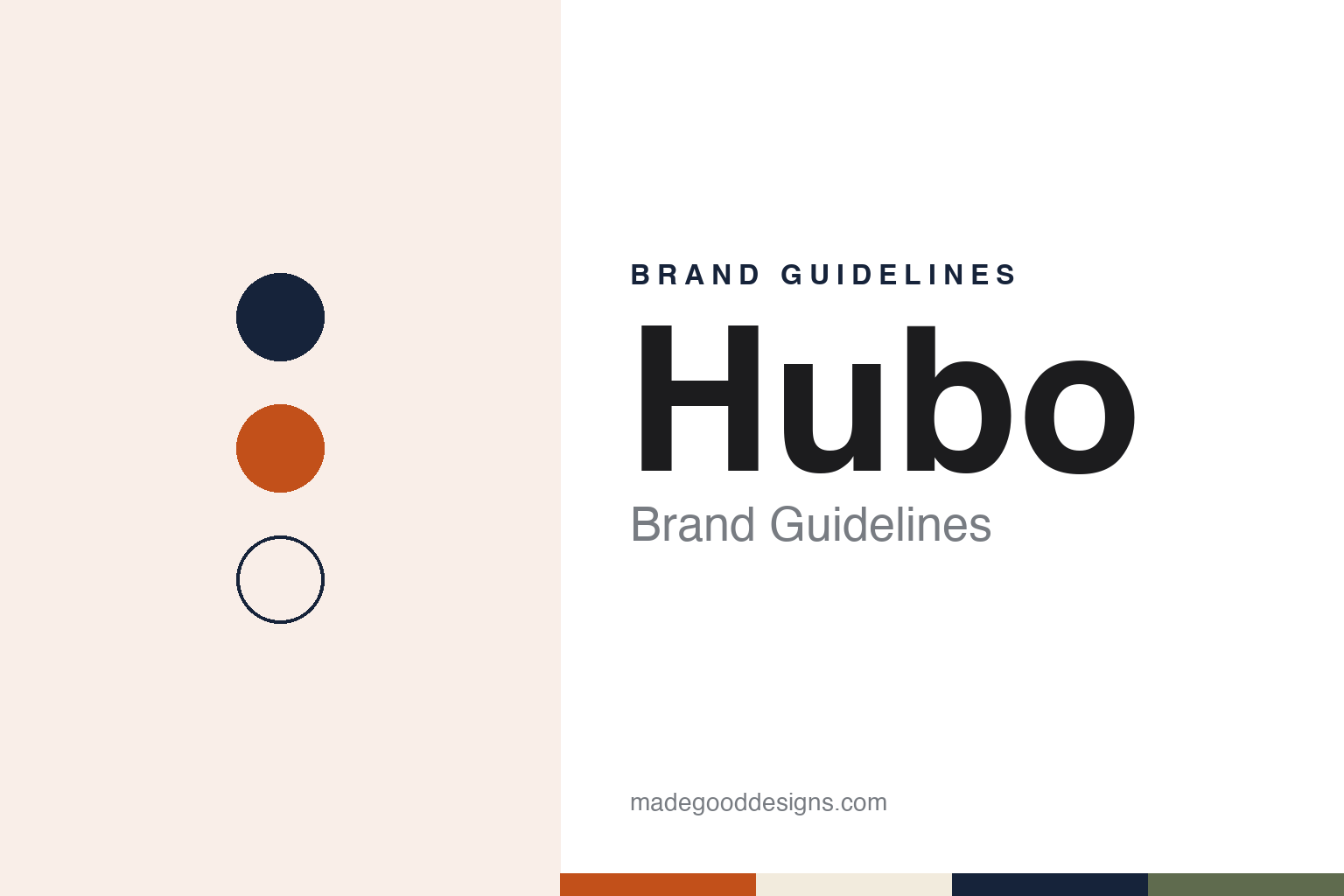
For a design guide, Hubo shows how a franchise name can be carried into a second country and then become an independent national chain through a management buyout. Compare Gamma, the Dutch franchise chain that also trades in Belgium, and Karwei, its decoration-led sister chain in the Netherlands. For this guide we use a workshop orange, an ink blue and a plywood tone with a sans, an unofficial interpretation; no product or logo is reproduced.
Explore & save
Keep Hubo’s identity on hand — save it to a board in the Made Good inspiration library.
Hubo identity set
Pin the Hubo orange, ink blue and plywood palette and the sturdy grotesque register to your own board.
Source & notes
Frequently Asked Questions
What font can I use to match the Hubo look?
This guide describes Hubo’s type as “A sturdy grotesque for a retail sign register”. Its type specimen is set in Archivo from Google Fonts as a stand-in; Archivo is not Hubo’s own lettering.
What colours are in the Hubo palette?
This guide’s Hubo palette is Workshop orange #C2501A, Ink blue #16233A, Plywood #F2EBDD, Garden olive #5F6B4E and Paper #F8F6F1. The tones are the guide’s own unofficial interpretation, not official Hubo hex codes.
When was Hubo founded?
Hubo was founded in 1972 (Belgian branch); independent from October 1992, in Belgium.