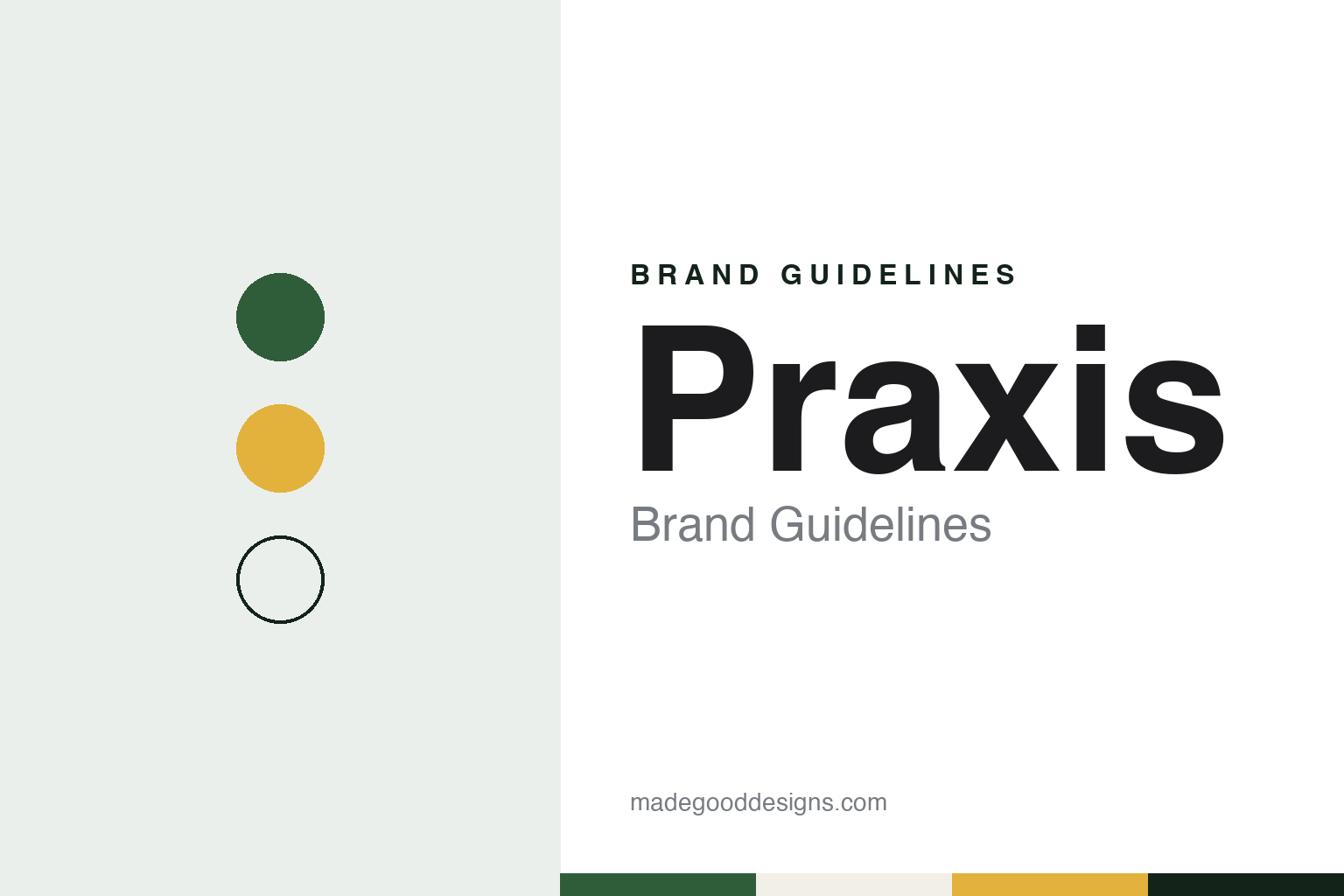
Praxis Brand Guidelines
A 1978 Venlo DIY store that grew into a Dutch chain inside a retail group.
Aa
Two constants: a Praxis workshop green and sawdust yellow palette and a Sturdy sans register. Abstract homage — not a Praxis product or mark; no store sign, logo or packaging is reproduced.
Venlo, 1978
A DIY chain born inside a retail group.
Praxis is a Dutch chain of DIY stores, run from Amsterdam by Praxis Doe-Het-Zelf Center B.V., according to Dutch Wikipedia. It began in 1978 with a single store in Venlo, in the province of Limburg, close to the German border. Its owner, Maxeda DIY Group, says that store opened as part of Maxis, a subsidiary of the retail group KBB, Koninklijke Bijenkorf Beheer, which Dutch Wikipedia describes as the group behind the De Bijenkorf department stores and HEMA. The name itself is a common word: Dutch Wikipedia notes that “praxis” is another word for practice, as opposed to theory.
The chain grew quickly. Maxeda says Praxis expanded through the 1980s by buying smaller chains and opening franchise stores, and that in 1988 it became a separate operating company within KBB, began advertising on television and rolled out a renewed store concept. In the 1990s and 2000s, the company says, it bought chains including Formido, Hubo, Superdoe and Marktkauf, which added many stores to the network.
Its parent changed shape several times. Dutch Wikipedia records that KBB merged with Vendex, the owner of V&D, in 1999 to form Vendex KBB, and that a consortium led by the investment firm KKR, with AlpInvest Partners and Change Capital Partners, took the group over in July 2004, after which its shares left the Amsterdam exchange. In June 2006 Vendex KBB was renamed Maxeda, Dutch Wikipedia says, citing the newspaper Trouw; Maxeda dates Praxis’s place in its DIY group to the same year.
Colour
From department stores to DIY alone.
Maxeda then narrowed its business to home improvement. Its own history page says a strategic review begun in February 2010 was completed on 31 January 2011, after the group had moved out of fashion and department stores; Dutch Wikipedia records the sales of V&D, de Bijenkorf and Hunkemöller in that period. What remained was a DIY business: Praxis in the Netherlands, and Brico and BricoPlanit in Belgium and Luxembourg.
In July 2015 the English-language site DutchNews reported that the European Commission had given Maxeda DIY Group permission to sell its Praxis and Formido chains, in a deal announced that June, to the French investor Ardian and the American firm GoldenTree Asset Management. The DIY chains were the last of Maxeda’s businesses to be sold, the site noted, after HEMA, V&D and de Bijenkorf. Dutch Wikipedia dates the two firms’ arrival as co-owners to 2016, when, it says, loans were converted into shares; the two accounts sit a year apart.
A bigger change to the store network came two years later. On 8 September 2017 NRC reported that Maxeda, owner of both chains, would gradually phase out the Formido name and continue its stores as Praxis. Formido then had 81 stores, mostly outside the large cities, the newspaper reported; Maxeda owned 19 of them and franchisees ran the rest. Dutch Wikipedia says conversion work began on 7 September 2017 and that the project finished in early 2020, with 44 Formido stores rebuilt as Praxis; the last were in ’s-Heerenberg and Nijkerk. Most stores stayed open during the work.
Ownership moved again in 2026. On 25 March 2026 RetailDetail reported that the recapitalisation had been completed and that funds managed by GoldenTree had become Maxeda’s majority shareholder.
Typography
Design and documentation.
Home-improvement and hardware chains speak to two audiences at once: households fixing, painting or refitting a room, and builders, trades and small contractors buying in bulk. Many chains answer that split with separate store formats under one name. In Chile, Sodimac runs a Homecenter format for home projects and decoration and a Constructor format for building professionals, and its first store in Mexico combined both under one roof in 2018, according to Gestión.
The store sign carries most of the identity. A chain’s name sits on a large warehouse façade, often beside a car park and a drive-in yard for heavy materials, and the same mark then reappears on aisle signs, trolleys, staff aprons and delivery trucks. Own-label ranges, trade-loyalty schemes and tool-hire counters are usually named as part of that same system, so the house style has to work from a billboard down to a shelf label.
Ownership shapes how these brands present themselves. Some began as co-operatives of builders or independent hardware dealers, and some still describe that member or dealer structure on their corporate pages; others belong to large retail groups that also run supermarkets, department stores and shopping centres, and that publish their store networks country by country. Sodimac belongs to Falabella and Easy to Cencosud, two Chilean retail groups whose home-improvement chains have competed in Chile since the 1990s, Peru Retail reported in November 2026.
Corporate history pages are where these companies tell their own story: the founding co-operative, the family or group that took control, the first store abroad. Read as a set, the chains in this series show how one category, from Latin America to North America, Asia, New Zealand and Europe, adapts a shared warehouse model to local ownership and local habits.
Aa
A sturdy sans for a DIY sign. (Specimen set in Archivo, a sans STAND-IN; NOT the Praxis logo.)
Praxis
Three store sizes and an app.
Praxis presents its network as three formats, according to Maxeda. Praxis City stores are compact town-centre shops of about 350 square metres with a basic range. The larger stores trade as Praxis, Praxis Megastores and Praxis Megastores & Tuin, the last with a garden centre; Maxeda gives their average size as about 4,100 square metres, ranging from 2,000 to 15,500. The third format is the praxis.nl web shop, where customers can have goods delivered or collect them in a store. The company says Praxis had 184 stores in the Netherlands in 2025, some of them run by franchisees under the Praxis name, and more than 350,000 products across its stores and web shop. Dutch Wikipedia notes that most Praxis stores were set up on the initiative of the head office. Services named by the company include timber cutting and tool rental.
Its loyalty scheme, Praxis Plus, works without a physical card: Maxeda says it runs entirely through the Praxis app, with personal discounts and digital receipts. Beyond the Praxis name, the group lists its own product brands, among them Perfection, Aquavive, Central Park and Sencys, which it presents on the same corporate site as its store chains.
The Praxis story is less about a founder than about a corporate owner. The chain was started by a retail group, grew under KBB and Vendex KBB, was renamed and reorganised under Maxeda, absorbed Formido, and passed into the hands of investment funds. Through all of it, the name on the stores stayed the same.
For a design guide, Praxis shows how a store name can outlast several changes of owner and absorb a second chain’s shops. Compare Kodin Terra, a Finnish hardware chain run by co-operatives, and Bunnings. For this guide we use a workshop green and a sawdust yellow with a sans, an unofficial interpretation; no product or logo is reproduced.
Explore & save
Keep Praxis’s identity on hand — save it to a board in the Made Good inspiration library.
Praxis identity set
Pin the Praxis workshop green and sawdust yellow palette and the Sturdy sans register to your own board.
Source & notes
Frequently Asked Questions
What font can I use to match the Praxis look?
This guide describes Praxis’ type as “A sturdy sans for a DIY sign”. Its type specimen is set in Archivo from Google Fonts as a stand-in; Archivo is not Praxis’ own lettering.
What colours are in the Praxis palette?
This guide’s Praxis palette is Workshop green #2F5D3A, Ink #14231A, Sawdust yellow #E3B23C, Plaster #F2EFE6 and Paper #FAF8F2. The tones are the guide’s own unofficial interpretation, not official Praxis hex codes.
When was Praxis founded?
Praxis was founded in 1978 (first store), in Venlo, Netherlands.
Who owns Praxis?
Praxis is owned by Maxeda DIY Group (GoldenTree majority, 2026).