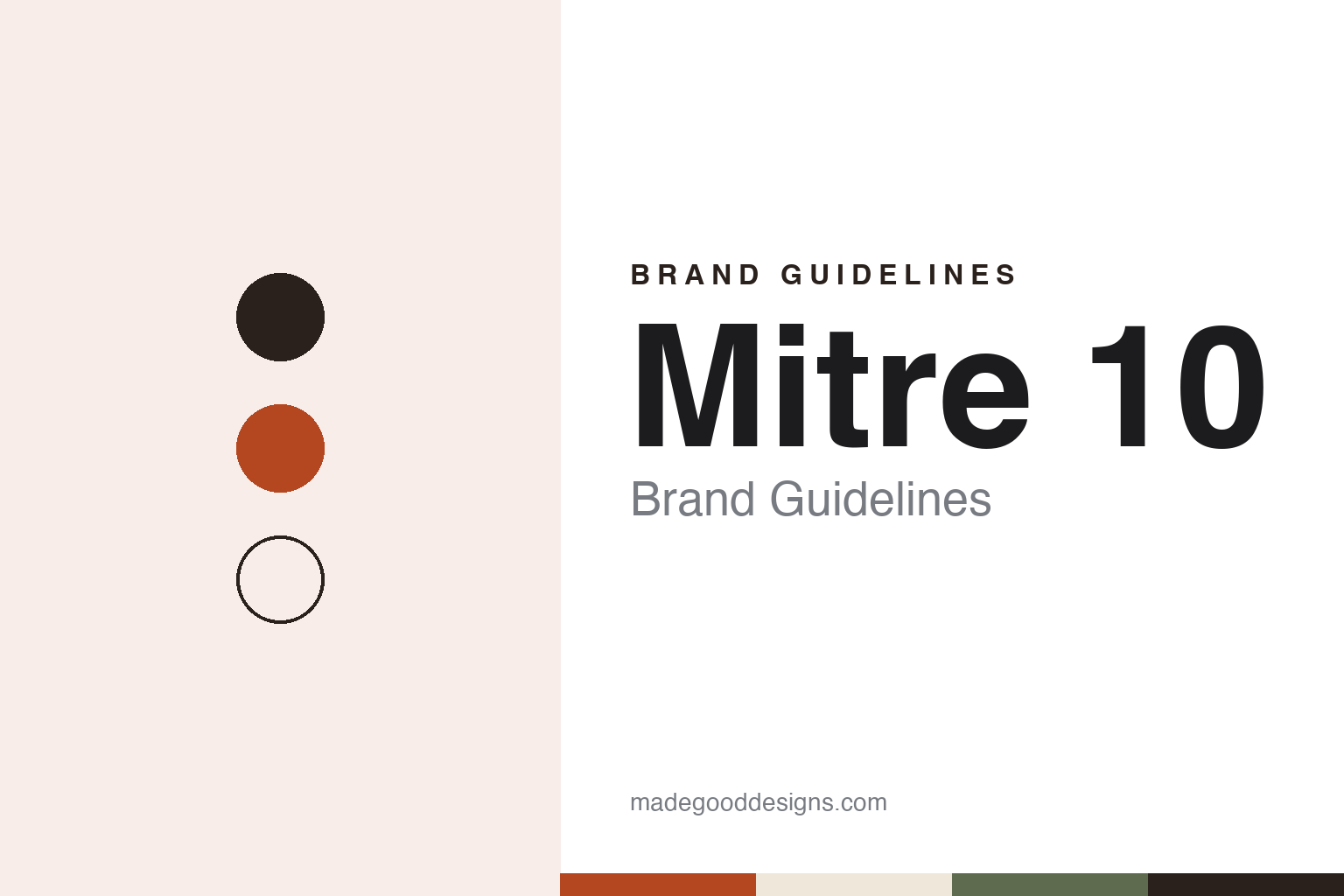
Mitre 10 Brand Guidelines
The co-operative of independent hardware stores that took full ownership of its own name.
Aa
Two constants: a kiln red, bark and sawdust palette and a workshop sans register. Abstract homage — not a Mitre 10 product or mark; no sign, logo or store fitting is reproduced.
Twelve members
Independent merchants pooling a name from across the Tasman.
Mitre 10 began in Australia, not New Zealand. English Wikipedia says the name was first used in Melbourne, where a group of independent hardware retailers met in 1959 to form a co-operative so that they could share the cost of advertising and promotion; the name refers to the mitre joint used in carpentry. The idea spread state by state in Australia during the 1960s.
New Zealand followed in June 1974. English Wikipedia cites the New Zealand Herald of 28 June 1974, which reported that some of the smaller firms in the timber and hardware trade were “grouping together to present a unified buying and selling front.” The first members’ meeting that year brought together twelve members representing fifteen stores. They adopted the Mitre 10 name, which in Australia had been managed by an overall licensing company since 1964, English Wikipedia says; the New Zealand group itself was a co-operative of the people who ran the shops.
That structure still defines the business. Mitre 10 (New Zealand) Limited is the national company, and the stores are run by member owners who hold shares in it. The Rotorua Daily Post gave one example in October 2015: a Bay of Plenty family whose business, the co-operative’s then chief executive said, had operated Mitre 10 stores in the region since 1978.
Colour
Home and Trade, Hammer, and the Mega box.
The range grew with the stores. English Wikipedia says the chain moved into home and garden products in the late 1980s, and in 1994 introduced the Mitre 10 Home and Trade name. Two further names, Hammer Hardware and Mitre 10 Mega, extended the network in both small and large towns and cities, English Wikipedia says.
The first Mega opened in Hastings in 2004, according to English Wikipedia. Mega stores carry a larger range than standard Mitre 10 stores, including more garden products, the same source says. In June 2012 the Northern Advocate reported on the Whangārei Mega, then about to open as Northland’s first, in an 8,000-square-metre building replacing a smaller Home and Trade store. Because such stores needed far more capital to set up, a company spokesman told the paper, the Whangārei Mega would open as a corporate store run by the national company rather than by a member.
That arrangement was meant to be temporary. In October 2015 the Rotorua Daily Post reported that the Bold Group, a Bay of Plenty family business that already ran Mitre 10 Mega Tauranga and Mitre 10 Waihi, had bought Mitre 10 Mega Rotorua from Mitre 10 (New Zealand) Ltd. The Rotorua store had opened in December 2012 as a company-owned store, the paper said, with the intention of finding an owner-operator for it. The pattern — national company builds, local family takes over — shows how the co-operative grew its larger format without giving up member ownership.
English Wikipedia gives the size of the network at different dates: 50 stores in 1999, 113 in 2003 and 83 in 2019.
Typography
Signs, own labels and owners.
Home-improvement and hardware chains speak to two audiences at once: households fixing, painting or refitting a room, and builders, trades and small contractors buying in bulk. Many chains answer that split with separate store formats under one name. In Chile, Sodimac runs a Homecenter format for home projects and decoration and a Constructor format for building professionals, and its first store in Mexico combined both under one roof in 2018, according to Gestión.
The store sign carries most of the identity. A chain’s name sits on a large warehouse façade, often beside a car park and a drive-in yard for heavy materials, and the same mark then reappears on aisle signs, trolleys, staff aprons and delivery trucks. Own-label ranges, trade-loyalty schemes and tool-hire counters are usually named as part of that same system, so the house style has to work from a billboard down to a shelf label.
Ownership shapes how these brands present themselves. Some began as co-operatives of builders or independent hardware dealers, and some still describe that member or dealer structure on their corporate pages; others belong to large retail groups that also run supermarkets, department stores and shopping centres, and that publish their store networks country by country. Sodimac belongs to Falabella and Easy to Cencosud, two Chilean retail groups whose home-improvement chains have competed in Chile since the 1990s, Peru Retail reported in November 2026.
Corporate history pages are where these companies tell their own story: the founding co-operative, the family or group that took control, the first store abroad. Read as a set, the chains in this series show how one category, from Latin America to North America, Asia, New Zealand and Europe, adapts a shared warehouse model to local ownership and local habits.
10
A sturdy workshop sans for a name taken from a carpentry joint. (Specimen set in Archivo, a sans STAND-IN; NOT the Mitre 10 logo.)
Mitre 10
One name, two separate businesses.
For its first 36 years the New Zealand co-operative did not fully own the name over its door. That changed in 2010. In Australia, English Wikipedia says, shareholders of Mitre 10 Australia voted in March 2010 to accept a bid from the wholesaler Metcash for a controlling stake, and Metcash bought the rest of the business in 2012. In the same year as the Australian vote, according to English Wikipedia, Mitre 10 (New Zealand) Limited took full ownership of the Mitre 10 brands for New Zealand.
Since then the two have shared a name and a heritage, but English Wikipedia describes the modern operations as separate. Mitre 10 in Australia is part of a listed wholesale group; Mitre 10 in New Zealand remains a member-owned co-operative. The Australian side has developed its own look and formats: English Wikipedia says its stores are painted in a traditional blue and white livery, and that Mitre 10 Australia opened its own first big-box “Mega” store at Beenleigh, Queensland, in June 2004, the same year as the first New Zealand Mega in Hastings. Anyone writing about the brand needs to say which one they mean: a store count, owner or logo for one tells you nothing about the other. Mitre 10 New Zealand is also unrelated to Mitre, the English sports-ball maker.
The name has also reached audiences outside the stores. English Wikipedia notes that it backed Mitre 10 Dream Home, a reality television series that ran from 1999 to 2013, and that from 2016 to 2020 it sponsored rugby’s National Provincial Championship, which became widely known as the Mitre 10 Cup. With Kiwibank it runs the annual Mitre 10 Awards for community projects, the same source says.
Mitre 10 is a retailer, not a manufacturer. English Wikipedia describes its range as household hardware, building supplies, heaters and air conditioners, garden products, barbecues and camping gear, sold through stores owned by members rather than by the national company.
For a design guide, Mitre 10 shows how a co-operative can keep one strong national sign over many independently owned shops, and how a licensed name can become a member-owned one. Compare Bunnings, the Australian home-improvement chain, and True Value, another hardware co-operative founded by independent store owners. For this guide we use kiln red, bark and sawdust with a flax-green accent and a sans, an unofficial interpretation; no product or logo is reproduced.
Explore & save
Keep Mitre 10’s identity on hand — save it to a board in the Made Good inspiration library.
Mitre 10 identity set
Keep the kiln red, bark and sawdust palette and the workshop sans register for your own hardware-store board.
Source & notes
Frequently Asked Questions
What font can I use to match the Mitre 10 look?
This guide describes Mitre 10’s type as “A sturdy workshop sans for a name taken from a carpentry joint”. Its type specimen is set in Archivo from Google Fonts as a stand-in; Archivo is not Mitre 10’s own lettering.
What colours are in the Mitre 10 palette?
This guide’s Mitre 10 palette is Kiln red #B4471F, Bark #2A211C, Sawdust #EFE7DA, Flax green #5E6B4E and Paper #FAF7F2. The tones are the guide’s own unofficial interpretation, not official Mitre 10 hex codes.
When was Mitre 10 founded?
Mitre 10 was founded in June 1974, in New Zealand.