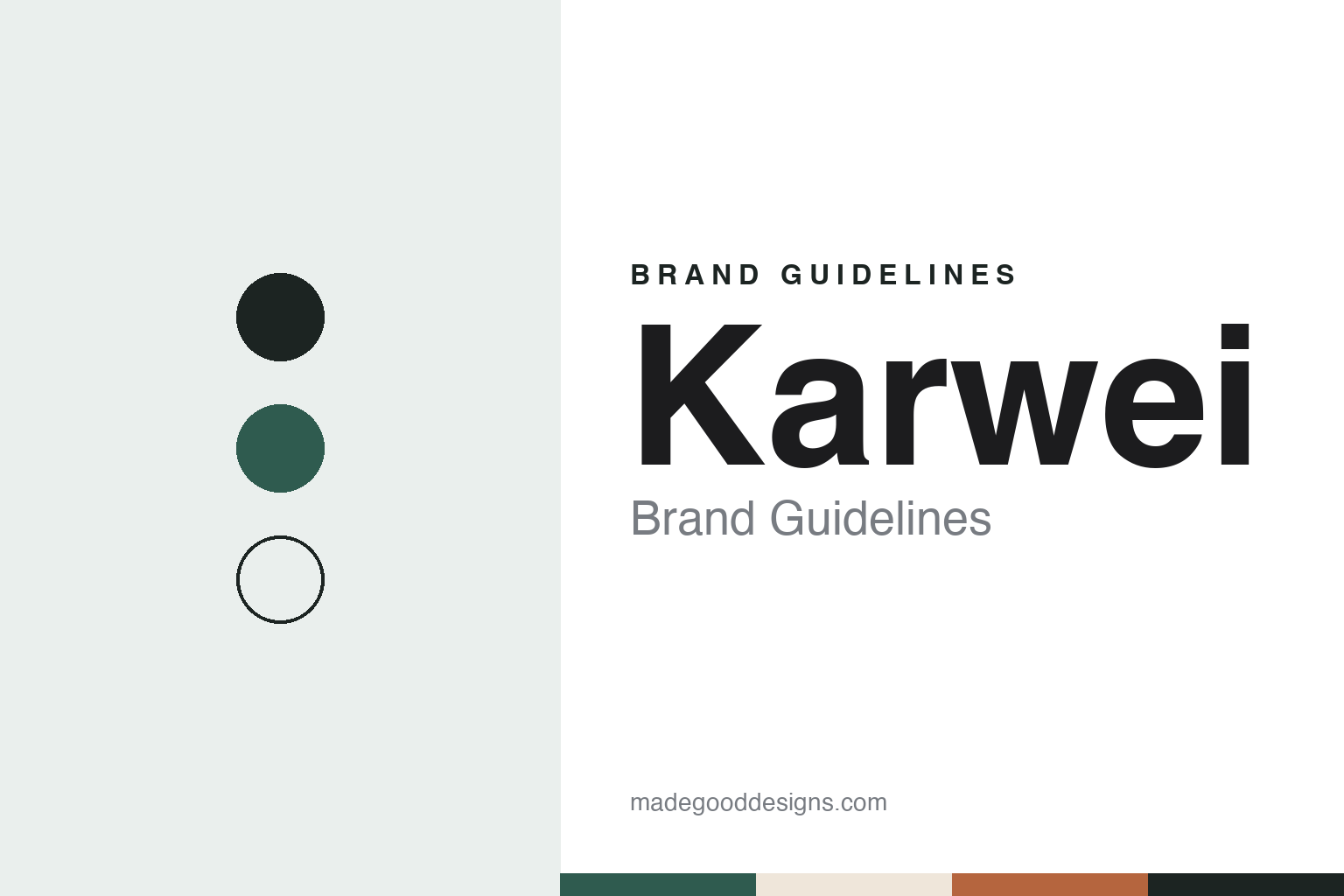
Karwei Brand Guidelines
A 1975 Utrecht DIY chain named after a trade fair.
Aa
Two constants: a sage, linen and terracotta palette and a decorative serif register. Abstract homage — not a Karwei asset; no store sign, logo or product is reproduced.
A Trade-Fair Name
Utrecht, 1975, and a word borrowed from the Jaarbeurs.
Karwei opened its first store in Utrecht on 14 May 1975, according to both English and Dutch Wikipedia. The word itself is everyday Dutch for a job or a piece of work around the house, and the chain borrowed it from a trade show. Dutch Wikipedia says that from 1967 a DIY trade fair called “Karwei” was held every year at the Jaarbeurs, Utrecht’s exhibition centre; the name turned out not to be protected, and the founders of the store registered it as their shop name.
From the start Karwei was a franchise. Intergamma, its owner today, says Karwei has been a franchise formula since 1975, which means the stores belong to independent business owners who run them under the shared name. That model came to the Netherlands from the United States in the same years: Intergamma’s own history says a group of Dutch building-materials traders saw the American “home improvement center” in 1970, and opened the first Gamma in Breda on 11 May 1971. The franchise model came from the United States too, the company says: the stores belonged to independent owners, who supplied the site, the building and the staff themselves.
The two chains came together in 1991. Intergamma says that in that year it took over the franchise chain Karwei Holland Nationaal bv, and English and Dutch Wikipedia both date Karwei’s membership of Intergamma to 1991. Intergamma had moved out of other formats in the early 1990s, selling the Lanser chain and letting its Bouwmaat building-materials business go its own way, according to the company’s history.
Since then Karwei and Gamma have shared an owner, a head office in Leusden and a supply chain, but have been run as separate formulas. Intergamma describes Gamma as aimed at the practical builder and Karwei more at customers looking for style and atmosphere.
Colour
Floors, lighting, windows and walls.
Karwei’s present character was set by a deliberate shift towards home decoration. In October 2016 the trade site RetailDetail reported that Karwei had launched a renewed store concept in Uden with a stronger focus on home decoration: floors, lighting, and window and wall decoration were grouped together so that customers could combine them, alongside the building materials needed to fit them, while products such as white goods, kettles and bicycles were dropped from the range.
Dutch Wikipedia describes a new store style, which it calls Q, that it dates from autumn 2017, beginning with the Karwei store in Heesch and followed by stores in Uden, Goirle and Amsterdam among others. In this layout, it says, the central aisle zigzags through the store instead of running straight with long side aisles, with smaller aisles branching off and inspiration areas for window decoration and flooring along the way. It counts more than fifteen stores converted by the end of 2023.
The chain also moved online. Intergamma’s history says the Karwei webshop started in 2014, a year after Gamma’s, and Dutch Wikipedia says online orders are supplied from Intergamma’s distribution centre, with click-and-collect from stores. Intergamma says it opened a new distribution centre in Tiel in mid-2025, bringing five logistics sites together.
Karwei trades only in the Netherlands. English Wikipedia counted 128 Karwei stores in 2011, out of 373 Intergamma stores at that time, and 136 stores as of 2019; Dutch Wikipedia gives 131, citing the company’s site in 2023; Dutch Wikipedia adds that about half are owned by Intergamma itself. Intergamma says the chain offers measuring, fitting and home advice as well as products, and stocks seasonal ideas for indoors and outdoors.
Typography
How DIY chains present themselves.
European DIY chains and builders’ merchants present themselves first through the building: a large shed on a retail park or industrial estate, with a fascia sign and on-site parking and loading. In the trade press, store openings are reported branch by branch, with the site, the town and the running total, and that branch count is often the main public measure of how a network has grown.
Ownership shapes the identity more than in most retail sectors. Some chains are owned by listed building-materials groups that run several trading names side by side; others are co-operatives or buying groups whose members are independent family firms. In the co-operative model the shared name may sit above the member’s own name rather than replacing it, and store formats are often run as franchises supplied by a central organisation.
Formats are named and graded with care. A group may run a full-size DIY store with a garden centre, a smaller local format, a trade-only warehouse and a merchant yard for builders, each with its own sign but a shared family resemblance. Own-label ranges, hire counters, kitchen design services and click-and-collect services are named by the companies themselves and appear in their store descriptions and opening announcements.
Corporate pages fill in the rest: founders, founding dates, acquisitions and the parent company. The guides in this series set out what dated, independent sources say about each chain — when it began, who owns it and how its network has changed — and keep the companies’ own descriptions clearly marked as theirs.
Aa
A decorative serif for a home-decoration register. (Specimen set in DM Serif Display, a serif STAND-IN; NOT the Karwei logo or store lettering.)
Karwei
A franchise formula inside a co-operative.
Karwei’s owner is organised in an unusual way. Intergamma says its franchisees are all shareholders in the company, and that they have a voice in the strategy of each formula through formula councils elected by the GAMMA-Karwei franchise association. Its board is named as that of Intergamma Coöperatief U.A., and the group says it runs almost 400 stores of Gamma and Karwei in the Netherlands and Belgium.
Ownership inside the group changed in 2018. RetailDetail and DutchNews reported in February 2018 that Intergamma would take over the Van Neerbos Groep, its largest franchisee with 156 Gamma and Karwei stores. RetailDetail wrote that Van Neerbos belonged to the Irish building-materials group CRH, which also held 49.8 per cent of Intergamma’s shares, and that franchisees had approved Intergamma’s purchase of the CRH shares with 92.5 per cent of the votes. The Dutch competition authority, the ACM, decided on 23 March 2018 that Intergamma Holding could take over the Van Neerbos stores and Intergamma, finding that enough competition would remain. Intergamma’s history records the takeover in 2018 and says that since then it has run stores itself as well as acting as franchisor.
Intergamma also converted the former Dutch and Belgian stores of the French chain Bricorama into Gamma and Karwei stores, according to the company’s history.
For a design guide, Karwei shows how a DIY chain can set itself apart from a sister brand under the same owner by narrowing its range towards decoration and changing the shape of the store itself. Compare Gamma, the Intergamma chain aimed at building work, and Hubo, a franchise name that began in Utrecht. For this guide we use a deep sage, linen and a terracotta with a serif, an unofficial interpretation; no product or logo is reproduced.
Explore & save
Keep Karwei’s identity on hand — save it to a board in the Made Good inspiration library.
Karwei identity set
Pin the Karwei sage, linen and terracotta palette and the decorative serif register to your own board.
Source & notes
Frequently Asked Questions
What font can I use to match the Karwei look?
This guide describes Karwei’s type as “A decorative serif for a home-decoration register”. Its type specimen is set in DM Serif Display from Google Fonts as a stand-in; DM Serif Display is not Karwei’s own lettering.
What colours are in the Karwei palette?
This guide’s Karwei palette is Deep sage #2F5B4F, Charcoal #1C2422, Linen #EFE6DA, Terracotta #B5653E and Paper #F8F5F0. The tones are the guide’s own unofficial interpretation, not official Karwei hex codes.
Who owns Karwei?
Karwei is owned by Intergamma (since 1991). Karwei is known for DIY and home decoration: floors, lighting, window and wall decoration.