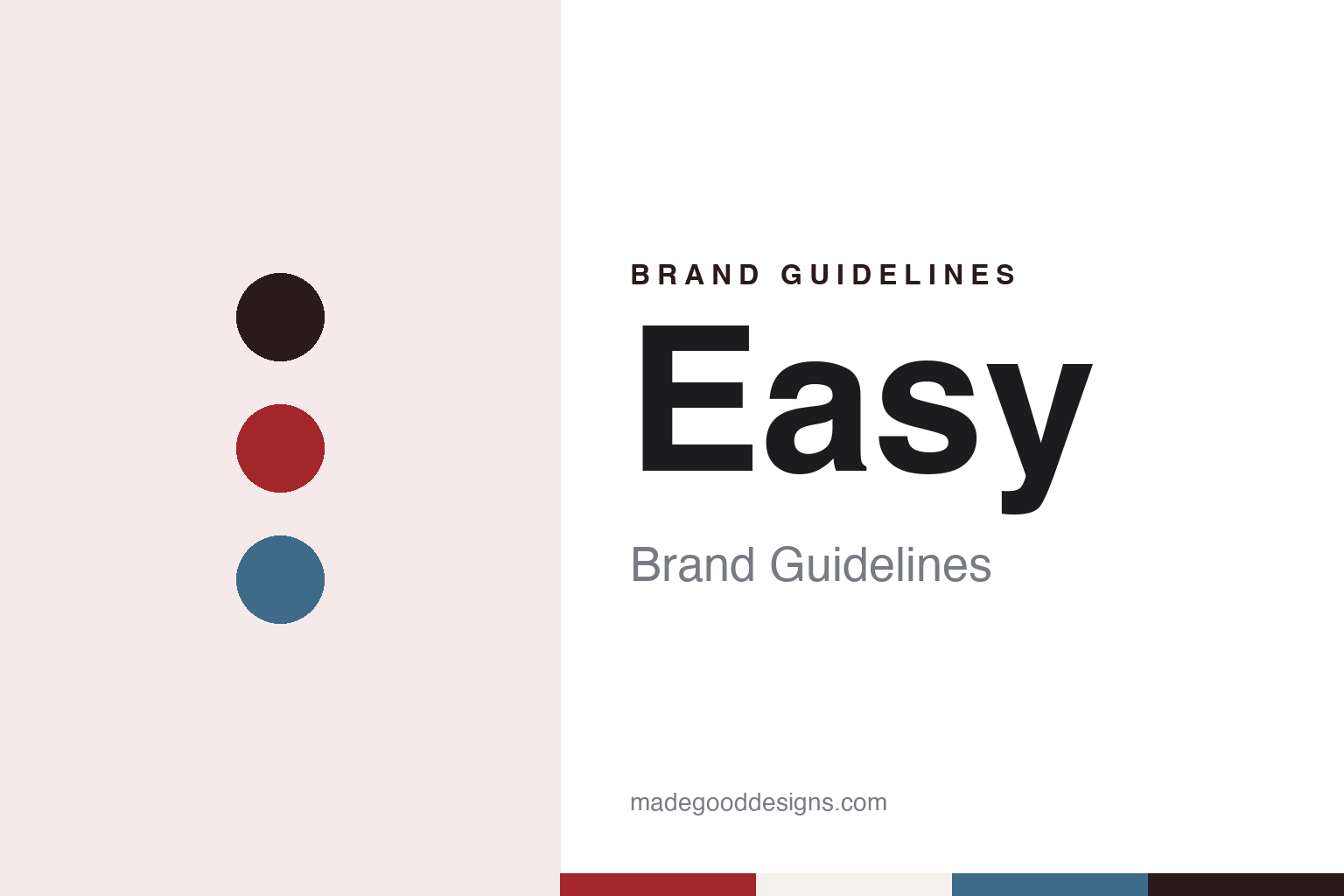
Easy Brand Guidelines
Cencosud’s home-improvement chain, from Santiago and Buenos Aires to Bogotá.
Aa
Two constants: a brick red, charcoal and steel blue palette and a condensed sans register. Abstract homage — not an Easy product or mark; no sign, logo or store fascia is reproduced.
A Retail Group’s DIY Arm
From supermarkets and malls to home improvement.
Easy is the home-improvement chain of Cencosud, the Chilean retail group. Cencosud’s own history page traces the group from a small restaurant to its first supermarket, Las Brisas, in the southern Chilean city of Temuco in 1963, then to the first Jumbo hypermarket in Chile in 1976, the first Jumbo in Argentina in 1982 and the Unicenter shopping centre in Argentina in 1988. The group was controlled by the German-born businessman Horst Paulmann, La Tercera noted in 2009, and Cencosud’s website says the Paulmann family controls about 56 per cent of the company. The group’s timeline records its listing on the Santiago stock exchange in 2004 and a share offering in New York in 2012.
Home improvement was added in 1993. Cencosud’s timeline lists the opening of its first home-improvement store under the Easy brand, in Chile, that year, and Peru Retail reported in November 2026 that Easy entered the Chilean market in 1993 with large stores combining building materials, equipment and decoration. The Argentine business dates its start to the same period: when El Cronista reported on the Argentine chain in September 2021, it noted the business’s 28th anniversary there.
The stores are large boxes, and many sit inside the group’s own shopping centres. Four of the Chilean stores that Cencosud chose to close in 2026 were in malls run by Cencosud itself, Just Retail reported, and the group runs supermarkets, department stores and shopping centres in the same countries, its website says.
Colour
Home Depot Argentina, Blaisten and Colombia.
Easy grew in Argentina by acquisition. In 2002, Cencosud’s timeline says, the group bought Proterra in Chile and Home Depot’s business in Argentina, both to build up the Easy brand. Five years later Cencosud moved into a neighbouring specialism. In October 2007 La Nación reported that the group, already owner of the Easy stores, had signed an agreement to buy all of Blaisten, a Buenos Aires chain specialising in kitchens and bathrooms with nine stores in the capital and its suburbs, subject to approval by Argentina’s competition authority; the group said it would keep the Blaisten name and staff. The seller was Banco Galicia, which had taken control of Blaisten in 2000 from the investment fund The Exxel Group, the paper said. Cencosud’s timeline lists the Blaisten acquisition in 2008. The paper set the deal against the wider Argentine market, where Easy met the Saint-Gobain group’s Barugel Azulay and Chile’s Sodimac.
Blaisten still trades beside Easy. In September 2026 iProfesional reported that Cencosud’s home-improvement division in Argentina covers both Easy and Blaisten, and El Cronista described the two chains as one business unit in 2021. In September 2021 El Cronista counted 44 Easy stores in Argentina, in provinces from Río Negro and Mendoza to Tucumán and Chaco as well as Buenos Aires.
Colombia came next. Cencosud’s timeline lists a 2007 joint venture with the French retailer Casino to develop Easy Colombia. In April 2009 La Tercera reported that Cencosud had announced the purchase of the 30 per cent stake Casino held in the Colombian subsidiary, that the only Easy store in Colombia had opened in October 2008. At that point, the report noted, Easy also operated in Argentina and Chile, and the single Colombian store employed 260 people. Easy’s manager for Latin America told reporters that in 2008 the chain had put money into four stores in Chile and four in Argentina, and had refurbished others.
The Colombian stores have since been reworked. In February 2025 the Bogotá radio news site Tropicana reported that Easy had rebuilt its store in the Centro Mayor shopping centre, moving from two floors of about 9,650 square metres to a single ground floor of about 5,200 square metres, with a garden and live-plants section, a building-materials yard, a wider flooring range and a paint colour centre where customers can have shades mixed to order.
Typography
The category.
Home-improvement and hardware chains speak to two audiences at once: households fixing, painting or refitting a room, and builders, trades and small contractors buying in bulk. Many chains answer that split with separate store formats under one name. In Chile, Sodimac runs a Homecenter format for home projects and decoration and a Constructor format for building professionals, and its first store in Mexico combined both under one roof in 2018, according to Gestión.
The store sign carries most of the identity. A chain’s name sits on a large warehouse façade, often beside a car park and a drive-in yard for heavy materials, and the same mark then reappears on aisle signs, trolleys, staff aprons and delivery trucks. Own-label ranges, trade-loyalty schemes and tool-hire counters are usually named as part of that same system, so the house style has to work from a billboard down to a shelf label.
Ownership shapes how these brands present themselves. Some began as co-operatives of builders or independent hardware dealers, and some still describe that member or dealer structure on their corporate pages; others belong to large retail groups that also run supermarkets, department stores and shopping centres, and that publish their store networks country by country. Sodimac belongs to Falabella and Easy to Cencosud, two Chilean retail groups whose home-improvement chains have competed in Chile since the 1990s, Peru Retail reported in November 2026.
Corporate history pages are where these companies tell their own story: the founding co-operative, the family or group that took control, the first store abroad. Read as a set, the chains in this series show how one category, from Latin America to North America, Asia, New Zealand and Europe, adapts a shared warehouse model to local ownership and local habits.
Aa
A tall condensed sans for price boards and aisle signs. (Specimen set in Barlow Condensed, a sans STAND-IN; NOT the Easy logo.)
Easy
Fewer, larger stores in Chile.
In Chile, Easy has long faced Falabella’s Sodimac. Peru Retail reported in November 2026 that the two chains had competed for more than three decades, and that at the end of 2025 Easy operated 42 stores in Chile.
In November 2026 Cencosud confirmed a decision to close four Easy stores in Chile, at Cenco Portal Ñuñoa and Cenco El Llano in the Santiago region and at Cenco Temuco and Cenco Osorno in the south, CNN Chile and Emol reported. Cencosud said the aim was to focus the chain on larger stores that could carry its full range; the four sites together covered about 12,000 square metres, roughly the size of one large-format Easy store, according to CNN Chile. The chain keeps a store on Avenida Caupolicán in Temuco, one in Villarrica, opened in 2025, and one in Osorno, Just Retail reported.
As of November 2026 Easy trades in Chile, Argentina and Colombia, according to Just Retail, with Blaisten as a sister chain in Argentina.
For a design guide, Easy shows how a short, plain word can carry one retail group’s home-improvement offer across three countries. Compare Sodimac, its rival in Chile, and The Home Depot, whose Argentine business Cencosud bought in 2002. For this guide we use a brick red, charcoal and steel blue with a condensed sans, an unofficial interpretation; no product or logo is reproduced.
Explore & save
Keep Easy’s identity on hand — save it to a board in the Made Good inspiration library.
Easy identity set
Pin the Easy brick red, charcoal and steel blue palette and the condensed sans register to your own board.
Source & notes
Frequently Asked Questions
What font can I use to match the Easy look?
This guide describes Easy’s type as “A tall condensed sans for price boards and aisle signs”. Its type specimen is set in Barlow Condensed from Google Fonts as a stand-in; Barlow Condensed is not Easy’s own lettering.
What colours are in the Easy palette?
This guide’s Easy palette is Brick red #A3262A, Charcoal #2A1A1A, Steel blue #3E6B8A, Chalk #F4F1EC and Sawdust #E6D3B3. The tones are the guide’s own unofficial interpretation, not official Easy hex codes.
Who owns Easy?
Easy is owned by Cencosud.


