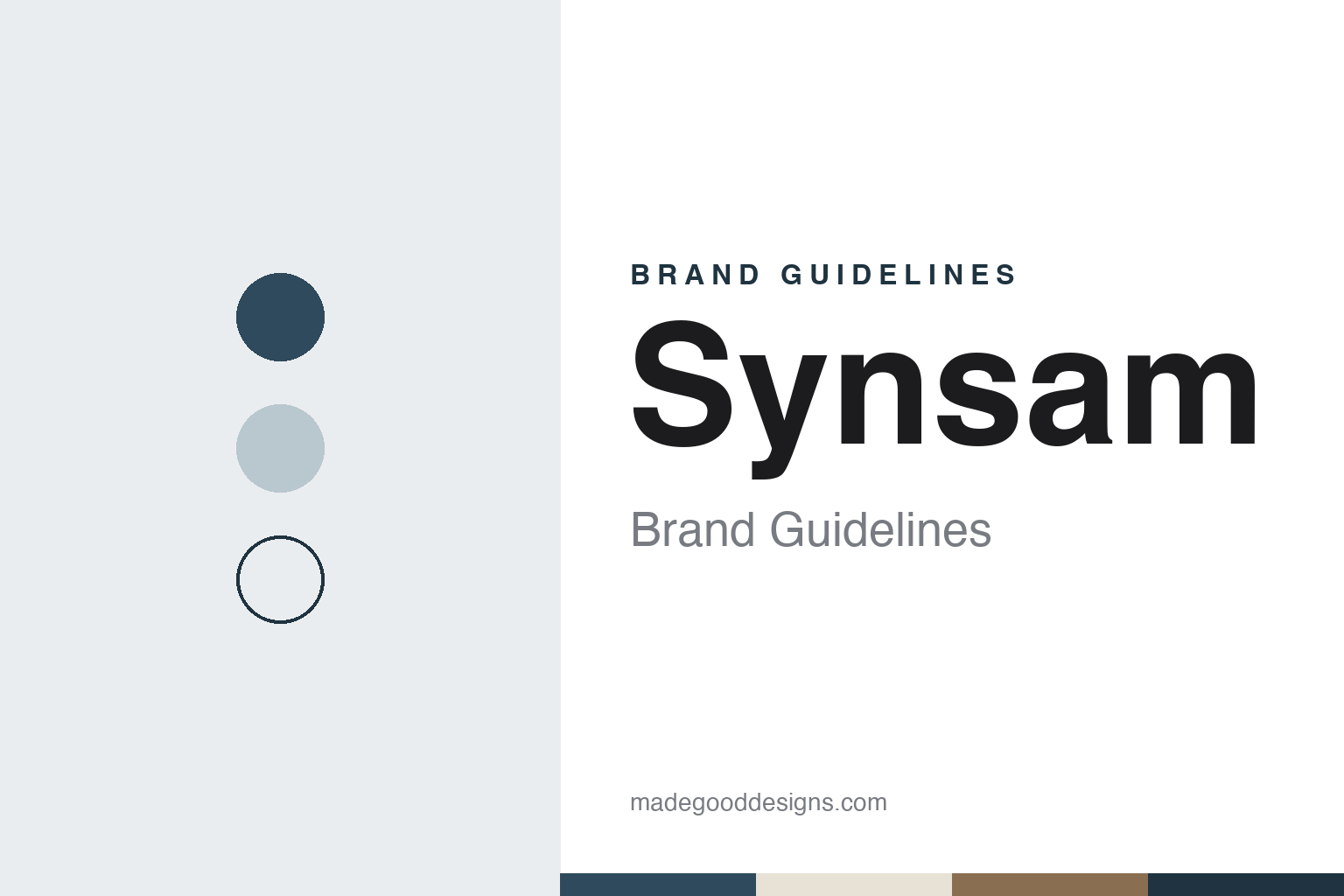
Synsam Brand Guidelines
A 1968 alliance of Swedish opticians that became a Nordic chain with its own frame works.
Aa
Two constants: a lake slate, birch and frost palette and a rounded Nordic sans register. Abstract homage — not a Synsam product or mark; no shop sign, logo or frame is reproduced.
Opticians under one name
A shared sign for independent shops.
Synsam began in 1968 as a joint effort by independent opticians in Sweden. Vision Monday, reporting in March 2014, described the start as opticians who “joined forces under a common brand name”, and the company’s own history page tells the same story: a group of opticians working together under one sign rather than a single founder with a single shop.
For almost four decades that is roughly what Synsam remained, a voluntary chain in which owner-opticians kept their own businesses and shared the name. The change came with the Swedish investment company Alipes, which Vision Monday said was owned by Inter IKEA Investments and Ikano and had held Synsam since 2007. Between 2007 and 2009, together with former store owners, Alipes carried out more than 200 separate purchases of Synsam and Profil Optik shops in Denmark, Norway and Sweden, turning the loose alliance into an integrated retail chain, the trade paper reported.
In March 2014 funds advised by CVC Capital Partners agreed to buy Synsam Nordic from Alipes and the former store owners. At that point, Vision Monday wrote, the group had more than 420 own stores and franchise stores across Sweden, Denmark and Norway. Stores in Sweden and Norway traded as Synsam and those in Denmark as Profil Optik; in Finland the Synsam name was then used through a cooperation agreement with a Finnish optical chain rather than by Synsam’s own shops. The trade paper noted that completion of the deal was subject to the usual competition clearances.
Colour
Two shop names, own-label frames and a works on Frösön.
The group still runs two shop names. Synsam Group says it trades as Synsam in Sweden, Norway and Finland and as Profil Optik in Denmark and Iceland, with stores in six markets including the Faroe Islands. It gives the network as more than 600 stores, most of them directly owned and the rest run by franchisees, alongside online sales and booking.
Around the main shops the company has added several formats. It says it launched Synsam Lifestyle, a subscription in which customers pay a monthly fee for frames, lenses and related services, in 2016; opened a flagship store on Norrmalmstorg in Stockholm in 2019; set up the Synsam Recycling Outlet in 2020 to resell returned frames after cleaning and repair; and in May 2025 added NK Eyewear & Optics, a premium concept run as a separate unit.
The most visible shift is in making frames. In 2020, the company said in a release of August 2022, Synsam Group decided to move its frame production from China to Sweden. The result was a Production and Innovation Center on Frösön, near Östersund in Jämtland, which opened in August 2022 in an 8,100-square-metre former hangar at Frösö Park. The opening range was Jämtö, six unisex frames whose design the company tied to the landscape of Jämtland, and which it said would reach its shops by September 2022. The company groups this work under the label “Made in Sweden”.
Since then the company has named further own-label ranges made at Frösön: Oscar Eide in 2023, Isa Nord and a collection with Peter Forsberg in 2025, and Alicia Lind in 2026. In 2026 it also announced an eyewear collection with Erling Haaland, which it says runs to 64 models across optical frames, sunglasses and sports glasses for women, men, young people and children, and which it presents as its step into markets beyond the Nordic region. Recycled frames, meanwhile, are sold through the separate Synsam Outlet shops and in selected Synsam stores, the company says.
Typography
How optical chains present themselves.
Optical retail chains present themselves above all through the shop sign. The name over the door has to work at street level, on a shopping-centre fascia and on a phone screen, and many chains in this group run more than one name at once. In the Nordic countries, Synsam trades as Synsam in Sweden, Norway and Finland but as Profil Optik in Denmark and Iceland, while Finland’s Instru Optiikka runs Instrumentarium, Nissen and Keops side by side.
Ownership is part of the story these companies tell, and it varies widely. Some chains began as alliances of independent opticians or as co-operatives and buying groups; others grew from a single founder or a family business; still others now sit inside listed groups or private-equity portfolios. Corporate pages on founders, owners and dates are often the most useful material for a designer, because they explain why one network carries several names or why a sign has outlived the company that created it.
Own-label frames are the second constant. Chains in Japan, Brazil, Spain, France, the Nordic countries and the Gulf sell frames under their own range names next to outside brands, and those names are given here as the companies publish them, collection by collection. Store formats follow the same pattern: flagship shops, outlet or second-hand formats, franchise stores and online sales are each described in the companies’ own terms.
The guides in this group set out each chain’s published history, ownership and store network with dates, and then offer an unofficial palette and a type stand-in for reference. They make no claims about eye care, lenses or examinations, and no logo or shop sign is reproduced.
Aa
A rounded, open Nordic sans for shop fronts and frame labels. (Specimen set in Manrope, a sans STAND-IN; NOT the Synsam logo.)
Synsam
From private equity to the Stockholm exchange.
CVC kept control for seven years and then took Synsam to the stock market. Trading in the shares of Synsam AB on Nasdaq Stockholm began on 29 October 2021, according to the law firm Roschier, which advised the company and the selling shareholder, Theia Holdings, a company indirectly majority owned by a CVC fund. Roschier described Synsam at the time as an optician group with 490 stores in Sweden, Denmark, Norway and Finland, run as directly owned and franchise stores and through e-commerce, and said the offering drew institutional investors as well as members of the public in Sweden, Denmark, Norway and Finland.
CVC then sold down its holding in stages. In June 2025 Theia Holdings sold its remaining shares through an accelerated book-building process, which Roschier described in a note dated 13 June 2025 as CVC’s full exit from its ownership.
Synsam has also expanded in Finland under its own name. Yle reported in May 2025, citing the optical trade association Näe ry, that Synsam had increased its Finnish locations from 50 to 69 over three years, at a time when the total number of optician shops in Finland had fallen by about five per cent since 2022. The same report counted 663 optician shops in Finland at the end of 2024, of which 132 belonged to no chain at all. In Meri-Lappi, the coastal area of Finnish Lapland, Synsam opened two shops in November 2024, Yle added.
For a design guide, Synsam shows how a shared shop sign can carry a group from an alliance of independent opticians to a single listed company with its own frame works, while keeping a second name, Profil Optik, where it already had a following. Compare Instrumentarium, a Finnish chain with a much older name, and Specsavers, another optical retailer built on a partnership model. For this guide we use a slate blue, birch and frost grey with a sans, an unofficial interpretation; no product or logo is reproduced.
Explore & save
Keep Synsam’s identity on hand — save it to a board in the Made Good inspiration library.
Synsam identity set
Pin the lake slate, birch and frost palette and the rounded Nordic sans register to your own board.
Source & notes
Frequently Asked Questions
What font can I use to match the Synsam look?
This guide describes Synsam’s type as “A rounded, open Nordic sans for shop fronts and frame labels”. Its type specimen is set in Manrope from Google Fonts as a stand-in; Manrope is not Synsam’s own lettering.
What colours are in the Synsam palette?
This guide’s Synsam palette is Lake slate #2E4A5C, Deep fjord #1F3340, Birch paper #E8E2D6, Frost grey #B9C7CF and Acetate brown #8A6E52. The tones are the guide’s own unofficial interpretation, not official Synsam hex codes.
When was Synsam founded?
Synsam was founded in 1968, as an alliance of opticians, in Sweden.
Where is Synsam made?
Synsam is made in Frösön, near Östersund (frame works opened 2022).


