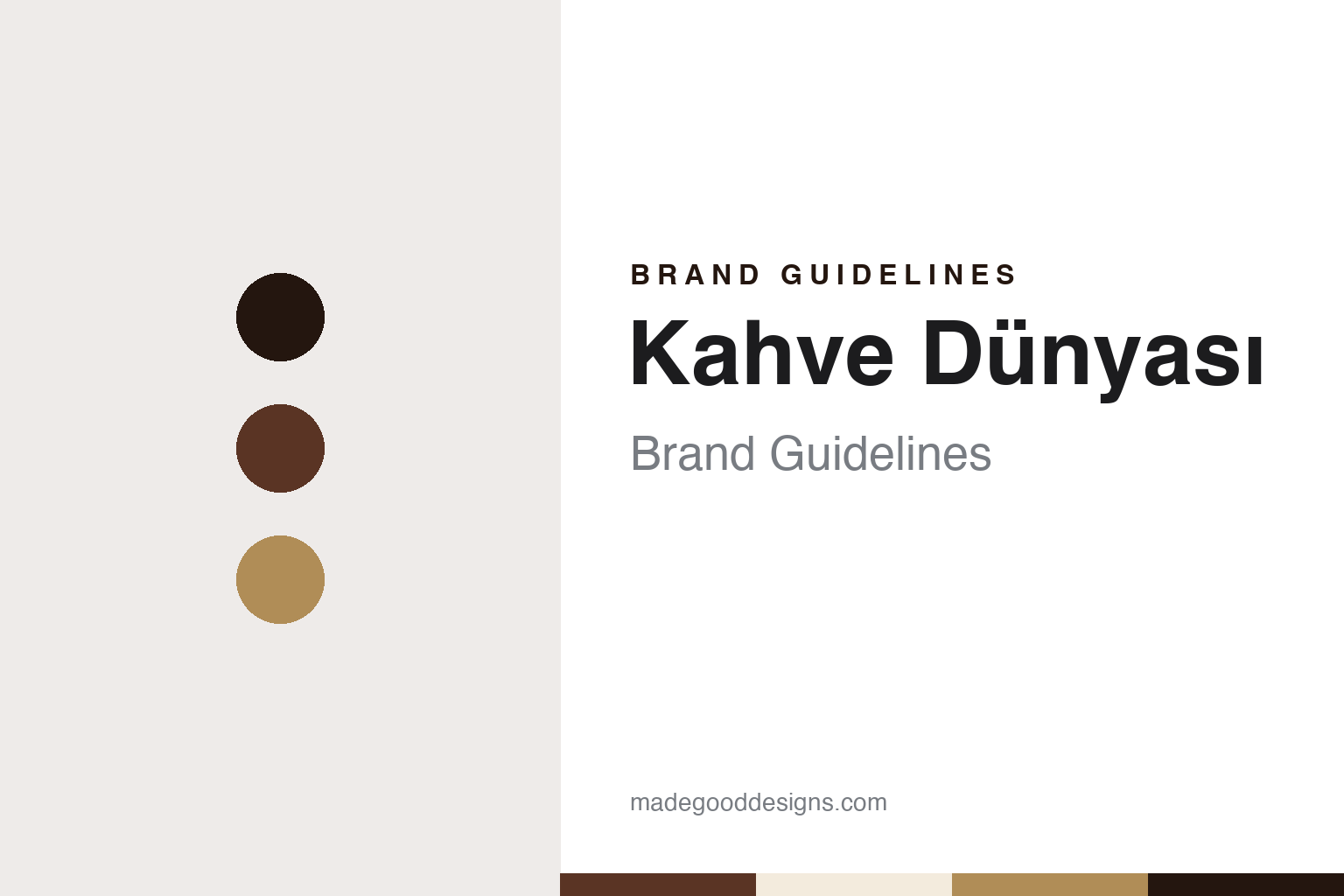
Kahve Dünyası Brand Guidelines
Altınmarka’s 2004 Eminönü coffee and chocolate chain.
Aa
Two constants: a roast brown, cream and brass palette and a coffeehouse serif register. Abstract homage — not a Kahve Dünyası product or mark; no cup, pack, logo or sign is reproduced.
Eminönü, 2004
A cocoa business opens a coffee shop.
Kahve Dünyası, Turkish for “coffee world,” is the retail arm of a business that started with raw materials. The Altınmarka group was founded in 1992 by Birol Altınkılıç, Ekonomist reported in July 2016, and grew as an importer and processor of cocoa and coffee; the magazine described it then as a group of seven companies that the public knew mainly through Kahve Dünyası. The company’s own history page says the group was set up to import coffee and cocoa and that the chain is one of its three arms, alongside industrial cocoa and chocolate and private-label consumer products.
The first Kahve Dünyası store opened in 2004 in Eminönü, the old trading quarter of Istanbul by the Golden Horn, the company says. Its stores combine a café with a shop counter for packed coffee and chocolate, and the company describes the format as its own mix of coffeehouse and chocolate and coffee market.
The chain is a family business. In 2016 Ekonomist interviewed Dilara Altınkılıç Kutmangil, who ran the group’s Detay chocolate company, and in October 2017 the magazine reported that her brother Kaan Altınkılıç, of the family’s second generation, had been running Kahve Dünyası for about a year and a half. In July 2026 Ekonomist described him as having led the chain as general manager for ten years.
What sets the chain apart from many café brands is that it makes most of what it sells. In the 2016 interview the group listed production sites at Hadımköy, Çatalca, Esenyurt and Çorlu, around Istanbul, and a new site opposite the Veliefendi racecourse in Bakırköy for ice cream, chocolate and coffee, with a museum inside. The company’s website says its coffee is roasted in its own factory and that its chocolate is made in the group’s Altınmarka and Detay factories from cocoa grown in Ghana and Côte d’Ivoire.
Colour
Coffee, chocolate and store formats.
The menu runs from Turkish coffee, espresso drinks and filter coffee to chocolate, pastries and ice cream. In October 2017 Kaan Altınkılıç told Ekonomist that the chain carried close to 600 products and that around 95 percent of what it sold was its own production, which he gave as the reason it did not franchise in Turkey.
He also described a refresh that began in May 2016, which he called “Kahve Dünyası 2.0”: new designs for the cups, new staff uniforms and new till systems, along with a mobile app and a rebuilt online shop. The same interview listed new store types. At Kemerburgaz the chain opened a factory-style store where customers could watch production; at Veliefendi it opened a “living museum” store, where, he said, products were made on machines a century old; and in central Istanbul neighbourhoods such as Bebek and Nişantaşı it opened stores with a newer interior design.
The smallest format is Kahve Dünyası Al Götür, a take-away concept that he said fitted into around 35 square metres, against the 200 square metres the chain had treated as its minimum until then. By 2026 the company was writing the name as one word, Algötür, and listing it with Kahve Dünyası Fabrika and Kahve Dünyası Köşe as sub-brands.
The chain has also sold through other channels. In 2016 the group told Ekonomist that the Yaşar group had taken on distribution of its coffee to supermarkets, and in 2017 Kaan Altınkılıç said Kahve Dünyası had outlets at Shell fuel stations. In January 2026 the company’s blog introduced Reform, a line of laptop bags, hats and shoulder bags made from used coffee sacks, and described a wall in its Algötür store on the Bebek slope finished with panels made partly from spent coffee grounds.
Typography
Turkish chains at home and abroad.
Turkish café, bakery, kebab and casual-dining chains tend to build their names around a single dish or a single place. Some carry a city in the name, as Mado does with Maraş, the older name of Kahramanmaraş; others carry the food itself, as Simit Sarayı does with the sesame-covered simit. On their own websites the companies present the dish first and the shop second, with menus organised by named dishes such as künefe, baklava, simit or döner rather than by abstract product lines.
Many of these chains grew by moving street food indoors. Hürriyet Daily News wrote in 2013 that simit, once sold from carts, had become a large business run by chain restaurants, and the companies themselves describe their shopfronts as cafés, bakeries or restaurants with seating, counters and displays that make the food the main sight.
Franchising carries the brands abroad. Turkish chains publish franchise pages and lists of foreign branches, and some work through master franchisees that run a whole region; Daily Sabah reported in 2017 that a Saudi retail group had held such a franchise for Simit Sarayı across the Middle East and North Africa since 2014. Shops abroad often sit in malls and on main shopping streets, according to the companies’ own branch lists.
Ownership is usually described plainly on corporate pages: a family company, a holding company behind several brands, or a founding partnership that later sold a minority stake. This guide sets out who founded each brand, who owns it now and where its food is made, using dated press reports where they exist and marking what rests only on the company’s own word.
Aa
A coffeehouse serif for a chain that sells coffee and chocolate side by side. (Specimen set in DM Serif Display, a serif STAND-IN; NOT the Kahve Dünyası logo.)
Kahve Dünyası
From Eminönü to Piccadilly Circus.
The chain’s first store outside Turkey opened in November 2011 at Piccadilly Circus in London. The Hürriyet Daily News reported on 24 November 2011 that Kahve Dünyası, “owned by Turkey’s Altınmarka,” had opened a two-storey store of 560 square metres there to introduce customers to Turkish coffee and Turkish delight, and that the company had financed the move abroad from its own capital.
Abroad the company works through partners. Its franchise page says it runs its own stores in Turkey but grants country franchises elsewhere, and lists stores in the United Kingdom, Romania, Northern Cyprus, the United Arab Emirates and Saudi Arabia. In July 2026 Kaan Altınkılıç told Ekonomist that Northern Cyprus was run with a master franchise partner and that all of the chain’s stores in Turkey were company-owned and company-run.
The size of the chain has grown steadily. In October 2017 Ekonomist reported 150 stores in Turkey and three abroad. In July 2026 the magazine reported that the group had restructured its retail businesses under one roof, Altınmarka Perakende, which brings together Kahve Dünyası, its sub-brands and the Baylan name, with Kaan Altınkılıç at its head; he told the magazine that the chain and its sub-brands then ran about 350 stores. The company’s website gives more than 300 stores in over 40 cities. The same Ekonomist report said the group had bought two dairy farms in the Aegean region, Efeler Çiftliği at Germencik in Aydın and Tazlar Çiftliği.
For a design guide, Kahve Dünyası shows how a manufacturer can build a café brand around its own products, with store formats that range from a factory floor to a take-away counter. Compare Starbucks, the international coffee chain, and Simit Sarayı, another Istanbul chain that has gone abroad. For this guide we use roast brown, cream and brass with a serif, an unofficial interpretation; no product or logo is reproduced.
Explore & save
Keep Kahve Dünyası’s identity on hand — save it to a board in the Made Good inspiration library.
Kahve Dünyası identity set
Pin the Kahve Dünyası roast brown, cream and brass palette and the coffeehouse serif register to your own board.
Source & notes
Frequently Asked Questions
What font can I use to match the Kahve Dünyası look?
This guide describes Kahve Dünyası’s type as “A coffeehouse serif for a chain that sells coffee and chocolate side by side”. Its type specimen is set in DM Serif Display from Google Fonts as a stand-in; DM Serif Display is not Kahve Dünyası’s own lettering.
What colours are in the Kahve Dünyası palette?
This guide’s Kahve Dünyası palette is Roast brown #5A3424, Cocoa #24160F, Foam cream #F3EBDD, Brass #B08D57 and Paper #FAF7F2. The tones are the guide’s own unofficial interpretation, not official Kahve Dünyası hex codes.
When was Kahve Dünyası founded?
Kahve Dünyası was founded in 2004 (first store), in Eminönü, Istanbul.
Who owns Kahve Dünyası?
Kahve Dünyası is owned by Altınmarka group (Altınkılıç family). Kahve Dünyası is known for Turkish coffee, chocolate, Al Götür stores.