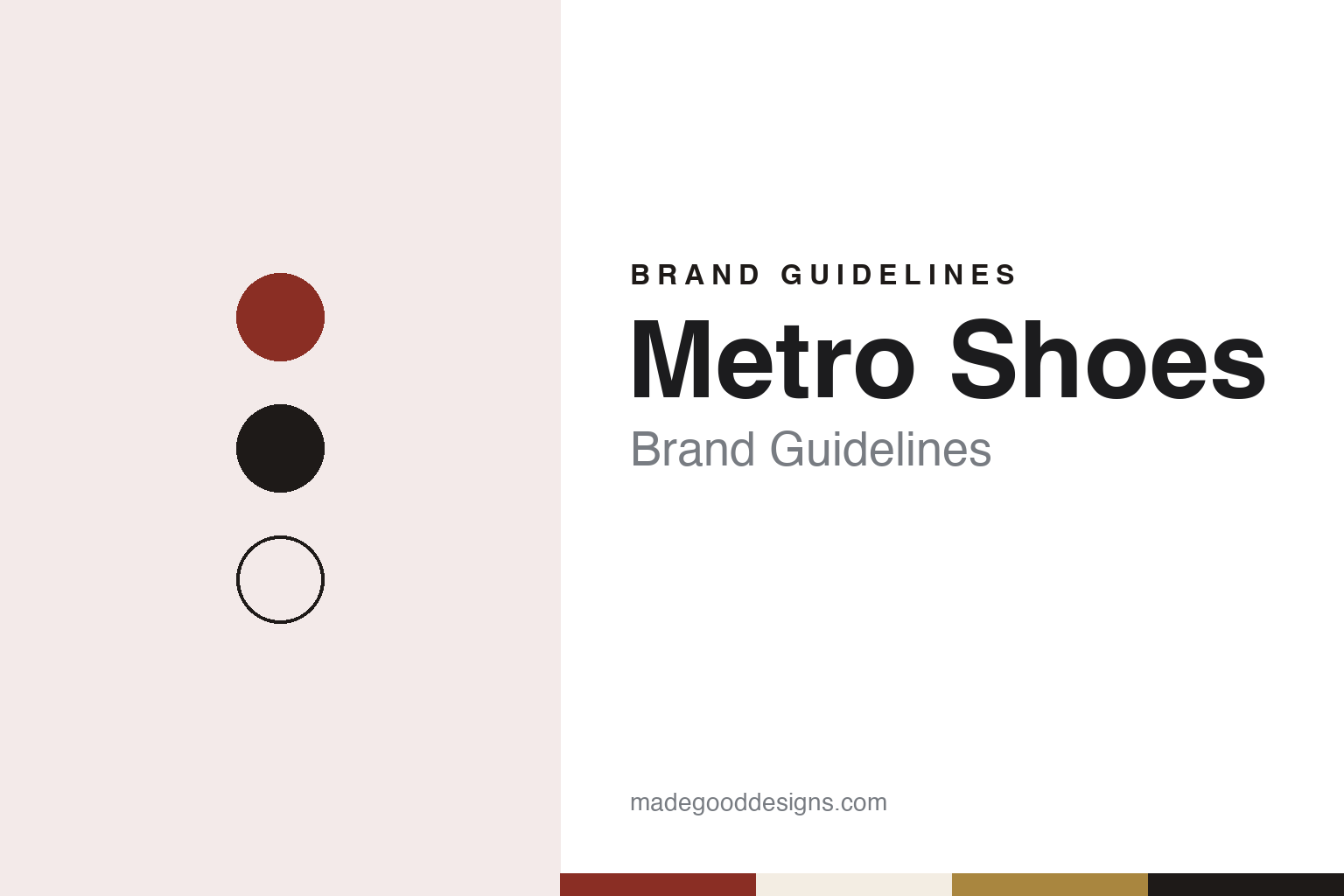
Metro Shoes Brand Guidelines
The Colaba shoe shop that grew into a listed retail group.
Aa
Two constants: a brick, ink and ivory palette and a shopfront serif register. Abstract homage — not a Metro Shoes product or mark; no shoe, logo or store sign is reproduced.
One shop in Colaba
A shoe shop in south Mumbai, named the way cinemas were.
Metro Shoes began as a single shoe shop in Colaba, in south Mumbai, opened by Malik Tejani. Sources give two founding dates. A 2012 profile in Entrepreneur, published by Franchise India, says the business was incepted in 1947 with that first Colaba store, and the company’s own web pages still carry the line “since 1947.” The text of the company’s About page, however, says it opened its first Metro store in Mumbai in 1955, and English Wikipedia gives 1955 as well. Both accounts agree on the place. The operating company was incorporated as Metro Shoes in January 1977, English Wikipedia says, and the company’s board biography dates its chairman’s directorship to the same month. It now trades as Metro Brands Limited, headquartered in Mumbai, with Metro Shoes as its original banner.
The family story was told in detail by Forbes India in February 2019. Before starting out on his own, Tejani worked as a salesman at a shop on Grant Road and then took over a small laundry in Colaba, the magazine reported. His son Rafique Malik, now the chairman, began working in the store during school holidays and opened a store of his own in 1969; from those two shops the chain reached about 50 stores by 2006, according to Forbes India. Malik told the magazine that his father insisted every store be owner-managed. The company later turned that rule into a pay model in which store managers earn a variable share linked to their own store’s performance, rather than running the chain through franchisees.
The name followed the custom of the day. Shoe shops in Mumbai at the time took their names from cinemas, Malik told Forbes India, because the cinema was the city’s idea of luxury; Entrepreneur gave the same account of the Metro name in 2012. Early promotion leaned on what Malik called the influencers of the period: film stars, the city’s Parsi community, whose wedding bands played drums lettered with the Metro Shoes name, and air hostesses. The shop also made shoes to order for film shoots through the Bollywood costume designers Mani Rabadi and Jeanne Naoroji, the magazine reported. When the Colaba store was air-conditioned, the family fitted automatic doors so customers would not have to push a door to come in; those doors were still in place in 2019, Forbes India reported.
Colour
A retailer rather than a factory.
Metro is a retailer first. Malik told Forbes India in 2019 that he had once started a shoe factory with a loan from his father and later turned it into an export unit, before concluding that “manufacturing and retailing are conflicts of interest”: a factory works on long runs of one style, colour and size, while a shop needs hundreds of styles and colours in many sizes. The company instead buys from a wide base of suppliers, about 180 national and international vendors “from Dharavi to Brazil” in 2019, according to the magazine. The 2012 Entrepreneur profile listed more than 100 vendors in Mumbai, Agra, Delhi, Kanpur and Chennai, plus suppliers in China, Malaysia and Brazil.
Metro stores have long mixed the company’s own labels with other makers’ shoes; Forbes India gave the split as roughly 30 to 70 in 2019. When the company listed in December 2021, Business Today reported that it sold its own footwear brands Metro, Mochi, Walkway, DaVinchi and J Fontini alongside third-party names such as Crocs, Skechers, Clarks and FitFlop, plus accessories including belts, bags, socks and wallets. Stock is chosen city by city: the 2012 profile described smaller sizes for Kolkata and higher heels for Chandigarh, and Forbes India said the range could differ not only between cities but between suburbs.
Film stars have stayed part of the marketing. Forbes India named Katrina Kaif and Sidharth Malhotra among the company’s recent brand ambassadors in 2019. The magazine also described how the business had passed to a third generation. Rafique Malik’s daughter Farah Malik Bhanji joined in 1999, starting in marketing before moving to product and concept development, and was appointed chief executive and managing director in 2013; she remains managing director, according to the company. Her sister Alisha Malik led e-commerce and marketing. The company says Nissan Joseph, who previously worked at Crocs and at a lifestyle retailer in the Philippines, became chief executive on 1 July 2021.
Malik told Forbes India that, with no sons and no certainty that any of his five daughters would join, he had professionalised the business early, bringing in an outside chief executive around 1990 and introducing a stock-option plan for managers.
Typography
Indian footwear and accessories.
Indian footwear, bag and accessory brands tend to present themselves through names more than through pictures. A single company often runs several labels at once, each with its own logo, catalogue and shop page, so that a rubber slipper, a sports shoe and a formal shoe can reach different buyers while sharing factories and distributors. On company websites the parent name usually sits in the footer and the investor pages, while the sub-brand names lead on the shelf.
Shopfronts carry much of that identity. Many of these companies sell through a mix of exclusive showrooms, franchised stores, multi-brand dealers and online marketplaces, and their own pages count those outlets and list the cities and states they reach. Some names are above all store names: Metro Brands runs Metro Shoes and Mochi as separate store banners.
Group ownership is part of the picture. Fastrack belongs to Titan Company, the watch and accessories business, and Woodland is the outdoor brand of the Delhi company Aero Club. Others, such as Relaxo, Liberty, Campus and Khadim’s, are listed companies whose corporate pages describe their founders, their factories and their share listings on the National Stock Exchange of India and BSE.
Advertising often leans on film actors, named in dated campaigns reported by the trade press, and on dated catalogues for each range. For a designer, the useful material is the documented part: the names, the store formats, the founding dates and the factories. The palettes and type in these guides are unofficial interpretations, and no logo or product is reproduced.
Aa
A shopfront serif for a shop named the way cinemas were. (Specimen set in DM Serif Display, a serif STAND-IN; NOT the Metro Shoes logo.)
Metro Brands
From family shop to listed company.
Outside capital arrived in 2007, when the family sold a 15 per cent stake to the investor Rakesh Jhunjhunwala, Forbes India reported. Its public share offer ran from 10 to 14 December 2021, and Metro Brands shares were listed on the National Stock Exchange and BSE on 22 December 2021, opening below the issue price, Business Today reported. The newspaper said the company then had 598 stores in 136 cities.
Growth has come through new banners and partner brands. The value format Walkway dates from 2009 and the premium label DaVinchi sits alongside Metro and Mochi, Forbes India reported; the company has run Crocs stores in India since a 2015 tie-up, with 87 of them in 2019. English Wikipedia adds an exclusive FitFlop arrangement in 2021, a FILA licence in 2022, a New Era deal in 2024, and an exclusive Clarks partnership and the multi-brand sports format MetroActiv in 2025. In October 2024 afaqs reported that Metro Brands would run Foot Locker’s physical stores in India under a licensing arrangement, with Nykaa Fashion handling online sales and the first store at Select Citywalk in New Delhi. English Wikipedia says the group had more than 1,000 stores in 221 cities as of 2026.
For a design guide, Metro Shoes shows how a shop name borrowed from Mumbai’s cinemas can become a group banner while staying tied to one address in Colaba. Compare Mochi, the group’s younger banner, and Khadim’s, another Indian footwear retail chain. For this guide we use brick red, ink and ivory with a brass accent and a serif, an unofficial interpretation; no product or logo is reproduced.
Explore & save
Keep Metro Shoes’s identity on hand — save it to a board in the Made Good inspiration library.
Metro Shoes identity set
Pin the Metro Shoes brick, ink and ivory palette and the shopfront serif register to your own board.
Source & notes
Frequently Asked Questions
What font can I use to match the Metro Shoes look?
This guide describes Metro Shoes’ type as “A shopfront serif for a shop named the way cinemas were”. Its type specimen is set in DM Serif Display from Google Fonts as a stand-in; DM Serif Display is not Metro Shoes’ own lettering.
What colours are in the Metro Shoes palette?
This guide’s Metro Shoes palette is Colaba brick #8A2E24, Ink #1E1A18, Ivory #F3EDE3, Brass #A9863F and Paper #FAF8F4. The tones are the guide’s own unofficial interpretation, not official Metro Shoes hex codes.
When was Metro Shoes founded?
Metro Shoes was founded in 1947 or 1955 (sources differ), in Colaba, Mumbai.
Who founded Metro Shoes?
Metro Shoes was founded by Malik Tejani in 1947 or 1955 (sources differ).