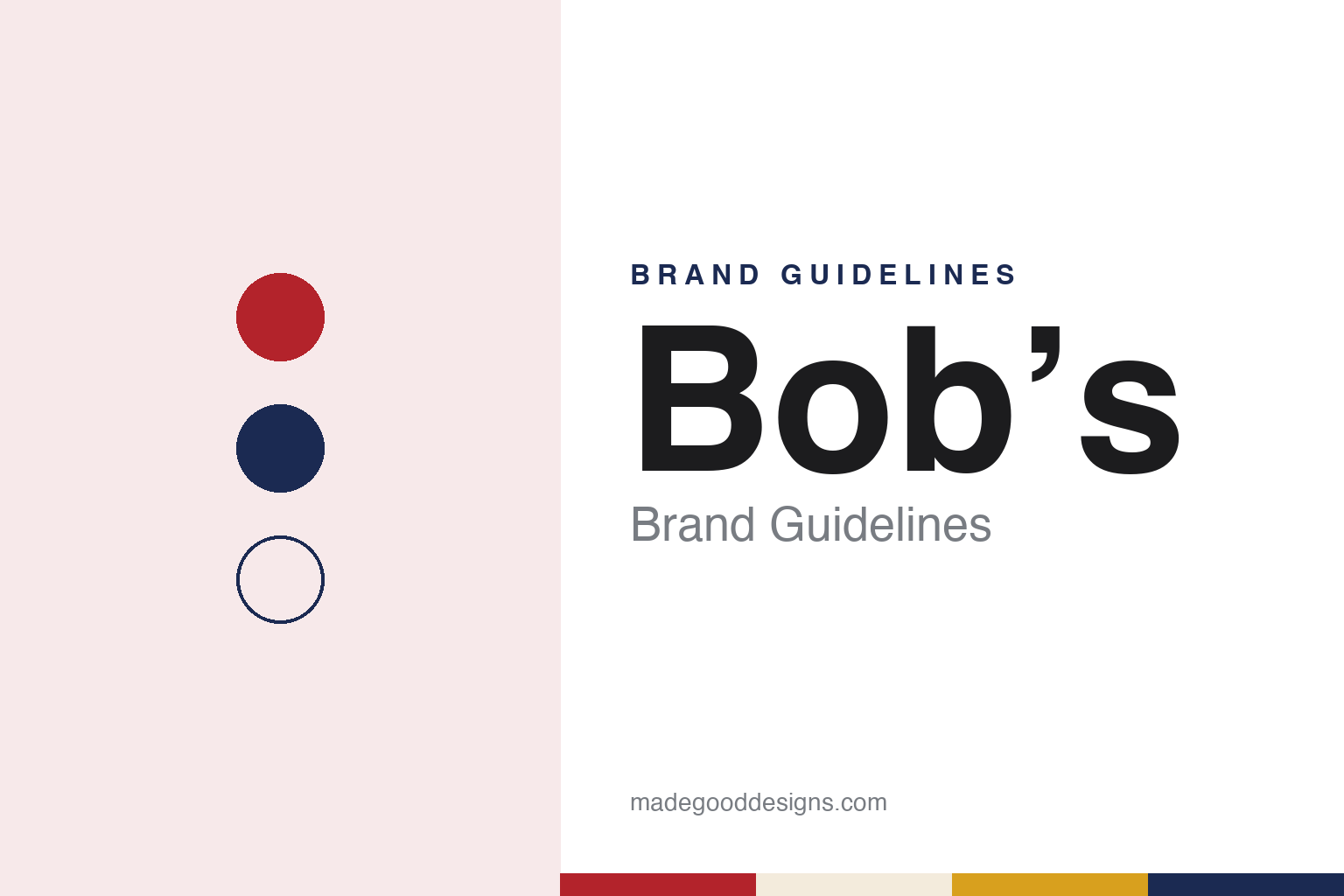
Bob’s Brand Guidelines
A Wimbledon champion’s 1952 Copacabana burger bar.
Aa
Two constants: a red, blue and cream palette and a heavy grotesque register. Abstract homage — not a Bob’s product or mark; no logo, packaging or menu item is reproduced.
Copacabana
A tennis champion, an ice-cream shop and a beachfront counter.
Bob’s began in Rio de Janeiro with an American tennis player. Robert “Bob” Falkenburg won the men’s singles title at Wimbledon in 1948, and the International Directory of Company Histories says he took to Rio while playing a tournament there and settled in the city. The business site Terra, in a 2015 profile, dates that first visit to 1946 and says he bought the rights, the recipe and two machines from a Los Angeles friend who ran ice-cream shops, moved in 1951 to what was then Brazil’s capital and opened the Falkenburg Sorveteria.
The original Bob’s followed in 1952 on the Copacabana beachfront, according to the Directory. IstoÉ Dinheiro, in a 2008 profile of the chain’s owners, gives the same year and neighbourhood and describes a snack bar for hamburgers and hot dogs. Terra tells it as a gradual change: the ice-cream shop added sundaes, hot dogs and hamburgers, then took its owner’s nickname. The Directory describes those early restaurants as large rooms of neon, chrome and glass, the period’s idea of modernity, and says their burgers, hot dogs, sundaes and shakes were then little known in Brazil.
Growth was steady rather than fast. Terra lists an Ipanema unit in 1956, then sites at Largo do Machado, in Tijuca and at Largo da Carioca. Falkenburg moved his family to Los Angeles in 1972, Terra reports, and in 1974, with 13 restaurants, all in the Rio area, he sold the business, then called Bob’s Comestíveis S.A., to the food company Libby, McNeill & Libby, the Directory says. Libby was majority-owned by Nestlé and was merged into it in 1976, so Bob’s spent the following decade under Nestlé, which opened more restaurants, broadened the menu and, from 1980, added table seating to attract families.
Colour
Nestlé, Vendex and a company formed to buy it.
Franchising began in 1984, while Nestlé still owned the chain, and by mid-1990 ten of the 69 Bob’s restaurants were franchises, according to the Directory. Nestlé had sold Bob’s in 1987 to a company affiliated with the Dutch retail group Vendex International, and the chain stayed in Dutch hands until 1996. That year it was bought by Trinity Americas Inc., a United States company set up to invest in Latin America, which kept Venbo Comércio de Alimentos as its Brazilian subsidiary and renamed itself Brazil Fast Food Corporation. IstoÉ Dinheiro adds that the company, known as BFFC, was created in the United States in 1996 specifically to buy Bob’s from Vendex, with shares traded on Nasdaq from the start.
The new owners grew the network through acquisitions and franchises. By August 1999 there were 173 Bob’s outlets, 108 of them franchised, the Directory says; it also records counters inside service-station convenience stores and a Bob’s in Portugal from 2001. In 2002 the Bomeny family, with the Forza group, raised its holding to about 60 percent, and Ricardo Bomeny became chief executive at the start of 2003. By September 2008 IstoÉ Dinheiro counted 622 Bob’s units across Brazil and reported that the BFFC holding, which controls Venbo, the owner of the Bob’s mark, also ran KFC and, in São Paulo state, Pizza Hut.
That structure has held. In July 2025 the Rio news site Diário do Rio reported that Bob’s belongs to the holding BFFC, which also controls franchises of KFC, Pizza Hut and Yoggis, and that the chain had 1,060 stores in 250 municipalities. The Directory notes that compact units of no more than about 30 square metres already made up some 15 percent of Bob’s outlets in 2004.
Typography
Brand and counter.
Latin American restaurant chains tend to present themselves through a small set of public surfaces: the shopfront, the menu, the delivery box and the corporate page. The shopfront carries the name and colours to the street, often on a corner unit or inside a shopping centre. Many chains refresh it on a cycle, and anniversaries are a common moment for a new look across dining rooms and signs.
Menus do much of the brand work. A chain is often remembered for one or two named dishes, such as a taco, a pizza or a breakfast plate, and the company repeats those names in its signs, its menus and its own telling of its history. Where a chain says it created a dish, the claim belongs to the company, and independent food writers do not always agree; a careful guide keeps the two apart. Mascots, packaging and delivery boxes extend the same vocabulary to takeaway and app orders.
Ownership is often a group matter. Several chains in Mexico, Brazil, Peru and Colombia sit inside larger restaurant or retail groups that run national brands next to international franchises, and some, like Toks within Grupo Gigante, began as a sideline of a supermarket business. Groups buy, convert and rename chains, so the same dining room can carry two names in a decade. Dated reports and stock-exchange filings are the plain record of who owns what, and when.
Franchising is the other common thread. Corporate pages describe founders, owners and franchise networks, and the business press counts units at a stated date, at home and abroad. Those counts change quickly, and openings in new countries do not always last, so each figure in these guides is tied to the report and the date that gave it.
Aa
A heavy grotesque — loud, compact lettering for a counter brand. (Specimen set in Archivo Black, a sans STAND-IN; NOT the Bob’s logo.)
Bob’s
Shakes, sauces and a red-and-blue cap.
The chain’s look has long been built from a few strong colours worn by its staff. Writing about a day spent behind a São Paulo counter in 2000, a newspaper correspondent quoted by the Directory described the uniform as a red tie, a blue and red baseball cap and an apron printed with the Bob’s name.
Milkshakes have drawn much of the press coverage. Exame reported in September 2016 that Bob’s had sold a shake made with Ovomaltine since 1959 and had held exclusive use of the Ovomaltine name in Brazil since 2005, but chose not to renew that contract; McDonald’s took the exclusivity, and Bob’s kept a shake it calls Crocante, still made with the malted ingredient but without its name or logo. Diário do Rio names the Big Bob and the Double Cheese as the chain’s classic sandwiches.
The chain has also been rethinking its rooms. In July 2025 Diário do Rio described a refitted concept store in Ipanema with fully digital ordering, pick-up lockers opened by QR code, a robot that prepares the Crocante shake, a seating area and a light panel recalling moments from the brand’s history since 1952; its menu added larger versions of two classics, the Mega Big Bob and the Mega Double Cheese. Outside the restaurants, the retail trade site Mercado&Consumo reported in May 2026 that a licensed supermarket line, Bob’s em Casa, began with a Big Bob sauce made with the partner Cepêra, followed by Burger & Salad and Bob’s Grill sauces, frozen fries and ice creams.
For a design guide, Bob’s shows how a beachfront snack bar of neon, chrome and glass became a national franchise identity that now stretches from drive-throughs to supermarket shelves. Compare Giraffas, another Brazilian fast-food chain, and Spoleto, a Rio franchise built on a counter where customers choose their own dish. For this guide we use a warm red, an ink blue, cream and mustard with a heavy sans, an unofficial interpretation; no product or logo is reproduced.
Explore & save
Keep Bob’s’s identity on hand — save it to a board in the Made Good inspiration library.
Bob’s identity set
Pin the Bob’s red, blue and cream palette and the heavy grotesque register to your own board.
Source & notes
Frequently Asked Questions
What font can I use to match the Bob’s look?
This guide describes Bob’s’ type as “A heavy grotesque — loud, compact lettering for a counter brand”. Its type specimen is set in Archivo Black from Google Fonts as a stand-in; Archivo Black is not Bob’s’ own lettering.
What colours are in the Bob’s palette?
This guide’s Bob’s palette is Copacabana red #B3232B, Ink blue #1B2A52, Shake cream #F3EBDC, Mustard #D8A01E and Paper #FAF8F4. The tones are the guide’s own unofficial interpretation, not official Bob’s hex codes.
When was Bob’s founded?
Bob’s was founded in 1952, in Copacabana, Rio de Janeiro.
Who founded Bob’s?
Bob’s was founded by Robert Falkenburg in 1952. Bob’s is known for Burgers, milkshakes, Big Bob.