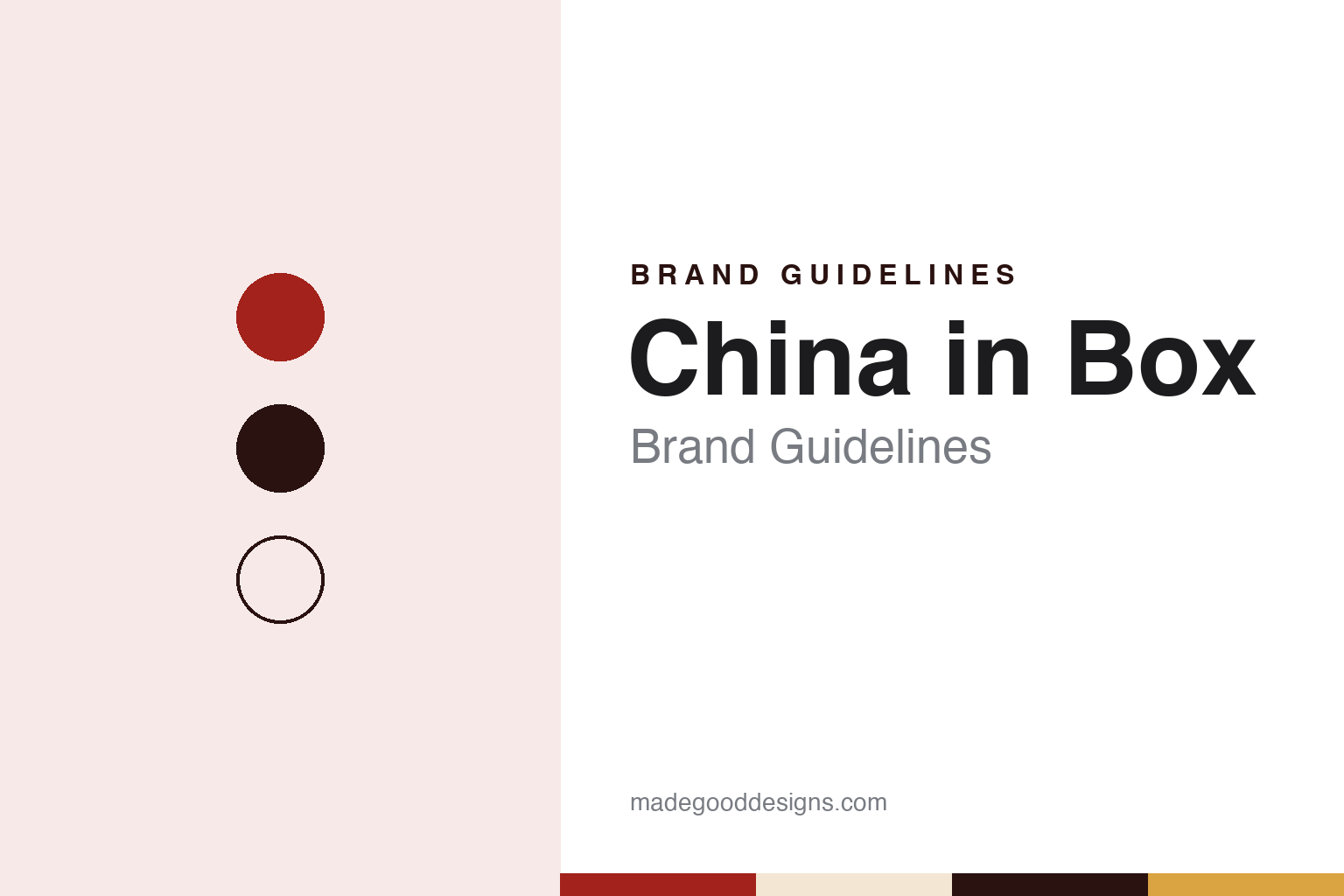
China in Box Brand Guidelines
A São Paulo delivery shop that put Chinese food in a folded paper box.
Aa
Two constants: a red, brown and rice-paper palette and a heavy grotesque register. Abstract homage — not a China in Box product or mark; no box, logo or menu is reproduced.
A box from the West Coast
A delivery-only shop in Moema.
China in Box began as an idea brought home from a holiday. Portuguese Wikipedia says Robinson Shiba, then a dentistry student, travelled to the west coast of the United States with friends in 1986, saw how many people there ate Chinese food from small takeaway boxes, and came back to Brazil with one of the boxes and the plan of offering Chinese food as a delivery alternative to pizza. His family backed the idea, and the Shibas set about adapting Chinese dishes to Brazilian tastes.
The first shop opened on 8 October 1992 in Moema, a district in the south of São Paulo, run by Shiba with his sister Helen and his brother Hideaki, according to Portuguese Wikipedia. It was a delivery-only operation, not a restaurant. Friends filled the other roles: a designer friend drew the logo and the packaging, an architect friend planned the shop, a friend at a print works produced the leaflets, and a cook friend ran the kitchen.
Several of the habits that shaped the brand date from those early years, the same source says. The chain brought the folded paper box from the United States instead of the metal lunch tins used by many local takeaways; it built its shops with kitchens that could be seen from outside; it printed full-colour leaflets with photographs of the dishes and of the kitchen, distributing about 100,000 of them around each new shop; and, with one of its delivery riders, it devised a branded cover for the insulated boxes the riders carried.
A second shop followed in Ibirapuera in 1993, and four more in 1994 through partnerships with relatives and friends. In 1995, with eight shops, the company took a stand at the franchise fair of the Brazilian Franchising Association, and Portuguese Wikipedia says 60 shops opened across 1995 and 1996. Abroad, an Argentine venture opened in 1998 and closed in 2001; the chain entered Mexico in 2002.
Colour
Yakisoba, sweet-and-sour chicken and spring rolls.
The menu is built on a few dishes that the press calls the brand’s classics. When China in Box opened its first shopping-centre restaurant in Rio de Janeiro, at Shopping Tijuca, O Globo reported in December 2023 that the classics on offer were sweet-and-sour chicken, yakisoba and spring rolls. The franchisee there told the paper that the same three dishes were the ones local diners ordered most. That unit served both take-away and eat-in customers, a step beyond the delivery-only shop of 1992. O Globo put the network at 145 units across Brazil at that date.
Delivery remained the core of the business. When the sale of the brand’s holding company was announced in October 2021, Pipeline, the business site of the Valor group, reported that 75 percent of TrendFoods’ sales came through delivery, and that China in Box was much more present in street shops than in shopping centres, because street shops make delivery easier.
Growth continued under the new owner. In March 2024 the trade site Mercado&Consumo reported that China in Box had opened 19 units in 2023, about a quarter of them in Minas Gerais, that it had reached two new state capitals, Rio Branco and Macapá, and that the brand was present in 26 states, with more than 150 shops in Brazil.
The brand’s look was redrawn the same year. In August 2024 Mercado&Consumo reported a rebrand aimed at a younger, urban audience. It covered a new positioning and reworked the brand’s editorial lines, colour palette, typography and graphic elements, and it appeared first in new restaurants, on social media and in the brand’s own website and app. Older franchise units were to switch to the new visual identity gradually, according to a Grupo Trigo director quoted by the site. The rebrand was developed by Grupo Sal, a branding, communication and entertainment company, while campaigns were made by Grupo Trigo’s in-house agency, a team of more than 35 people across audiovisual, design, content and social media. The same report said the menu gained new ingredients and a new sauce, and that the group opened a cooking school in São Paulo to train franchisees, managers and staff.
Typography
Shopfronts, menus and franchise networks.
Latin American restaurant chains tend to present themselves through a small set of public surfaces: the shopfront, the menu, the delivery box and the corporate page. The shopfront carries the name and colours to the street, often on a corner unit or inside a shopping centre. Many chains refresh it on a cycle, and anniversaries are a common moment for a new look across dining rooms and signs.
Menus do much of the brand work. A chain is often remembered for one or two named dishes, such as a taco, a pizza or a breakfast plate, and the company repeats those names in its signs, its menus and its own telling of its history. Where a chain says it created a dish, the claim belongs to the company, and independent food writers do not always agree; a careful guide keeps the two apart. Mascots, packaging and delivery boxes extend the same vocabulary to takeaway and app orders.
Ownership is often a group matter. Several chains in Mexico, Brazil, Peru and Colombia sit inside larger restaurant or retail groups that run national brands next to international franchises, and some, like Toks within Grupo Gigante, began as a sideline of a supermarket business. Groups buy, convert and rename chains, so the same dining room can carry two names in a decade. Dated reports and stock-exchange filings are the plain record of who owns what, and when.
Franchising is the other common thread. Corporate pages describe founders, owners and franchise networks, and the business press counts units at a stated date, at home and abroad. Those counts change quickly, and openings in new countries do not always last, so each figure in these guides is tied to the report and the date that gave it.
Aa
A heavy grotesque — a takeaway-box register. (Specimen set in Archivo Black, a sans STAND-IN; NOT the China in Box logo.)
China in Box
From TrendFoods to Grupo Trigo.
For most of its life China in Box sat inside a holding company of its own, TrendFoods, which also owned the Japanese-food chain Gendai. On 28 October 2021 Grupo Trigo, the Rio de Janeiro group behind Spoleto, signed the purchase of TrendFoods, Pipeline reported the next day. At the time China in Box had 143 units and Gendai 49, and the combined group was to reach 613 restaurants, most of them run by franchisees. The terms were not disclosed. Pipeline reported that Carlos Sadaki, who had led TrendFoods, would stay on at the head of the brands as a partner of the new owner. Later trade reports describe China in Box as a Grupo Trigo brand, alongside Spoleto, Koni, Gurumê and Gendai.
Grupo Trigo itself was founded in Rio de Janeiro in 1992, the same year as China in Box, by Eduardo Ourivio and Mário Chady, according to Portuguese Wikipedia, which says the group took the name Grupo Trigo in January 2012 after trading as Grupo Umbria. The same source says the group runs its own food production and distribution site in Volta Redonda, in Rio de Janeiro state, and keeps an office in São Paulo. In the 2021 deal coverage, Pipeline described the purchase as complementary: Grupo Trigo’s brands were concentrated in shopping centres, while China in Box was strongest in street shops geared to delivery.
For a design guide, China in Box shows how much of a brand can sit in its packaging and print: a folded paper box, photo-led leaflets and a branded cover for the delivery rider’s box carried the name before most customers ever saw a shop, and the 2024 rebrand returned to palette and type as the main tools. Compare Spoleto, its sister brand under Grupo Trigo, and Habib’s, another São Paulo fast-food network. For this guide we use a lacquer red, a soy brown and a rice-paper cream with a heavy sans, an unofficial interpretation; no product or logo is reproduced.
Explore & save
Keep China in Box’s identity on hand — save it to a board in the Made Good inspiration library.
China in Box identity set
Pin the China in Box red, brown and rice-paper palette and the heavy grotesque register to your own board.
Source & notes
Frequently Asked Questions
What font can I use to match the China in Box look?
This guide describes China in Box’s type as “A heavy grotesque — a takeaway-box register”. Its type specimen is set in Archivo Black from Google Fonts as a stand-in; Archivo Black is not China in Box’s own lettering.
What colours are in the China in Box palette?
This guide’s China in Box palette is Lacquer red #A3221B, Soy brown #2A1210, Rice paper #F3E7D3, Wok gold #D9A441 and Steam white #FBF8F2. The tones are the guide’s own unofficial interpretation, not official China in Box hex codes.
When was China in Box founded?
China in Box was founded on 8 October 1992, in Moema, São Paulo, Brazil.
Who founded China in Box?
China in Box was founded on 8 October 1992 by Robinson Shiba, with Helen and Hideaki Shiba.
Who owns China in Box?
China in Box is owned by Grupo Trigo (deal signed October 2021).


