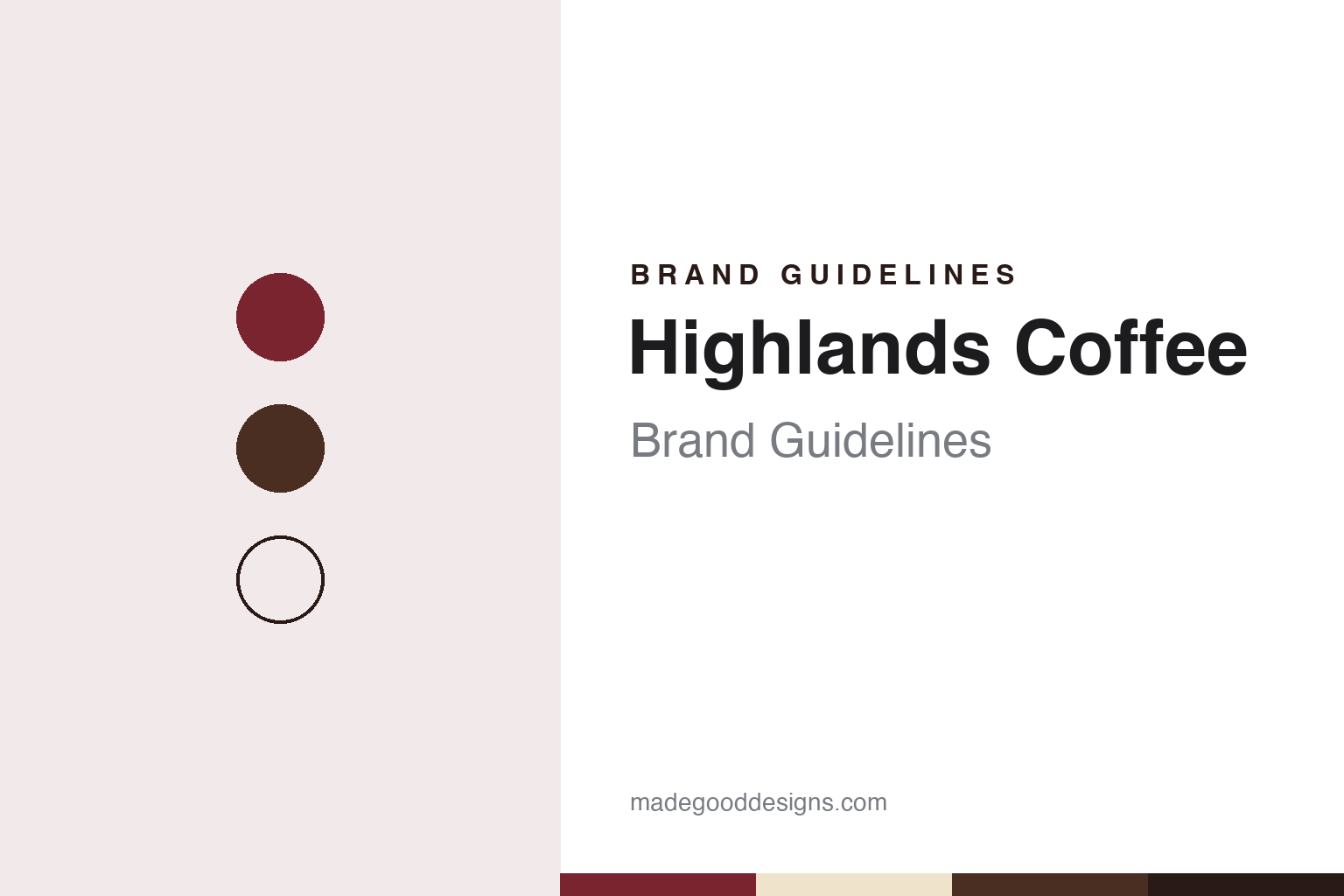
Highlands Coffee Brand Guidelines
A packaged-coffee business from Hanoi that became a café chain of more than a thousand outlets.
Aa
Two constants: a maroon, dark roast and condensed-milk cream palette and a bold café sans register. Abstract homage — not a Highlands Coffee product or mark; no cup, logo or shopfront is reproduced.
From packaged coffee to cafés
A Hanoi coffee business that opened its cafés in the south.
Highlands Coffee was founded by David Thai, a Vietnamese American entrepreneur who, English Wikipedia says, grew up in Seattle and watched Starbucks grow there. Sources give two dates for the start. English Wikipedia says the business began operating in Hanoi in 1998 and became a joint stock company in 2000; Vietnam Investment Review said in September 2026 that Thai set up his company, Viet Thai International, in 1998, while VnExpress International in April 2025 and Tuoi Tre News in March 2026 date the founding of the Highlands Coffee brand to 1999.
The business did not begin with cafés. According to English Wikipedia, Highlands first sold packaged coffee to supermarkets, hotels, restaurants and cafés, and only opened its first coffee shop in 2002, in Ho Chi Minh City, across from the city’s Notre-Dame Cathedral; Tuoi Tre News also gives 2002 and Ho Chi Minh City for the first café. By 2009, English Wikipedia says, the company ran 80 coffee shops in six cities and provinces: Hanoi, Ho Chi Minh City, Hai Phong, Da Nang, Vũng Tàu and Đồng Nai.
The packaged side kept growing alongside the shops. English Wikipedia lists the roast-and-ground and whole-bean blends the company sold by May 2010, among them Heritage Blend, Traditional Blend, Moka Blend and Culi Supreme, as well as espresso lines; in December 2009 it added a ready-to-drink canned iced coffee in two versions, one with milk and one black. English Wikipedia adds that the espresso range included a water-process decaffeinated espresso and espresso pods packed in Malaysia.
Highlands also bought into the restaurant trade. In 2011, English Wikipedia says, it purchased the phở chain Phở 24; the same source says Highlands’ parent group, SuperFoods, also owns Phở 24.
Colour
A café chain counted in the hundreds, then past a thousand.
The chain’s growth is easiest to follow through the store counts reported in the press. When Jollibee Foods first invested in 2012, Highlands had 56 stores, Tuoi Tre News reported in March 2026. By late 2024 it operated about 850 stores in Vietnam and abroad, including franchised outlets, VnExpress International reported in April 2025. At the end of 2025 the count was 985, according to Tuoi Tre News, citing Jollibee’s results: 851 stores owned directly and 96 franchised in Vietnam, plus 38 franchised stores in the Philippines, its first market outside Vietnam. By the end of June 2026 the chain had about 1,062 outlets in Vietnam and overseas, Vietnam Investment Review and VietNamNet reported in September 2026; VietNamNet added that it employed more than 10,000 people and served more than 100 million customers a year, a figure Tuoi Tre News also gave in March 2026.
Not every format stayed. VnExpress International reported in November 2023 that Highlands had opened street kiosks in 2019 and that these had since been shut down, as had kiosk experiments at other Vietnamese beverage chains.
Highlands also roasts coffee itself. In April 2025, VnExpress International reported that Highlands had opened its first roasting and grinding facility, an automated plant of 24,000 square metres in the southern province of Bà Rịa–Vũng Tàu. In the same interview Thai said that, for a chain of that size, consistency of taste across all stores came first.
Outside Vietnam, English Wikipedia says the Philippine company IP Ventures became the Highlands Coffee franchisee for the Philippines in 2011, and that in July 2013 the Philippine doughnut maker The Doughnut People agreed to sell Highlands coffees and its ice-blended “Freeze” drink in its Go Nuts Donuts shops.
Typography
Vietnam’s café and restaurant chains.
Vietnam’s café and restaurant chains grew up in a country with a deep street culture of coffee, tea and noodle soup, and most of them present themselves through the shop itself. A chain’s identity is carried by its shopfronts and seating, by the cup a drink is handed over in, and by the bags of ground coffee and boxes of tea sold at the counter or in supermarkets.
Menus are built around named drinks and dishes rather than abstract promises. Coffee chains list house blends, iced coffee with condensed milk and ice-blended drinks; tea chains list fruit teas, milk teas and loose-leaf varieties from Vietnam’s highland growing areas; phở, pizza and hot-pot chains name their broths, toppings and set menus. Store formats vary too, from large flagship cafés to kiosks placed inside supermarkets, and the press has followed which formats the chains keep and which they close.
Ownership is often part of the story. Several of the chains in this set belong to wider groups: Highlands Coffee sits under SuperFoods, in which the Philippine group Jollibee Foods holds a stake, alongside Phở 24; Phúc Long is a subsidiary of the Vietnamese consumer group Masan; others covered here belong to the restaurant group Golden Gate or the retail group Seedcom, as their own guides set out. Store counts change quickly, so each guide gives its figures with the date and the publication that reported them.
Each guide sets out what can be checked about a brand from independent, dated reporting by publications such as VnExpress International, Tuoi Tre News, Viet Nam News and Vietnam Investment Review: who founded it, who owns it, how it trades and what its stores and products look like, with company statements marked as the company’s own word.
Aa
A bold café sans for signs and cups. (Specimen set in Be Vietnam Pro, a sans STAND-IN; NOT the Highlands Coffee logo.)
Jollibee and SuperFoods
A Philippine investor, and a founder who stayed in charge.
In 2012 the Philippine fast-food group Jollibee Foods invested in Highlands. VnExpress International and Vietnam Investment Review both describe the deal as a 49 percent stake in the Vietnamese business and 60 percent of its Hong Kong business; English Wikipedia gives the figure as half of the shares. Highlands’ parent is SuperFoods Group, Tuoi Tre News reports, and its Vietnamese operations are held by SF Vung Tau JSC, according to Viet Nam News. Jollibee later raised its holding to 60 percent, giving it control, according to Viet Nam News and VietNamNet in September 2026.
Thai stayed in charge of the chain. Speaking to VnExpress International in April 2025, he said Jollibee acts as an investor and strategic adviser and is not involved in day-to-day operations, and that Highlands remains a Vietnamese company.
In September 2026 the two shareholders agreed to change that balance. On 23 September 2026, Jollibee disclosed that its subsidiary JSF Investments had agreed to sell an 11 percent stake in SF Vung Tau to Viet Thai International, Thai’s company, Vietnam Investment Review, Viet Nam News and VietNamNet reported. On completion, Jollibee’s holding would fall from 60 to 49 percent and Viet Thai International’s would rise from 40 to 51 percent, returning majority control to the founder’s company. The sale was agreed in September 2026 and was subject to final regulatory approvals; it had not been completed at the time of writing.
For a design guide, Highlands Coffee shows how a coffee brand built on packaged blends turned itself into a chain whose identity lives in its cafés and cups. Compare Phở 24, the phở chain in the same group, and Trung Nguyên, the Buôn Ma Thuột coffee house. For this guide we use a deep maroon, dark roast brown and a condensed-milk cream with a sans, an unofficial interpretation; no product or logo is reproduced.
Explore & save
Keep Highlands Coffee’s identity on hand — save it to a board in the Made Good inspiration library.
Highlands Coffee identity set
Pin the Highlands Coffee maroon, dark roast and cream palette and the bold café sans register to your own board.
Source & notes
Frequently Asked Questions
What font can I use to match the Highlands Coffee look?
This guide describes Highlands Coffee’s type as “A bold café sans for signs and cups”. Its type specimen is set in Be Vietnam Pro from Google Fonts as a stand-in; Be Vietnam Pro is not Highlands Coffee’s own lettering.
What colours are in the Highlands Coffee palette?
This guide’s Highlands Coffee palette is Roast maroon #7A2430, Dark roast #4A2E22, Condensed milk #EFE3CC, Espresso ink #2A1A17 and Paper cup white #F7F3EC. The tones are the guide’s own unofficial interpretation, not official Highlands Coffee hex codes.
When was Highlands Coffee founded?
Highlands Coffee was founded in 1998–1999 (sources differ), in Hanoi, Vietnam.
Who founded Highlands Coffee?
Highlands Coffee was founded by David Thai in 1998–1999 (sources differ).